Farmer's Hold
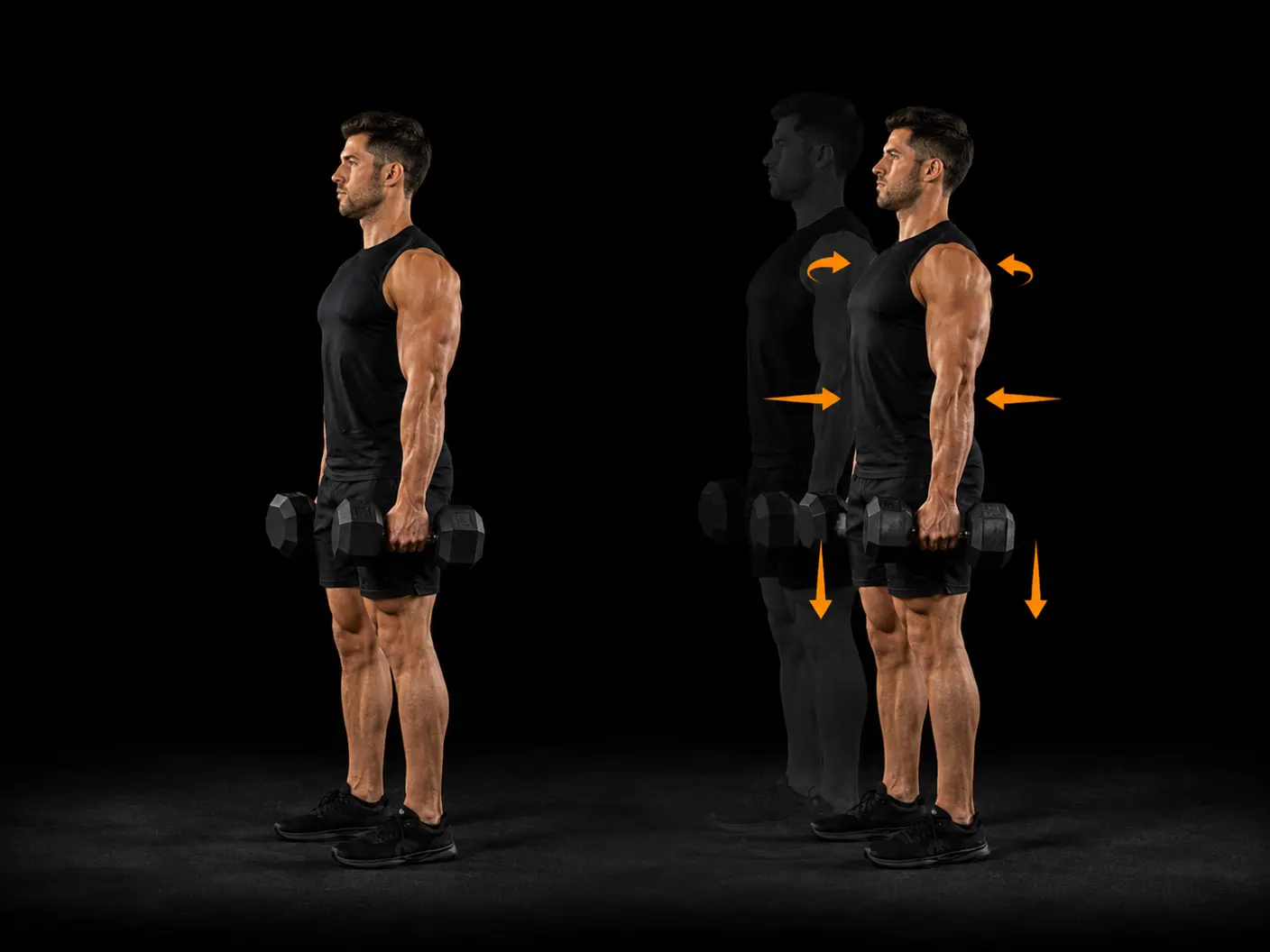
The farmer's hold is a static loaded carry variation in which the lifter stands upright holding heavy implements at the sides for a prescribed duration. It trains the grip, forearm flexors, and postural muscles under sustained tension — a pattern that underpins nearly every pulling movement in strength training. It suits beginners learning to brace and breathe under load, as well as more experienced athletes looking to address grip as a limiting factor.
How to do it
Pick up two heavy dumbbells or farmer's handles. Stand tall with handles at the sides, no shrug, no body english. Hold for time — 30–60 seconds per set.
Coaching cues
- Tall posture
- Crush the handles
- Long spine
- Breathe through the hold
Why train it
- Develops grip strength and forearm endurance simultaneously, addressing one of the most common weak links in pulling and hinging movements.
- Challenges the upper traps and core to maintain tall, stable posture under load, reinforcing spinal alignment that transfers across compound lifts.
- The static nature of the hold makes it straightforward to load and progress without requiring significant technical instruction, keeping training time efficient.
- It is accessible with a range of equipment — heavy dumbbells, a trap bar, or dedicated farmer's handles — making it practical in most training environments.
Common mistakes
- Shrugging the shoulders upward — let the arms hang long and keep the shoulders packed down and back throughout the hold.
- Allowing the torso to lean or sway as fatigue sets in — maintain a long spine from the outset and resist any body english for the full duration.
- Gripping too loosely at the start — take a firm, deliberate hold of the handles before lifting, as grip position is difficult to correct once under load.
- Holding the breath — breathe steadily through the hold rather than bracing once and stiffening, which limits how long quality posture can be sustained.
Primary: Forearm Flexors.
Secondary: Trapezius, Rectus Abdominis.
Equipment
Good for
Easier variation
Dead hang — similar grip target from a pull-up bar.
Similar movements
Frequently asked
- What muscles does the farmer's hold work?
- The primary muscles are the forearm flexors and grip muscles, which are under continuous isometric tension throughout the hold. The upper traps and core work as secondary stabilisers, maintaining upright posture against the downward pull of the load.
- How long should I hold for, and how many sets should I do?
- A practical starting point is 30–60 seconds per set for 3–4 sets, with rest periods long enough to allow the grip to recover — typically 90 seconds to 2 minutes. As grip endurance improves, increase load before extending duration further.
- What is the difference between a farmer's hold and a farmer's carry?
- The hold is a static variation performed on the spot, whereas the carry involves walking with the implements over a set distance. The hold is useful when space is limited or when the goal is to build pure grip endurance under maximal load without the coordination demands of walking.
- Can the farmer's hold help with my deadlift?
- Grip is a frequent limiting factor in the deadlift, and the farmer's hold directly addresses forearm and hand endurance under load. Programming it as an accessory movement alongside your deadlift sessions is a straightforward way to reduce the likelihood of grip failing before the target muscles do.
- What equipment do I need?
- Heavy dumbbells are sufficient and widely available, making them the most accessible option. A trap bar or dedicated farmer's handles allow heavier loading and a more neutral hand position, which can be useful as strength progresses beyond what standard dumbbells accommodate.
Want this movement in a plan built for you?
Adaptiv programmes the right exercises for your goal, equipment and experience — then adapts them as you train.
Build my programme