Wrist CARs
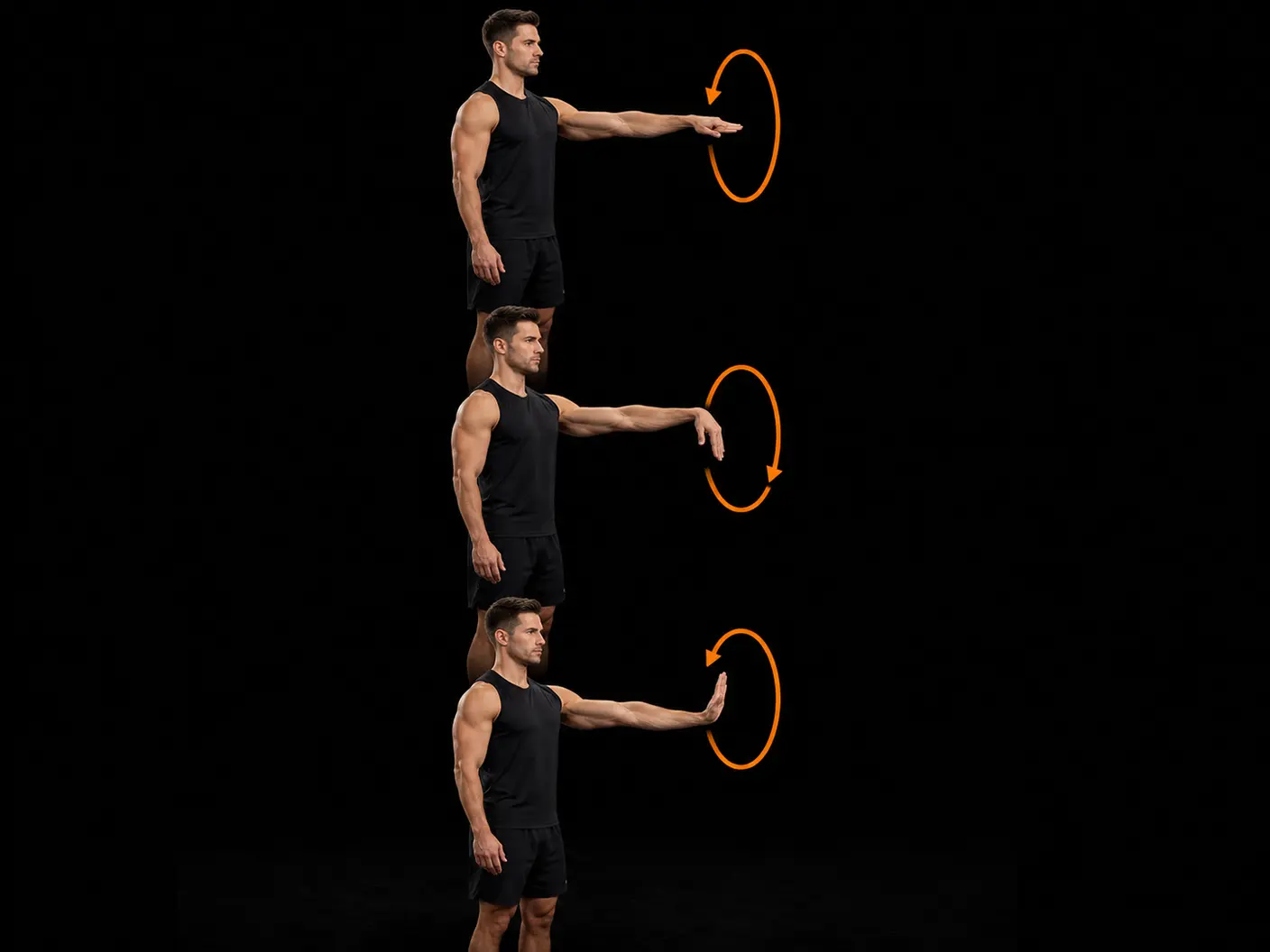
Wrist CARs (Controlled Articular Rotations) are a mobility drill that takes the wrist joint through its full available range of motion under deliberate muscular control. The movement trains active ownership of wrist mobility by requiring you to produce and resist force at every point in the circle, rather than passively moving through it. They suit any lifter, desk worker, or athlete who wants to maintain or develop healthy wrist function.
How to do it
Extend one arm forward. Make a fist. Circle the fist slowly through the full available range — up, out, down, in. Fight for the end range at each point. Reverse direction. Work both wrists.
Coaching cues
- Full range
- Slow and controlled
- Fight end ranges
- Pain-free
Why train it
- Regular practice helps preserve the full range of motion available at the wrist joint, which tends to reduce with sedentary habits or repetitive loading patterns.
- Because the movement is performed slowly and under control, it reinforces muscular coordination between the forearm muscles and the wrist joint rather than relying on passive tissue stretch.
- Wrist CARs serve as an effective warm-up tool before pressing, pulling, or grip-intensive work by increasing synovial fluid distribution and preparing the joint for load.
- The drill is low-threshold and requires no equipment, making it straightforward to programme as a daily maintenance practice or between working sets.
Common mistakes
- Moving too quickly through the circle — slow the rotation right down so each degree of the range receives deliberate muscular attention rather than momentum carrying the fist through.
- Allowing the elbow to bend or the shoulder to compensate — keep the arm extended and still so the movement is isolated to the wrist joint throughout.
- Stopping short at end ranges rather than fighting into them — consciously push into the limit of each direction and hold briefly before continuing the circle.
- Working only one direction — always complete rotations in both clockwise and anticlockwise directions on each wrist to address the full range symmetrically.
Primary: Forearm Flexors.
Equipment
Good for
Easier variation
Smaller partial circles.
Similar movements
Frequently asked
- What muscles do wrist CARs work?
- The primary structures trained are the wrist joint itself and the forearm muscles that produce and control its movement. The grip musculature acts as a secondary contributor, particularly when the fist is held tight throughout the drill.
- How many sets and reps should I do?
- Two to three sets of five slow rotations in each direction per wrist is a practical starting point for daily maintenance or warm-up use. The emphasis should be on quality of control rather than volume.
- Can wrist CARs help with wrist pain?
- This drill is intended to be performed pain-free throughout — if you experience discomfort beyond mild end-range tension, reduce the range to a comfortable arc and consider consulting a qualified professional before progressing.
- When in a session should I do wrist CARs?
- They are well-suited to the warm-up, particularly before any pressing, rowing, or grip-heavy work. They can also be used between sets or as part of a morning mobility routine outside of structured training.
- What exercises are alternatives or progressions to wrist CARs?
- Wrist circles performed passively with the opposite hand offer a lower-threshold starting point if active control is limited. Progressions include adding light load or moving into wrist extension and flexion holds at end range to build active strength through the positions the CARs reveal.
Want this movement in a plan built for you?
Adaptiv programmes the right exercises for your goal, equipment and experience — then adapts them as you train.
Build my programme