Dead Hang (Active)
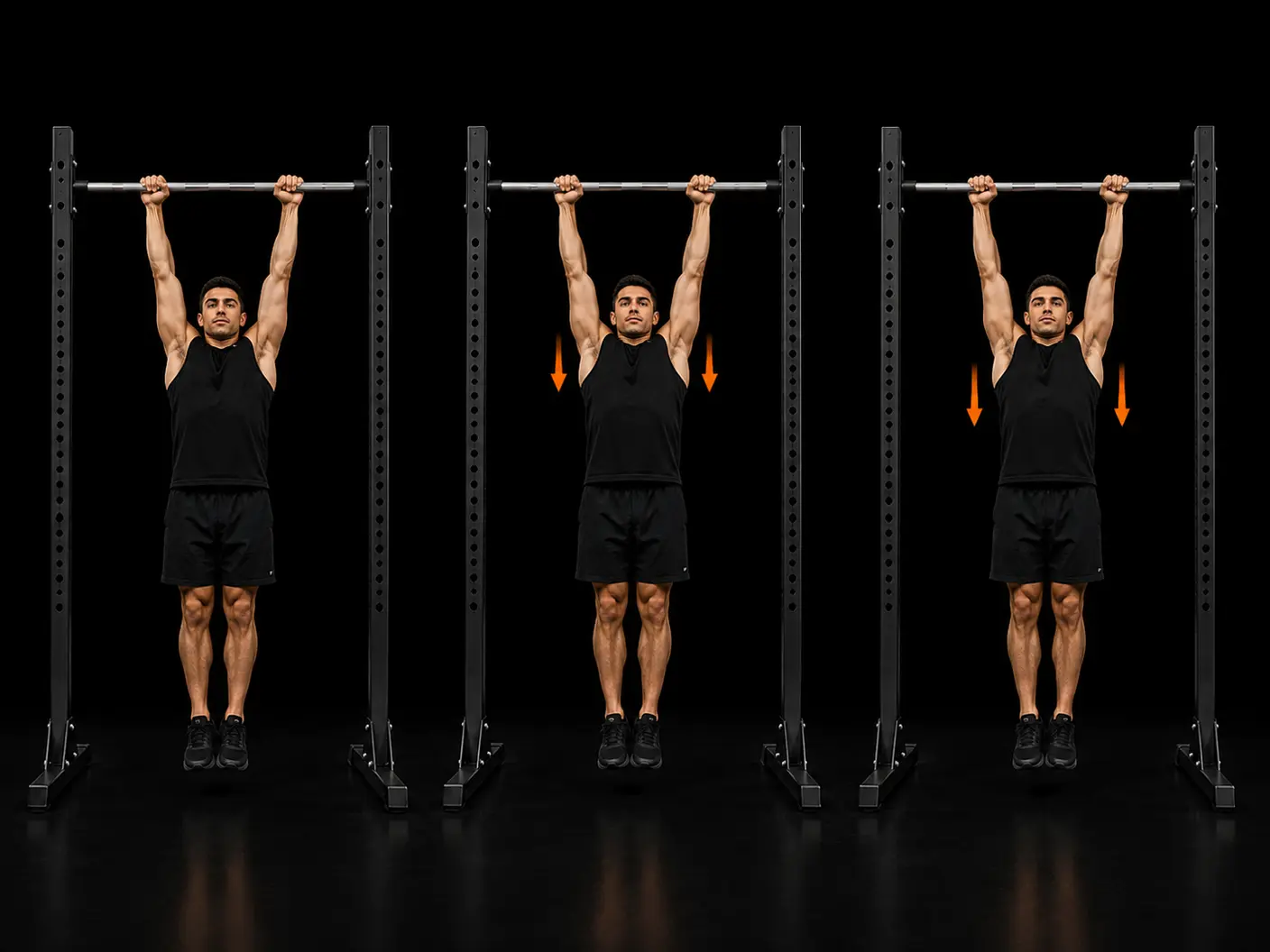
The active dead hang is a foundational mobility drill performed on a pull-up bar, requiring you to maintain a packed shoulder position — blades drawn down and back — rather than allowing passive shrug into the ears. It trains shoulder stability, grip endurance, and spinal decompression under load. It suits beginners building overhead tolerance as well as trained athletes maintaining shoulder health within a broader programme.
How to do it
Hang from a pull-up bar with an active shoulder position — shoulders packed down and back, not jammed into the ears. Hold for time. Breathe through the hang. Builds shoulder stability and grip.
Coaching cues
- Shoulders packed
- Breathe through it
- Crush the bar
- Long spine
Why train it
- Develops active shoulder stability by reinforcing scapular depression and retraction under bodyweight, which carries over to all pulling and overhead movements.
- Builds grip strength and endurance in a low-skill context, making it an efficient addition to warm-ups or accessory work.
- Provides traction through the spine and shoulder girdle, helping to restore length through the lats and thoracic tissues after compressive loading.
- Suits a wide range of training goals — from general fitness to athletic performance — due to its low technical barrier and high transfer value.
Common mistakes
- Allowing the shoulders to ride up to the ears — actively pull the shoulder blades down and back to maintain a packed position throughout the hold.
- Holding the breath — breathe steadily and rhythmically through the hang to manage tension and extend the duration of each set.
- Letting the core go entirely slack — keep a gentle brace through the midsection to maintain a long, neutral spine rather than an exaggerated arch.
- Gripping too loosely — maintain firm, even pressure through the fingers and palm to reinforce grip endurance and keep the shoulder position honest.
Primary: Latissimus Dorsi, Forearm Flexors, Posterior Deltoid.
Secondary: Rectus Abdominis, Trapezius.
Equipment
Good for
Easier variation
Passive hang — shoulders relaxed.
Similar movements
Frequently asked
- What muscles does the active dead hang work?
- The primary muscles trained are the lats, the grip, and the shoulder complex. The core works as a secondary stabiliser to maintain spinal position throughout the hold.
- How long should I hang for and how many sets should I do?
- A practical starting point is 3 sets of 20–30 seconds, focusing on quality of shoulder position over raw duration. As grip and shoulder stability improve, you can progress toward holds of 60 seconds or more.
- What is the difference between a passive and an active dead hang?
- In a passive hang the shoulders shrug upward and the lifter simply hangs without muscular engagement. In an active hang the shoulder blades are deliberately packed down and back, making it a stability drill rather than purely a stretch.
- Can the active dead hang help with shoulder mobility?
- It can support shoulder mobility by placing the joint in an overhead position under controlled load, encouraging length through the lats and surrounding tissues. If you have an existing shoulder concern, check with a qualified professional before programming it.
- What exercise can I do if I cannot yet hold a dead hang?
- A band-assisted hang or a foot-supported hang using a box reduces the proportion of bodyweight you must support, allowing you to practise the packed shoulder position while building the grip and stability needed for an unassisted hold.
Want this movement in a plan built for you?
Adaptiv programmes the right exercises for your goal, equipment and experience — then adapts them as you train.
Build my programme