Banded Pull-Apart
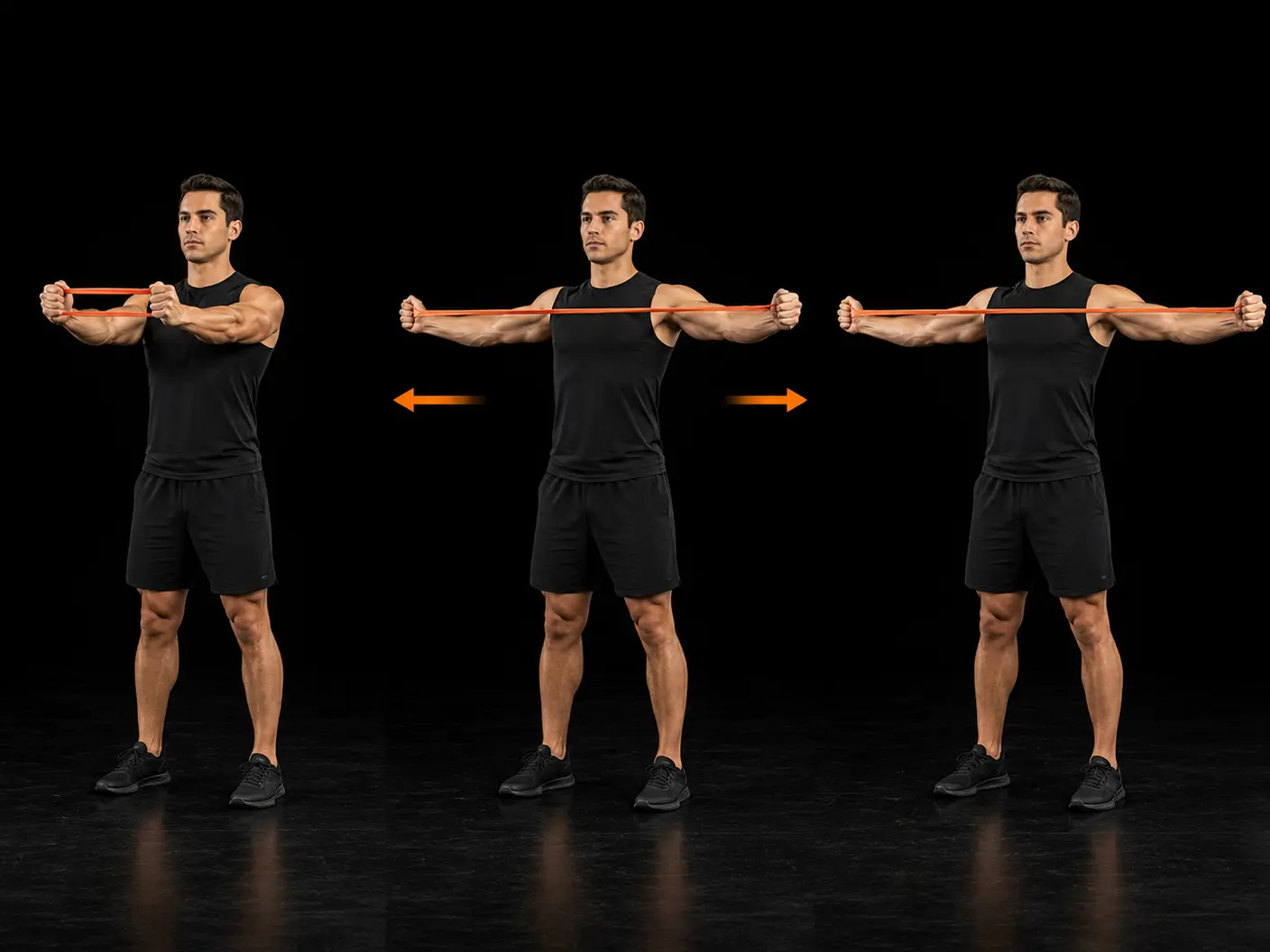
The banded pull-apart is a foundational mobility drill performed with a resistance band held at shoulder width. It trains horizontal shoulder abduction, reinforcing scapular retraction and developing the posterior shoulder musculature through a controlled, repeatable range of motion. It suits beginners establishing movement quality, as well as more experienced lifters using it as a warm-up before pressing or pulling sessions.
How to do it
Hold a resistance band at shoulder-width with straight arms. Pull the band apart by driving the arms out to the sides; squeeze the shoulder blades together. Pause briefly. Return under control. Perform 15–25 reps as a warm-up.
Coaching cues
- Arms stay straight
- Squeeze the blades
- Control both directions
- High rep warm-up
Why train it
- Directly activates the middle trapezius, rhomboids, and rear deltoids — muscles that are frequently underworked relative to the anterior shoulder in many training programmes.
- Reinforces scapular retraction mechanics, which carry over to improved positioning in rows, pull-ups, and overhead pressing movements.
- The high-rep, low-load nature makes it an efficient warm-up tool that raises tissue temperature in the posterior shoulder without generating meaningful fatigue.
- Consistent use helps develop the rotator cuff as a secondary stabiliser, supporting shoulder integrity during compound upper-body work.
Common mistakes
- Bending the elbows during the pull — keep the arms fully straight throughout so the load stays on the intended muscles rather than shifting to the biceps.
- Shrugging the shoulders towards the ears — keep the traps depressed and focus on drawing the shoulder blades together horizontally.
- Rushing the return phase — the concentric and eccentric portions should be equally controlled, as the resistance on the way back provides useful stimulus.
- Using a band with too much resistance — if the arms cannot stay straight or the movement becomes jerky, switch to a lighter band and prioritise range and control.
Primary: Trapezius, Posterior Deltoid, Rhomboids.
Secondary: Rotator Cuff.
Equipment
Good for
Easier variation
Lighter band or partial range.
Similar movements
Frequently asked
- What muscles do banded pull-aparts work?
- The primary muscles are the middle trapezius, rear deltoids, and rhomboids, which drive scapular retraction during the pull. The rotator cuff works secondarily to stabilise the shoulder joint throughout the movement.
- How many reps and sets should I do for banded pull-aparts?
- As a warm-up drill, 15–25 reps per set is the recommended range, typically performed for one to three sets before upper-body training. The goal at this rep range is activation and movement quality rather than muscular fatigue.
- When should I include banded pull-aparts in a session?
- They are best placed at the start of a session as part of a warm-up, particularly before pressing or pulling movements where posterior shoulder and scapular control are important. Performing them after extended periods of sitting or desk work is also a common and practical application.
- What can I use if I do not have a resistance band?
- A light cable machine set to chest height can replicate the horizontal abduction pattern using a rope attachment. In the absence of equipment, a face pull variation or prone Y-T-W drill targets similar musculature, though the band remains the most accessible and specific option.
- Are banded pull-aparts suitable for beginners?
- Yes — the movement is classified as foundational, requires minimal load, and has a straightforward technique, making it appropriate for those new to structured training. Beginners should focus on keeping the arms straight and feeling the shoulder blades draw together rather than simply pulling the band as far as possible.
Want this movement in a plan built for you?
Adaptiv programmes the right exercises for your goal, equipment and experience — then adapts them as you train.
Build my programme