Fingertip Push-Up
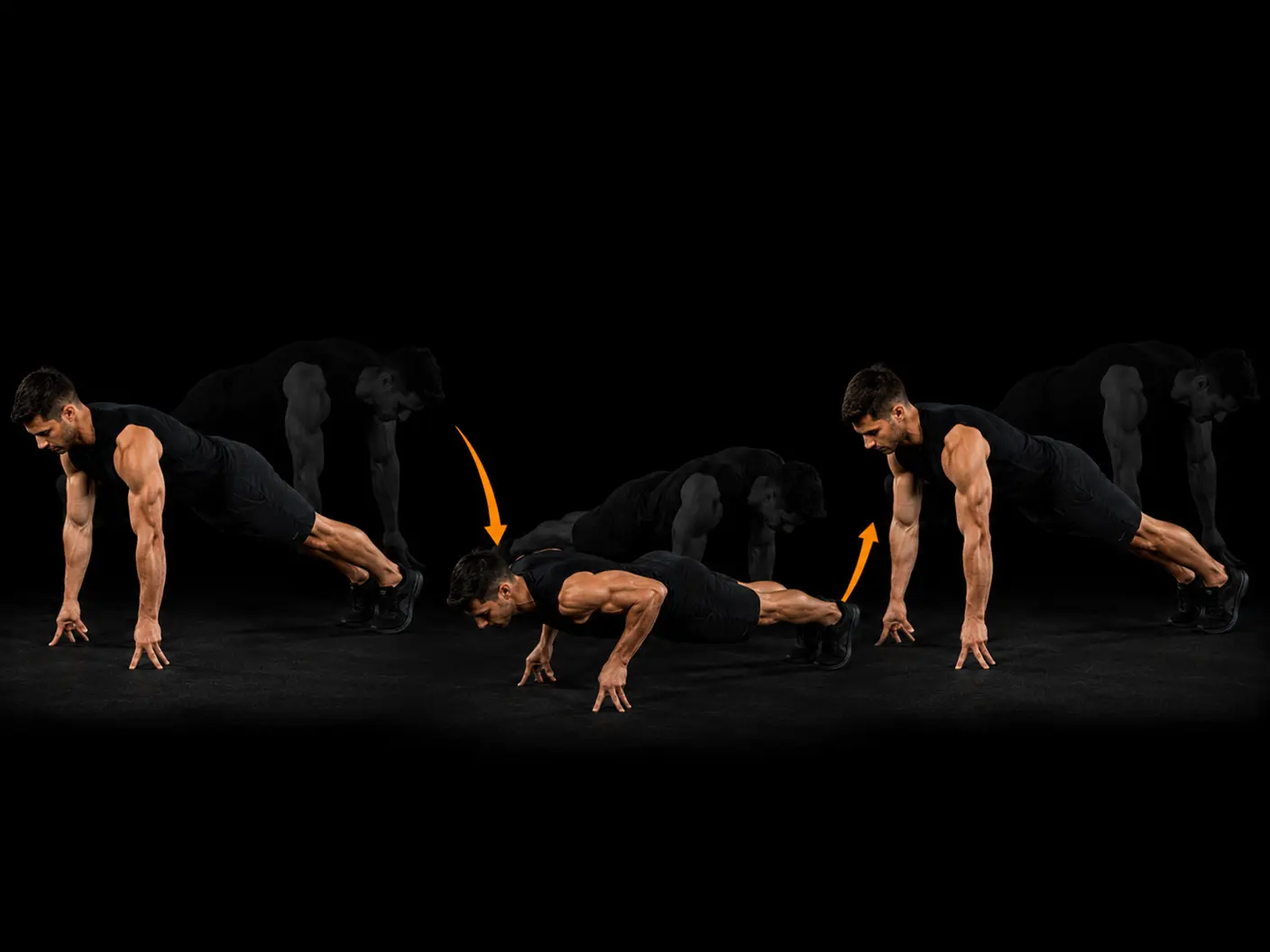
The fingertip push-up is a bodyweight horizontal pushing exercise that performs the same movement pattern as a standard push-up, with one critical distinction: the hands are elevated onto the fingertips rather than placed flat on the floor. This transfers the entire load through the fingers and forearms, making grip and finger strength the primary training stimulus rather than the chest and shoulders. It suits intermediate trainees who have established solid push-up mechanics and want to develop the hand and forearm strength required for climbing, racket sports, or contact disciplines.
How to do it
Set up in a standard push-up position. Instead of placing the full palm on the floor, balance on the tips of the fingers, specifically the first and second joints of each finger. Perform a standard push-up. The entire load passes through the fingertips, developing finger and forearm strength.
Coaching cues
- Balance on the fingertips
- Plank from head to heels
- Elbows 45°
- Controlled descent
Why train it
- Directly develops finger and forearm strength by forcing the fingers to bear the full load of the movement on every repetition.
- Trains grip endurance under a sustained isometric demand, as the fingers must maintain position throughout both the descent and ascent.
- Builds the pectoralis major, triceps, and anterior deltoid as secondary movers, meaning upper-body pushing capacity is maintained alongside the grip work.
- Requires no equipment and can be integrated into bodyweight programmes or used as a specific preparatory drill for sport.
Common mistakes
- Collapsing onto the palms mid-set — maintain contact on the fingertips for the full duration of each set, and reduce reps if the position cannot be held.
- Allowing the hips to sag or pike — hold a rigid plank from head to heels throughout, engaging the trunk before initiating each repetition.
- Flaring the elbows out to 90° — keep them at roughly 45° to the torso on the descent to reduce stress on the finger joints and maintain structural integrity.
- Rushing the descent — lower under control, as a fast drop shifts load abruptly onto the fingers and reduces the training stimulus to the forearms.
Primary: Forearm Flexors.
Secondary: Pectoralis Major, Triceps Brachii, Anterior Deltoid.
Equipment
Good for
Easier variation
Standard push-up — full palm contact for stability.
Similar movements
Frequently asked
- What muscles do fingertip push-ups work?
- The primary muscles trained are the forearm flexors and grip muscles, which bear the load of supporting the body through the fingertips. The pectoralis major, triceps, and anterior deltoid work as secondary movers in the same way they do during a standard push-up.
- How many sets and reps should I do for fingertip push-ups?
- A practical starting point is 3 sets of 5–8 controlled repetitions, prioritising position over volume. Once you can maintain clean fingertip contact and a straight plank for all reps, you can progress the rep range gradually.
- What is a good alternative to fingertip push-ups?
- If fingertip push-ups are currently beyond your grip strength, knuckle push-ups reduce wrist extension load while still providing forearm stimulus. For progressive finger strength specifically, dead hangs and towel pull-ups target a similar adaptation.
- Are fingertip push-ups suitable for building a bigger chest?
- They are not the most efficient choice if hypertrophy of the pectoralis major is the primary goal, as the limiting factor will almost always be finger and grip strength rather than chest fatigue. Standard or weighted push-up variations are better suited to chest development.
- How do I progress to fingertip push-ups if I cannot do them yet?
- Begin by holding the fingertip support position in a plank without performing any reps, building finger endurance over several sessions. From there, introduce partial-range descents before working towards full repetitions.
Want this movement in a plan built for you?
Adaptiv programmes the right exercises for your goal, equipment and experience — then adapts them as you train.
Build my programme