Standard Push-Up
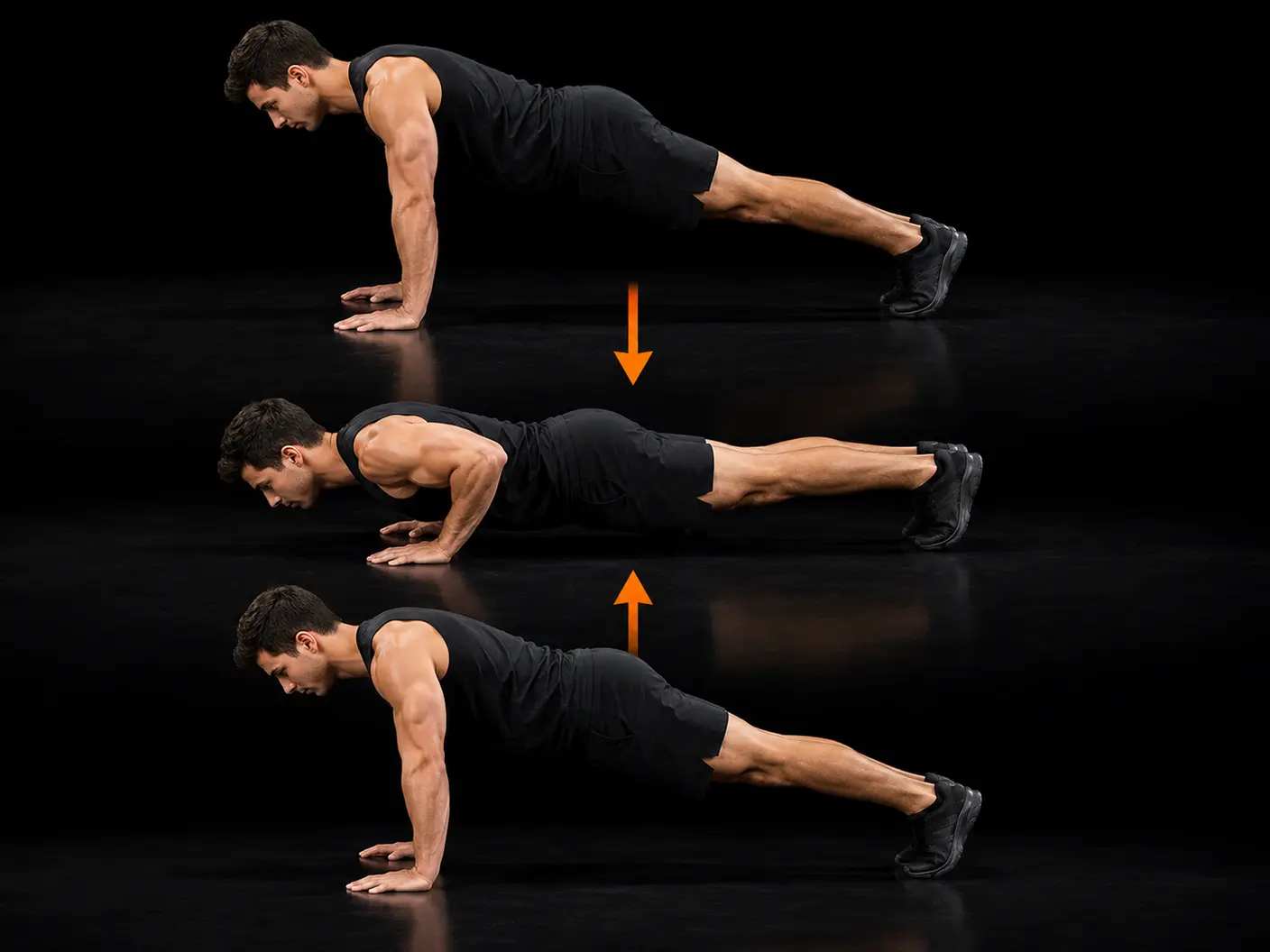
The standard push-up is a bodyweight horizontal pushing movement that trains the chest, triceps, and anterior deltoid in a closed-chain pressing pattern. The requirement to maintain a rigid plank position throughout means the core and serratus anterior are working continuously, making this a genuine full-body coordination exercise rather than simply an upper-body drill. It suits beginners building a foundation in pressing mechanics and experienced lifters maintaining volume or training without equipment.
How to do it
Set the hands slightly wider than shoulder-width. Straight line from head to heels. Set the shoulder blades — do not let them pinch. Lower the chest to just above the floor, elbows ~45°. Press the floor away, protracting the shoulder blades at the top.
Coaching cues
- Plank from head to heels
- Elbows 45°
- Chest to the floor
- Protract at the top
Why train it
- The closed-chain nature of the movement demands core stability throughout every repetition, developing full-body tension that carries over directly to barbell and dumbbell pressing.
- Because no equipment is required, the push-up can be programmed at high frequency and in virtually any setting, making it one of the most practical options for accumulating pressing volume.
- The serratus anterior is actively loaded during scapular protraction at the top of each rep, developing shoulder stability that supports a wide range of overhead and pressing movements.
- Scaling is straightforward — elevating the hands reduces load and declining the feet increases it — allowing the exercise to remain appropriately challenging across a wide range of ability levels.
Common mistakes
- Letting the hips sag toward the floor — brace the trunk firmly before the set begins and maintain a straight line from head to heels throughout the movement.
- Flaring the elbows out to 90° — keep them at approximately 45° to the torso to reduce stress on the shoulder joint and more effectively load the pectorals.
- Failing to protract the shoulder blades at the top — actively push the floor away at the end of each rep to bring the scapulae forward, which fully completes the range of motion and engages the serratus anterior.
- Cutting the range short by stopping well above the floor — lower until the chest is just above the floor on every rep, as partial reps reduce stimulus to the pectoralis major and build poor movement habits.
Primary: Pectoralis Major, Triceps Brachii.
Secondary: Anterior Deltoid, Serratus Anterior, Rectus Abdominis.
Equipment
Good for
Easier variation
Incline push-up with hands on a bench — reduces the load.
Similar movements
Frequently asked
- What muscles does the standard push-up work?
- The primary muscles are the pectoralis major and triceps, with meaningful secondary contribution from the anterior deltoid and serratus anterior. The core musculature is engaged isometrically throughout to maintain the plank position.
- How many sets and reps should I do?
- For general fitness and hypertrophy, 3–4 sets of 10–20 repetitions is a practical starting point. If you can comfortably exceed 20 clean repetitions, consider adding load via a weight plate on the back or elevating the feet to keep the stimulus appropriately challenging.
- Is the push-up useful for building strength or is it only for beginners?
- It is a legitimate strength and hypertrophy tool at any level when load and volume are managed appropriately. Weighted variations, decline positioning, or high-volume accumulation blocks all extend the usefulness of the movement well beyond the introductory stage.
- What is a good alternative if I cannot yet perform a full push-up?
- Elevating the hands on a bench or box reduces the proportion of bodyweight being lifted and allows you to train the same horizontal pushing pattern with the same mechanics. This is preferable to performing knee push-ups, which alter the plank position and reduce core demand.
- How does the push-up differ from the bench press?
- Both train the same primary muscles in a horizontal pushing pattern, but the push-up is a closed-chain movement where the hands are fixed and the body moves, which adds a stability and core-bracing demand that the bench press does not replicate. The two exercises complement each other well within a programme rather than being strict substitutes.
Want this movement in a plan built for you?
Adaptiv programmes the right exercises for your goal, equipment and experience — then adapts them as you train.
Build my programme