Dumbbell Bench Press
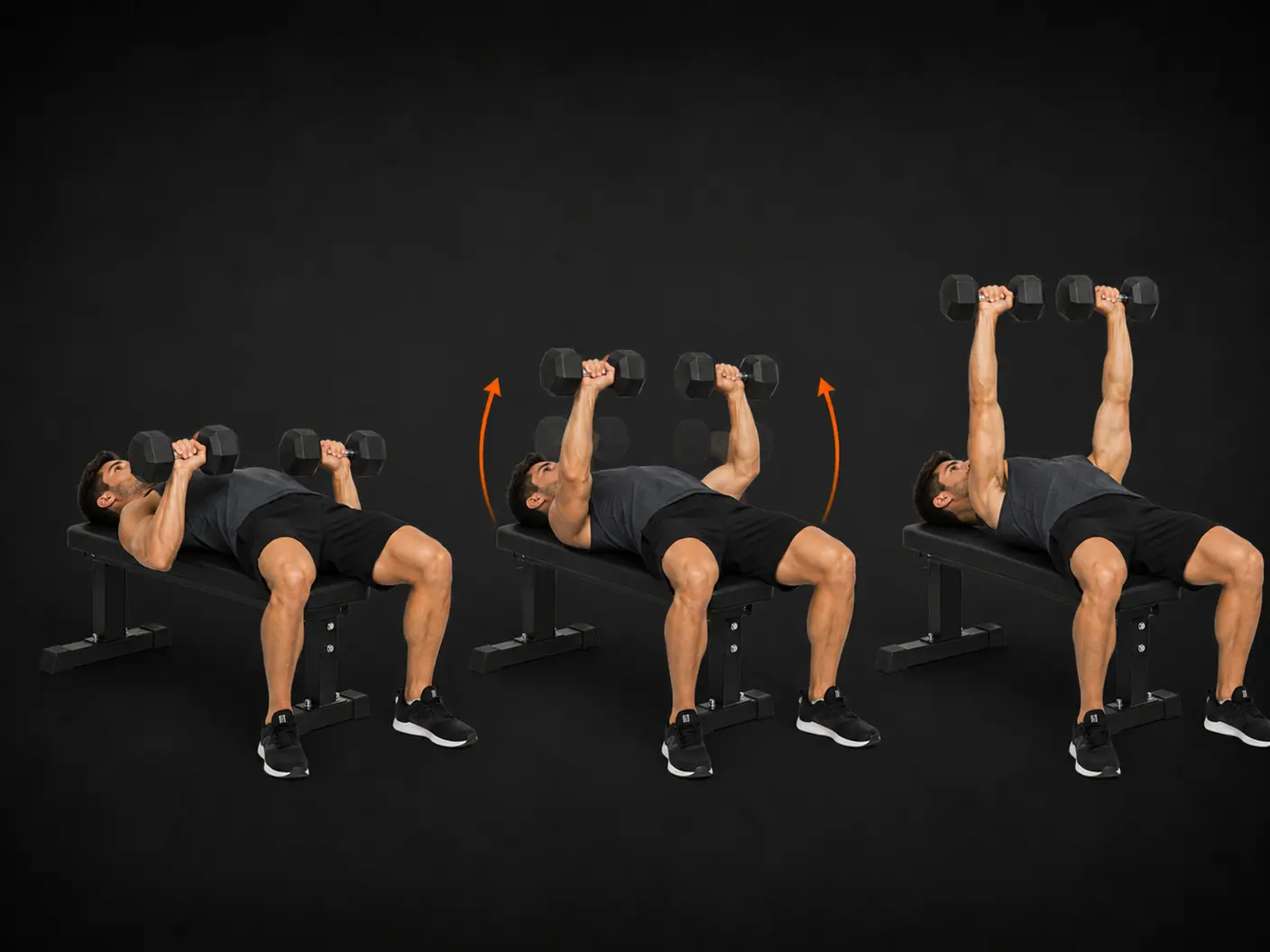
The dumbbell bench press is a flat-bench horizontal pushing movement that develops the chest, triceps, and anterior deltoid through a pressing pattern with independent loading on each side. Unlike a barbell, dumbbells allow each arm to travel its natural arc, which tends to produce a deeper stretch at the bottom and greater freedom at the shoulder joint. It suits intermediate lifters building upper-body pushing strength or hypertrophy, and works equally well within general fitness programmes.
How to do it
Sit on the end of a flat bench, dumbbells on the thighs. Kick back one knee at a time and lie flat. Set the shoulder blades. Start with dumbbells at the outer chest, elbows ~45°. Press up and slightly inward; dumbbells meet at the top without clanking. Lower under control to a deep stretch.
Coaching cues
- Shoulder blades down
- Press and meet
- Deep stretch
- Control the eccentric
Why train it
- Each dumbbell moves independently, helping to identify and address strength imbalances between the left and right sides over time.
- The range of motion at the bottom position is typically greater than with a barbell, placing the pectoralis major under a more pronounced stretch and supporting hypertrophy adaptations.
- The pressing angle and grip can be subtly adjusted to suit individual shoulder mechanics, making it a more adaptable option than fixed-bar variations for many lifters.
- As a compound movement it trains the pectoralis major, triceps, and anterior deltoid simultaneously, making it an efficient choice for both strength and general fitness sessions.
Common mistakes
- Flaring the elbows out to 90 degrees — keep them at roughly 45 degrees from the torso to reduce unnecessary stress on the shoulder joint and keep the chest working effectively.
- Allowing the shoulder blades to lose their set position and round forward during the press — retract and depress the blades before the first rep and hold that position throughout the set.
- Rushing the lowering phase — control the descent deliberately to reach the deep stretch the movement is designed for and to keep the musculature under tension.
- Letting the dumbbells drift apart at the top rather than pressing inward to meet — cue the dumbbells to travel slightly toward each other as you extend, finishing with them close without clanking together.
Primary: Pectoralis Major, Triceps Brachii.
Secondary: Anterior Deltoid, Serratus Anterior.
Equipment
Good for
Easier variation
Machine chest press — fixed path is easier for beginners.
Similar movements
Frequently asked
- What muscles does the dumbbell bench press work?
- The primary muscles are the pectoralis major (specifically the sternocostal portion) and the triceps. The anterior deltoid and serratus anterior contribute as secondary movers throughout the press.
- How many sets and reps should I do for the dumbbell bench press?
- For hypertrophy, three to four sets of eight to twelve reps with a controlled tempo is a well-supported approach. For strength development, four to five sets of four to six reps at a heavier load is more appropriate, though you should always be able to safely unload the dumbbells at the end of a set.
- What is the difference between the dumbbell bench press and the barbell bench press?
- The main practical differences are range of motion and unilateral demand. Dumbbells typically allow a deeper stretch at the bottom and require each side to stabilise independently, which can expose strength imbalances. A barbell fixes the hands relative to each other and generally allows heavier absolute loading.
- Is the dumbbell bench press suitable for building chest size?
- Yes — the combination of a deep stretch at the bottom, a squeeze at the top, and the ability to control the eccentric phase makes it a sound choice for hypertrophy-focused programming targeting the pectoralis major.
- How do I set up safely without a spotter?
- Sit on the end of the bench with the dumbbells resting on your thighs, then use a knee kick to help drive each dumbbell into position as you lie back — one at a time. To finish the set, lower the dumbbells to your thighs and sit up; do not attempt to drop them sideways from a lying position.
Want this movement in a plan built for you?
Adaptiv programmes the right exercises for your goal, equipment and experience — then adapts them as you train.
Build my programme