Diamond Push-Up
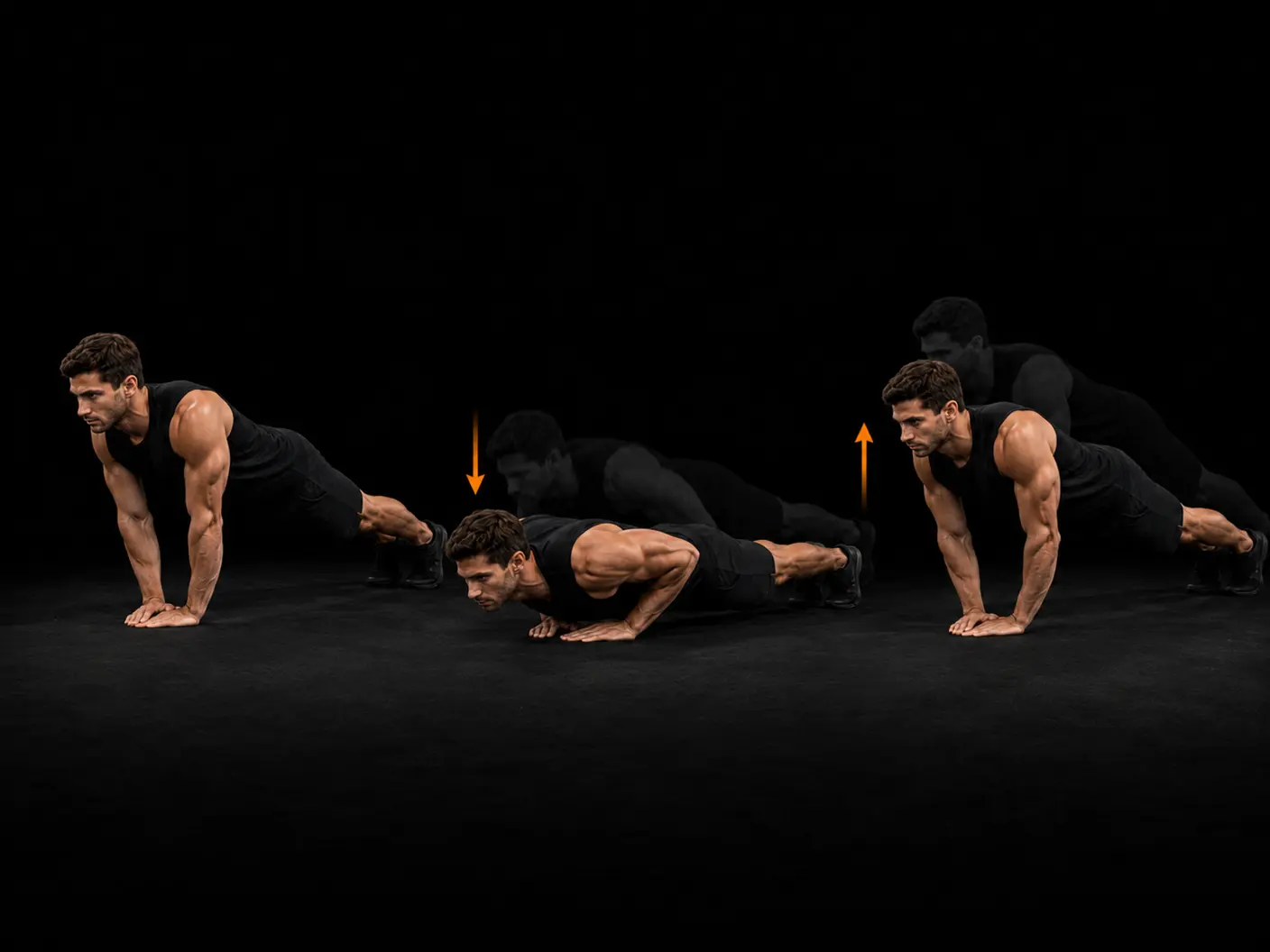
The diamond push-up is a bodyweight compound exercise in the horizontal push pattern, distinguished by placing the hands in a diamond shape directly beneath the chest rather than at shoulder width. The narrow hand position shifts emphasis decisively onto the triceps brachii while the pectoralis major and anterior deltoid contribute as synergists. It suits intermediate trainees who have already built a solid foundation in standard push-up mechanics and are looking to develop upper-arm and chest strength without additional equipment.
How to do it
Form a diamond with the thumbs and index fingers under the chest. Plank from head to heels. Lower the chest to the hands, keeping the elbows close to the ribs. Press the floor away.
Coaching cues
- Hands in a diamond
- Elbows tight
- Plank shape
- Chest to the hands
Why train it
- The diamond grip places the triceps brachii under significantly greater demand than a standard push-up, making it an efficient tool for upper-arm hypertrophy within a bodyweight programme.
- Because it requires no equipment, it can be programmed as a primary pressing movement or a finishing exercise in any setting, removing barriers to consistent training.
- Maintaining a rigid plank from head to heels throughout every rep develops full-body tension and core stability as an integrated training effect rather than an afterthought.
- The movement complements barbell and dumbbell pressing work by targeting the triceps in a closed-chain context, adding variety to a hypertrophy block without duplicating loading patterns.
Common mistakes
- Allowing the elbows to flare outward — keep them tracking close to the ribs on every descent to maintain the mechanical advantage that makes this variation effective.
- Sagging at the hips or piking upward — establish a straight line from head to heels before the first rep and hold that position for the duration of the set.
- Placing the hands too far forward on the chest — position the diamond directly beneath the sternum so that at the bottom of the rep the chest can actually reach the hands.
- Only performing partial repetitions — lower the chest fully to the hands on each rep, as cutting the range of motion reduces the stimulus to both the triceps and pectoralis major.
Primary: Triceps Brachii, Pectoralis Major.
Secondary: Anterior Deltoid.
Equipment
Good for
Easier variation
Close-grip push-up with hands shoulder-width — same tricep bias, easier loading.
Similar movements
Frequently asked
- What muscles do diamond push-ups work?
- The primary muscles are the triceps brachii and pectoralis major, with the anterior deltoid acting as a secondary contributor. The narrow hand position means the triceps take on a larger share of the workload compared with a standard push-up.
- How many sets and reps should I do for diamond push-ups?
- For hypertrophy, three to four sets of eight to fifteen reps with controlled tempo is a reasonable starting point. If you can complete more than fifteen clean reps, consider slowing the descent or elevating the feet to increase the challenge.
- What is a good alternative to the diamond push-up?
- Close-grip bench press and triceps dips both train the triceps brachii as a primary mover and are suitable alternatives when equipment is available. If you are working towards the diamond push-up, a close-grip push-up with hands slightly narrower than shoulder width makes a sensible progression step.
- Are diamond push-ups suitable for beginners?
- This exercise is classed as intermediate difficulty, so a degree of existing pressing strength and body control is expected. Beginners would benefit from consolidating standard push-up technique first before moving to the diamond variation.
- Can diamond push-ups help build chest size?
- The pectoralis major is a primary muscle in this movement, so it does contribute to chest development. That said, the hand position places comparatively greater stress on the triceps, so if chest hypertrophy is the primary goal, wider-grip pressing variations are generally more direct tools.
Want this movement in a plan built for you?
Adaptiv programmes the right exercises for your goal, equipment and experience — then adapts them as you train.
Build my programme