Parallel-Bar Dip
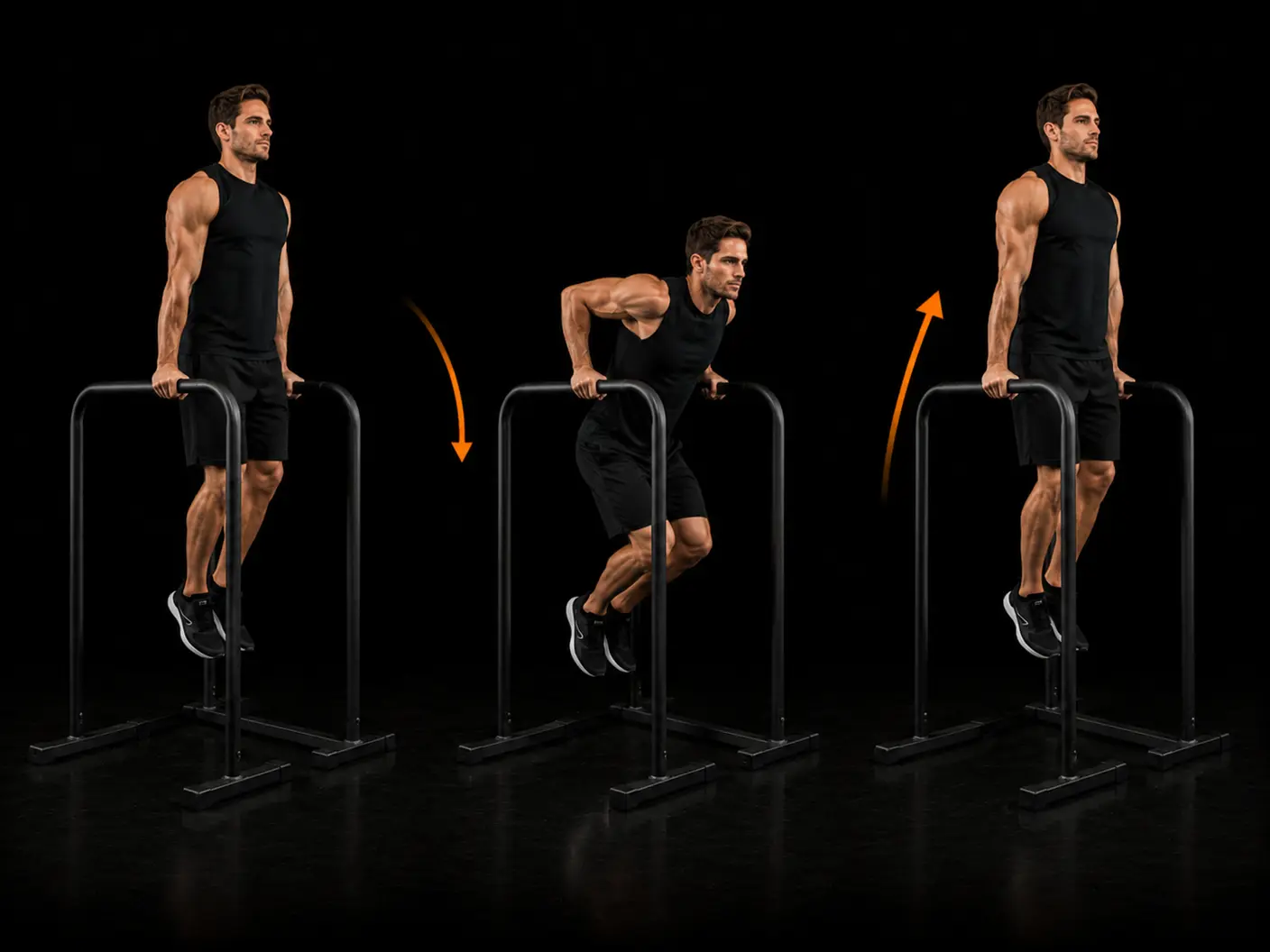
The parallel-bar dip is a compound vertical push exercise performed on parallel bars or a dip station, training the pressing muscles through a substantial range of motion under load. Torso angle determines the primary stimulus: a forward lean shifts emphasis towards the lower pectoralis major, while an upright position places greater demand on the triceps. It suits intermediate trainees who have established baseline pressing strength and sufficient shoulder stability to manage the movement safely.
How to do it
Grip the bars and jump into support with arms fully extended, shoulder blades depressed. Lean the torso forward slightly for chest bias or stay upright for tricep bias. Lower under control until upper arms are parallel to the floor or slightly below. Press back to full extension.
Coaching cues
- Shoulder blades down
- Lean forward for chest
- Upright for triceps
- Control the descent
Why train it
- The dip develops both the lower pectoralis major and triceps simultaneously, making it one of the more efficient upper-body pressing movements available with minimal equipment.
- Full extension at the top of each rep reinforces complete elbow lockout, which carries over directly to strength in other pressing patterns.
- Bodyweight as the baseline load means difficulty can be scaled progressively — from assisted variations for those building into the movement, to added load via a belt for more advanced trainees.
- The requirement to stabilise the shoulder blades in depression throughout the set develops active scapular control, which supports shoulder health across a broad range of pressing work.
Common mistakes
- Allowing the shoulder blades to rise and shrug upward — actively depress them before you descend and maintain that position throughout the set.
- Descending too quickly and losing control at the bottom — the eccentric phase should be deliberate, taking roughly two seconds to reach parallel with the floor.
- Cutting the range of motion short — lower until the upper arms are at least parallel to the floor before pressing back up, otherwise the chest and triceps are only partially loaded.
- Neglecting torso angle relative to your training goal — decide before you grip the bars whether you are targeting the chest or the triceps, then hold that angle consistently across every rep.
Primary: Pectoralis Major, Triceps Brachii.
Secondary: Anterior Deltoid, Serratus Anterior.
Equipment
Good for
Easier variation
Bench dip — feet on floor, hands on bench behind — much lower load.
Similar movements
Frequently asked
- What muscles do parallel-bar dips work?
- The primary muscles are the lower pectoralis major and the triceps. The anterior deltoid and serratus anterior act as secondary contributors, assisting with shoulder stabilisation and scapular control throughout the movement.
- How many sets and reps should I do for dips?
- For hypertrophy, three to four sets of eight to twelve reps with controlled technique is a reliable starting point. For strength development, lower rep ranges of four to six with added load via a belt are more appropriate once bodyweight reps are performed cleanly.
- Should I lean forward or stay upright on dips?
- That depends on your goal for the session. A moderate forward lean increases stretch and load on the lower pectoralis major, while staying upright concentrates the work on the triceps. Choose an angle and maintain it consistently rather than drifting between positions mid-set.
- What are good alternatives to parallel-bar dips?
- If bars are unavailable or the movement is not yet appropriate for your current level, close-grip bench press and decline press train a similar pattern with more controlled loading. Assisted dip machines allow the same movement with reduced bodyweight demand while technique is being established.
- Are dips suitable for building chest size?
- Yes, when performed with a consistent forward lean and full range of motion, the dip places meaningful mechanical tension on the lower pectoralis major and can contribute to chest hypertrophy within a well-structured programme. Pairing them with incline or flat pressing work gives broader coverage across the chest.
Want this movement in a plan built for you?
Adaptiv programmes the right exercises for your goal, equipment and experience — then adapts them as you train.
Build my programme