Ring Dip
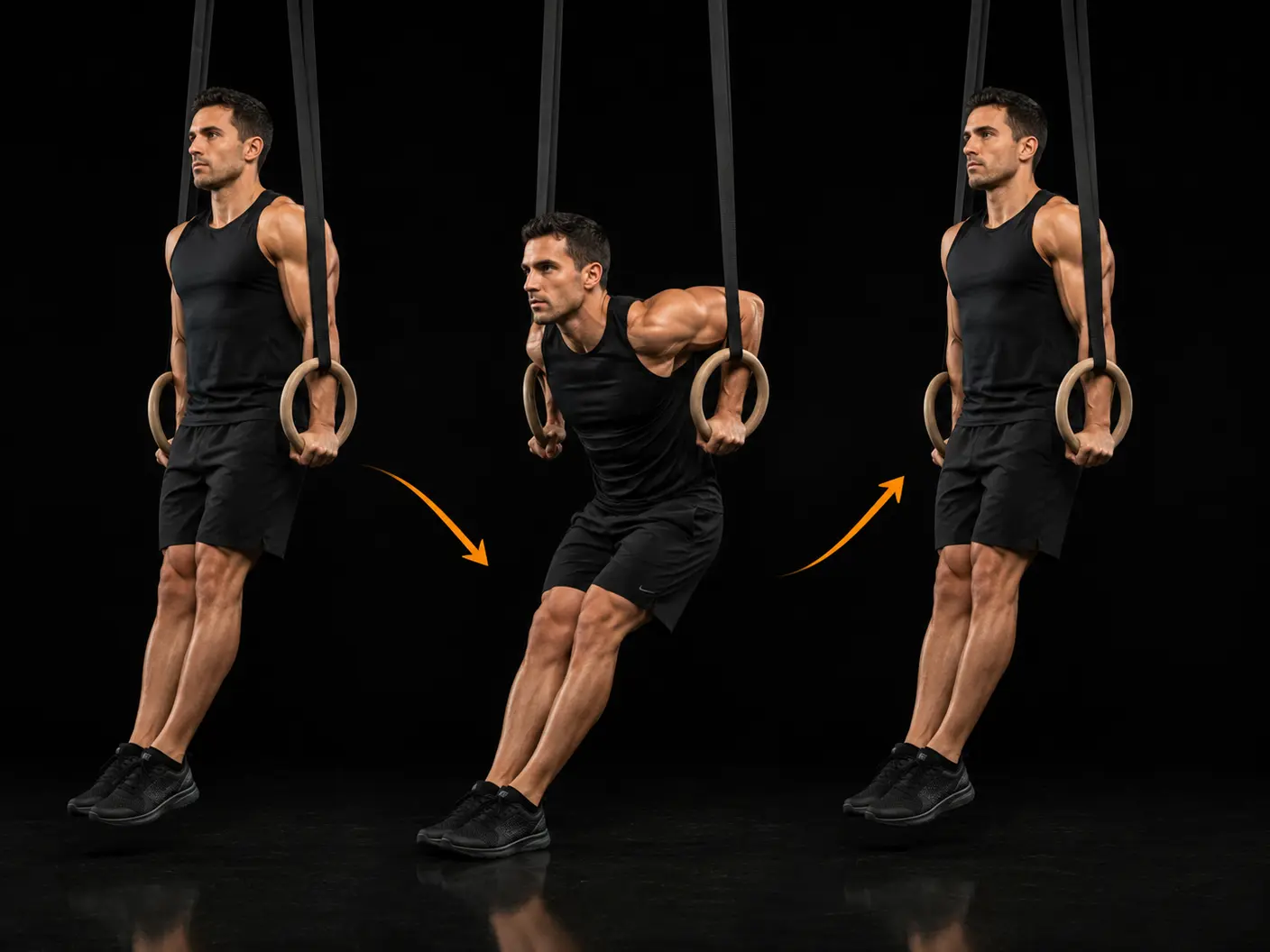
The ring dip is a compound vertical push movement performed on gymnastic rings, requiring the athlete to control both the pressing pattern and the instability introduced by the suspension medium. It trains the pectoralis major and triceps through a demanding range of motion while placing significant demand on shoulder stabilisers and serratus to maintain a safe, efficient position throughout. It suits intermediate to advanced trainees who have already established sound technique on fixed-surface dips and basic ring support holds.
How to do it
Support on the rings with arms fully extended, rings turned out slightly. Depress and retract shoulder blades. Lower under control; elbows stay close. Reach parallel or below. Press back to support; turn the rings out at the top for full lockout.
Coaching cues
- Rings turned out at top
- Elbows close
- Support through the shoulders
- Slow eccentric
Why train it
- The unstable surface of the rings recruits stabilising musculature around the shoulder girdle to a greater degree than a fixed bar, reinforcing shoulder integrity under load.
- A slow, controlled eccentric phase develops strength through a long range of motion in the pectoralis major and triceps, which supports both hypertrophy and maximal force production.
- Turning the rings out at the top of each rep cues full elbow lockout and active external rotation, reinforcing scapular control and a strong, stable support position.
- Because it demands body tension and co-ordination alongside raw pressing strength, the ring dip transfers well to athletic contexts where upper-body force must be produced through an unstable base.
Common mistakes
- Flaring the elbows wide — keep them close to the torso throughout the descent to protect the shoulder joint and maintain efficient pressing mechanics.
- Shrugging the shoulders up toward the ears — actively depress and retract the shoulder blades before and during the movement to maintain structural support through the shoulder girdle.
- Cutting the range of motion short — lower until the upper arm reaches at least parallel to the ground before pressing back up, as a shallow dip significantly reduces the stimulus to the target muscles.
- Rushing the descent — observe a deliberate, slow eccentric on every repetition, as controlled lowering builds the strength and body awareness needed to progress the movement safely.
Primary: Pectoralis Major, Triceps Brachii.
Secondary: Anterior Deltoid, Serratus Anterior.
Equipment
Good for
Easier variation
Parallel-bar dip — fixed bars eliminate the stability demand.
Similar movements
Frequently asked
- What muscles do ring dips work?
- The primary movers are the pectoralis major and triceps brachii. The anterior deltoid, serratus anterior, and a range of shoulder stabilisers contribute meaningfully to controlling position throughout the movement.
- How many sets and reps should I do for ring dips?
- For strength, three to five sets of three to six reps with full recovery between sets is a reliable starting point. For hypertrophy, three to four sets of six to ten reps with a deliberate eccentric tempo works well, provided you can complete each rep with controlled form.
- What should I be able to do before attempting ring dips?
- You should have a solid foundation on fixed-bar or parallel bar dips and be comfortable holding a stable ring support position with the rings turned out for at least twenty to thirty seconds. Attempting ring dips without that base makes it difficult to separate technique faults from simple strength deficits.
- Are ring dips suitable for building muscle as well as strength?
- Yes — the combination of an extended range of motion, an unstable surface, and a slow eccentric makes them an effective stimulus for hypertrophy in the chest and triceps, provided you are working in an appropriate rep range and managing volume sensibly across your programme.
- What are good alternatives if I cannot yet perform ring dips?
- Parallel bar dips or fixed-handle dips allow you to develop the same pressing pattern without the added instability, making them the most direct regression. Once comfortable there, ring support holds and slow ring push-ups can serve as a bridge before loading the full dip.
Want this movement in a plan built for you?
Adaptiv programmes the right exercises for your goal, equipment and experience — then adapts them as you train.
Build my programme