Flat Barbell Bench Press
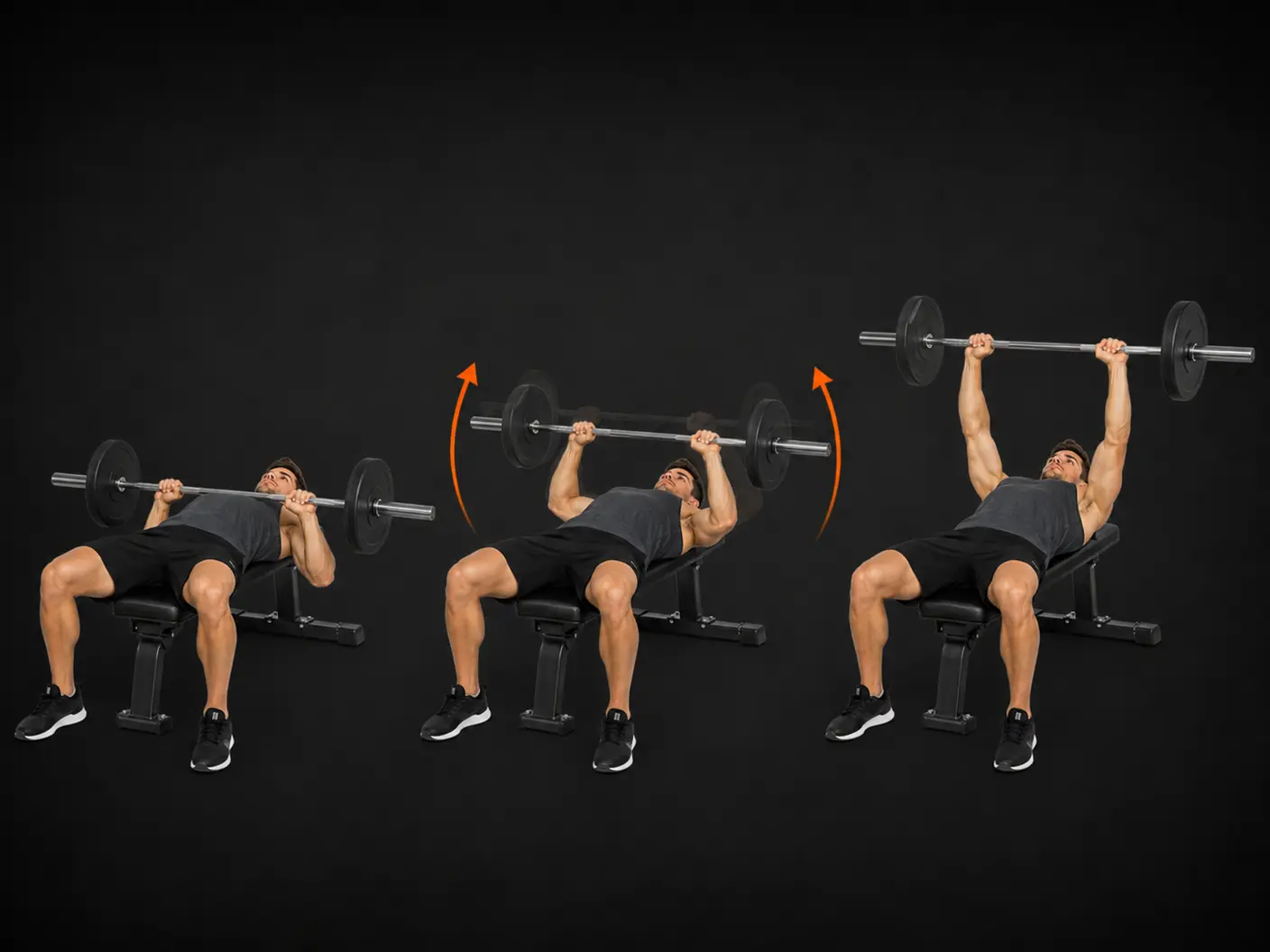
The flat barbell bench press is a compound horizontal push movement that loads the pectoralis major (sternocostal head), triceps brachii, anterior deltoid, and serratus anterior simultaneously. Performed lying supine on a bench with a racked barbell, it trains the ability to produce force through a stable, horizontally-oriented pressing pattern — a quality that transfers broadly to upper-body strength. It suits intermediate lifters who have the shoulder stability and technical awareness to manage a loaded barbell safely.
How to do it
Lie flat with eyes under the bar. Retract and depress the shoulder blades into the bench; set a slight arch in the upper back. Grip slightly wider than shoulder-width, wrists stacked over elbows. Unrack with straight arms. Lower the bar to the lower chest with elbows tucked ~45–70°. Drive the bar up and slightly back; press the bench away through the feet.
Coaching cues
- Shoulder blades pinned
- Elbows 45–70°
- Bar to lower chest
- Leg drive
Why train it
- The multi-joint loading of the chest, triceps, and anterior deltoid makes it one of the most efficient upper-body mass-building movements available.
- Progressive overload is straightforward to apply because the barbell allows small, incremental load increases over time, supporting long-term strength development.
- Practising shoulder blade retraction and depression under load builds the scapular stability that underpins most pressing and overhead movements.
- The leg drive component engages the lower body to create full-body tension, reinforcing the coordination of force production across multiple segments at once.
Common mistakes
- Allowing the elbows to flare to 90° — tuck them to between 45° and 70° from the torso to reduce shoulder joint stress and keep the pectorals in a stronger line of pull.
- Bouncing the bar off the chest — lower under control and pause or transition smoothly at the lower chest to ensure the muscles are doing the work rather than momentum.
- Letting the wrists roll back — stack the wrists directly over the elbows throughout the lift so force transfers efficiently through the forearm into the bar.
- Losing shoulder blade position mid-set — actively maintain retraction and depression from unrack to re-rack, as allowing the blades to wing forward reduces pressing stability and places greater strain on the anterior shoulder.
Primary: Pectoralis Major, Triceps Brachii.
Secondary: Anterior Deltoid, Serratus Anterior.
Equipment
Good for
Easier variation
Dumbbell bench press — removes the fixed bar path; easier on the shoulders.
Similar movements
Frequently asked
- What muscles does the flat barbell bench press work?
- The primary movers are the pectoralis major (sternocostal head) and triceps brachii. The anterior deltoid and serratus anterior contribute as secondary muscles, assisting with shoulder flexion and scapular stabilisation respectively.
- What sets and reps should I use for the bench press?
- For strength, 3–5 sets of 3–6 reps at higher relative loads with full recovery between sets is a well-established approach. For hypertrophy, 3–4 sets of 6–12 reps with moderate loads and 60–90 seconds of rest is more appropriate. Your specific programme should align these parameters with your overall training volume and recovery capacity.
- How wide should my grip be on the barbell?
- A grip slightly wider than shoulder-width is the standard starting point, placing the wrists stacked vertically over the elbows at the bottom position. Grip width can be adjusted marginally based on limb proportions, but excessively wide grips tend to increase shoulder stress without a meaningful benefit to pressing mechanics.
- Is the flat bench press suitable for building a bigger chest?
- Yes — the sternocostal head of the pectoralis major is heavily recruited throughout the movement, making it a reliable choice for chest hypertrophy when programmed with appropriate volume and progressive overload. Pairing it with incline or cable variations can address additional portions of the pectoralis major for more complete development.
- What are good alternatives if I do not have access to a rack?
- The dumbbell bench press replicates the horizontal push pattern using the same muscles without requiring a rack, and it also introduces a greater demand on stabilising musculature. The floor press is another option that limits the range of motion but can be performed with either dumbbells or a barbell in settings where a bench is unavailable.
Want this movement in a plan built for you?
Adaptiv programmes the right exercises for your goal, equipment and experience — then adapts them as you train.
Build my programme