Machine Chest Press
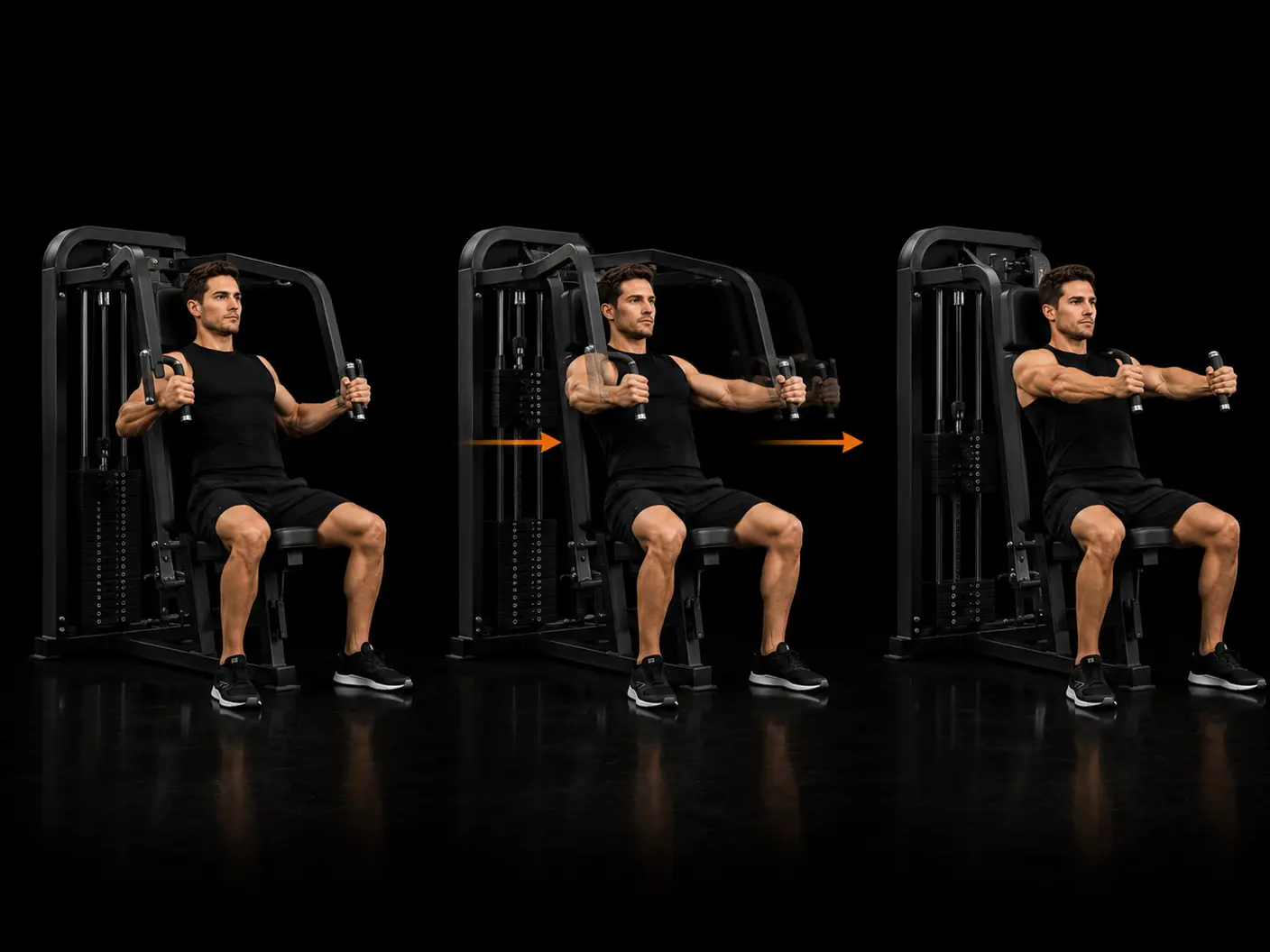
The machine chest press is a guided horizontal push exercise that trains the pectoralis major through a fixed arc, supported by the anterior deltoid and triceps as secondary contributors. Because the machine stabilises the load path, the lifter can direct attention to chest recruitment and controlled range of motion rather than managing balance. It suits beginners building foundational pressing strength, as well as more experienced trainees looking to isolate the chest with reduced demand on the stabilisers.
How to do it
Adjust the seat so the handles align with the mid-chest. Set shoulder blades against the pad. Grip the handles. Press forward until the arms are nearly straight; do not lock out. Pause briefly. Lower under control to a deep pec stretch.
Coaching cues
- Shoulder blades pinned
- Handles to mid-chest
- Stretch at the bottom
- Do not lock out
Why train it
- The fixed movement path removes the stabilisation demand of free weights, making it a reliable option for learning the pressing pattern safely and consistently.
- Training close to muscular failure is more manageable on a machine, which supports the sustained mechanical tension that drives hypertrophy in the pectoralis major.
- The seat and pad setup keeps the shoulder girdle in a consistent position, allowing the lifter to focus on achieving a genuine stretch at the bottom of each repetition.
- It fits naturally into a broader upper-body programme as an accessory or primary pressing movement without the technical overhead of barbell or dumbbell variations.
Common mistakes
- Setting the seat too high or too low — adjust the seat before loading so the handles align precisely with the mid-chest, not the shoulders or upper abdomen.
- Allowing the shoulder blades to peel off the pad during the press — keep them pinned throughout the set so the shoulder joint stays in a stable, consistent position.
- Locking the elbows out at the top of the rep — stop just short of full extension to maintain tension on the pectorals and reduce unnecessary joint stress.
- Rushing the lowering phase — control the return deliberately until you feel a full stretch across the chest, as this eccentric portion is where a significant portion of the training stimulus is produced.
Primary: Pectoralis Major.
Secondary: Anterior Deltoid, Triceps Brachii.
Equipment
Good for
Easier variation
Seated dumbbell press — same pattern with free weights.
Similar movements
Frequently asked
- What muscles does the machine chest press work?
- The primary muscle trained is the pectoralis major. The anterior deltoid and triceps act as secondary muscles, contributing to the press but working at lower relative intensity than the chest.
- How many sets and reps should I do on the machine chest press?
- For hypertrophy, three to four sets of eight to fifteen repetitions with controlled tempo is a well-supported range. For general fitness, two to three sets at a moderate load that allows clean form throughout is a practical starting point.
- Is the machine chest press suitable for beginners?
- Yes — its guided path and stable set-up make it one of the more accessible pressing movements. A beginner can establish the fundamental horizontal push pattern here before progressing to free-weight alternatives.
- What is a good alternative to the machine chest press?
- The dumbbell bench press trains a very similar movement pattern and muscle group. It introduces a greater stabilisation demand, so it serves as a natural progression once the pressing mechanics are solid.
- Should I feel a stretch at the bottom of the machine chest press?
- Yes — allowing the handles to travel back to a position where you feel a genuine stretch across the pectorals is an important part of the technique. Cutting the range of motion short reduces the stimulus to the chest and limits the value of the exercise.
Want this movement in a plan built for you?
Adaptiv programmes the right exercises for your goal, equipment and experience — then adapts them as you train.
Build my programme