Cable Chest Press
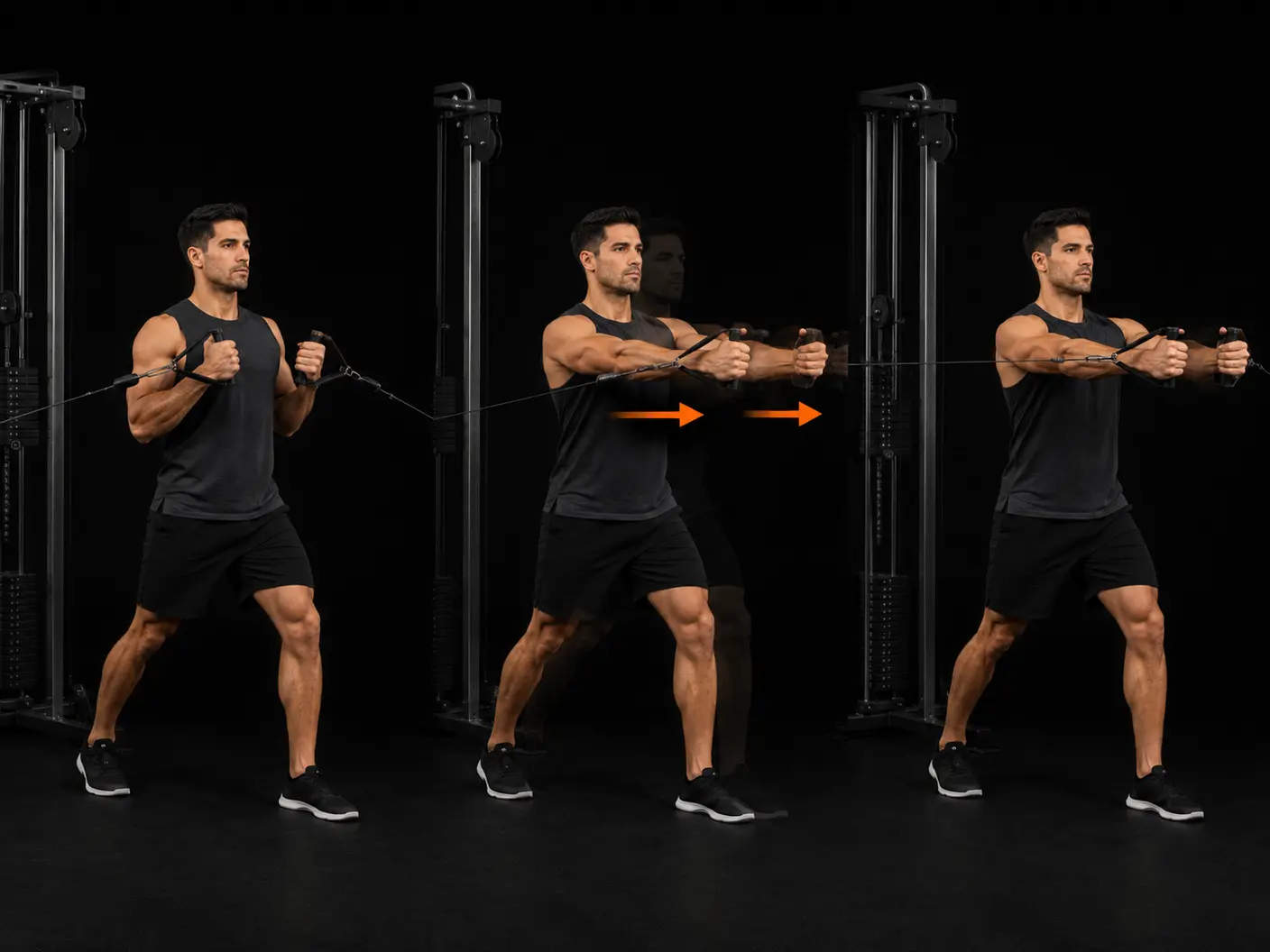
The cable chest press is a compound horizontal push exercise performed on a dual-pulley cable machine, with the handles set at chest height and pressed forward and inward to meet in front of the body. Unlike a barbell or dumbbell press, the cables maintain constant tension throughout the full range of motion, making this a reliable option for targeting the pectoralis major with sustained mechanical load. It suits intermediate lifters looking to complement their free-weight pressing or add variety to a hypertrophy-focused upper-body programme.
How to do it
Set the cables at chest height on a dual pulley. Face away from the stack, handle in each hand at the shoulders. Step forward into a split stance. Press the handles forward and inward so they meet in front of the chest. Pause briefly. Lower under control back to the shoulders.
Coaching cues
- Handles meet in front
- Stagger the stance
- Pause at peak contraction
- Smooth cable path
Why train it
- The constant cable tension keeps the pectoralis major under load at every point in the movement, including the shortened position where free weights typically unload.
- The inward arc of the press engages the serratus anterior and anterior deltoid as effective secondary contributors, reinforcing shoulder stability under load.
- The split stance required by the setup trains the core and lower body to resist rotation, adding a useful anti-rotational demand without dedicating a separate exercise to it.
- The smooth, guided resistance path allows precise control of tempo and a deliberate pause at peak contraction, which is particularly useful for developing the mind-muscle connection in the chest.
Common mistakes
- Allowing the elbows to flare excessively wide — keep them at roughly 45 to 75 degrees from the torso to reduce shoulder stress and direct force through the pectorals.
- Leaning too far forward at the trunk — maintain an upright or only mildly inclined torso so the force vector remains horizontal and the chest, not momentum, drives the press.
- Rushing through the return phase — lower the handles under control back to shoulder height to preserve time under tension and protect the anterior shoulder from sudden loading.
- Failing to pause at peak contraction — a brief hold when the handles meet in front of the chest maximises pectoral activation at the shortened position, which is where much of the hypertrophic stimulus in this movement is earned.
Primary: Pectoralis Major.
Secondary: Anterior Deltoid, Triceps Brachii, Serratus Anterior.
Equipment
Good for
Easier variation
Standing cable press one hand at a time — addresses asymmetry.
Similar movements
Frequently asked
- What muscles does the cable chest press work?
- The primary muscle is the pectoralis major. The anterior deltoid, triceps, and serratus anterior work as secondary contributors to drive and stabilise the press.
- How many sets and reps should I do for the cable chest press?
- For hypertrophy, three to four sets of eight to fifteen reps works well, with a controlled tempo and a short pause at the point where the handles meet. For general fitness, three sets of ten to twelve reps at a moderate load is a practical starting point.
- Can I use the cable chest press as a substitute for the barbell bench press?
- It serves a complementary rather than direct replacement role. The cable version provides constant tension and a converging press path that a barbell cannot replicate, but it lacks the heavy loading potential of a barbell, so most intermediate lifters benefit from programming both.
- Is the cable chest press suitable for beginners?
- It is classified as an intermediate movement because managing the dual cables, maintaining a split stance, and controlling the inward press path simultaneously requires a baseline of upper-body coordination and pressing strength. Beginners may find a flat dumbbell press or machine chest press more appropriate initially.
- Where should I set the cable height for a chest press?
- Set both pulleys at chest height so the handles start level with the shoulders when you face away from the stack. This ensures the press travels on a horizontal plane and keeps the load correctly directed through the pectoralis major.
Want this movement in a plan built for you?
Adaptiv programmes the right exercises for your goal, equipment and experience — then adapts them as you train.
Build my programme