Incline Barbell Bench Press
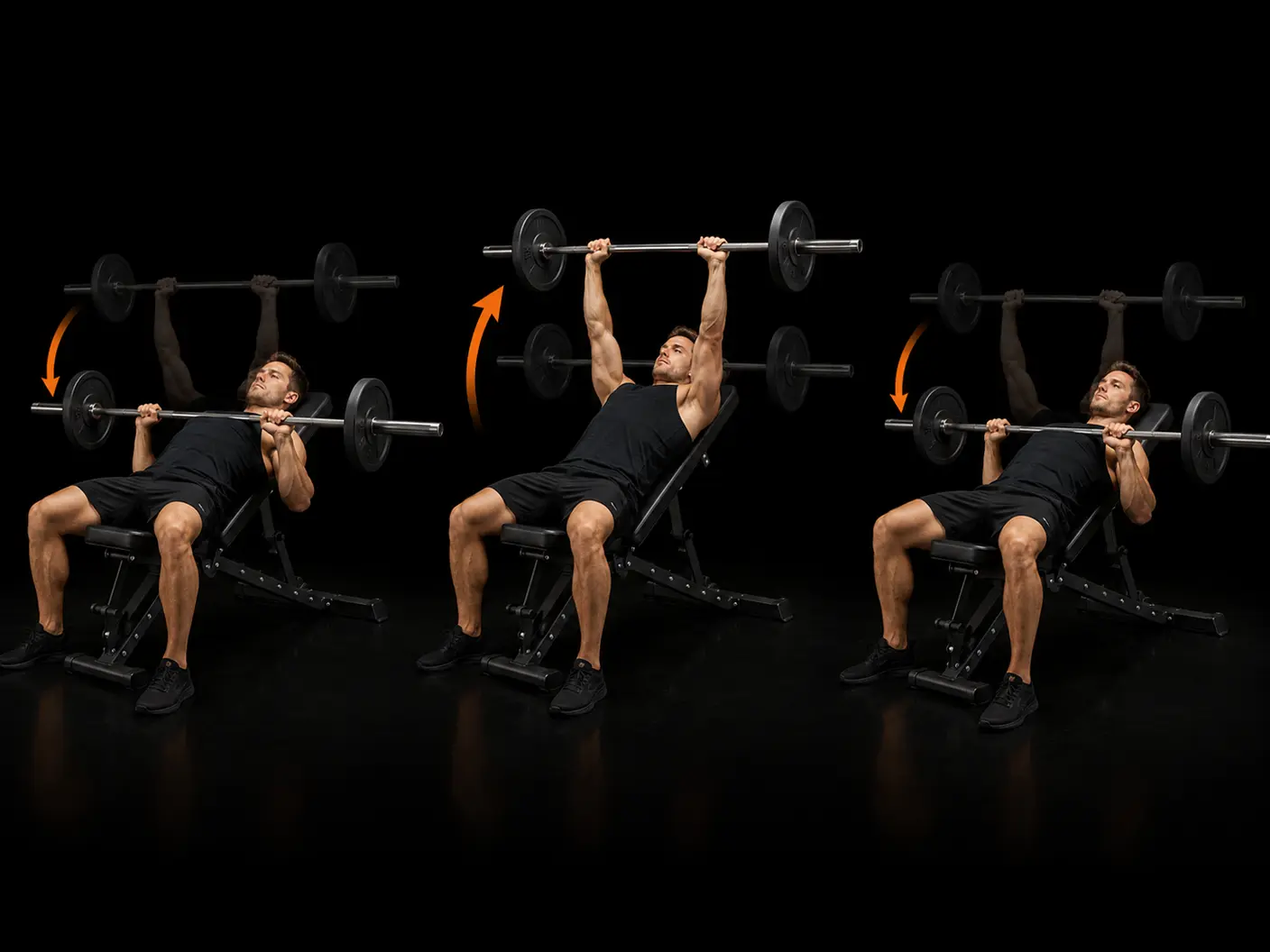
The incline barbell bench press is a compound horizontal push performed on a bench set to approximately 30°, placing greater mechanical demand on the clavicular head of the pectoralis major than a flat press would. The angled torso position shifts the line of force upward, making it a reliable tool for developing the upper chest alongside the anterior deltoid and triceps. It suits intermediate lifters who have established solid pressing mechanics and are looking to address upper chest development or build overall pressing strength.
How to do it
Set the bench to 30°. Lie back, eyes under the bar. Set the shoulder blades. Grip slightly wider than shoulder-width. Unrack. Lower the bar to the upper chest, elbows ~45°. Press up in a slight backward arc. Keep the wrists stacked over the elbows.
Coaching cues
- 30° incline
- Bar to upper chest
- Shoulder blades set
- Control the descent
Why train it
- The inclined angle preferentially loads the clavicular head of the pectoralis major, making it one of the more direct barbell options for developing upper chest mass.
- As a compound movement, it recruits the anterior deltoid and triceps as meaningful secondary contributors, allowing you to accumulate volume across multiple muscle groups in a single exercise.
- The barbell variation allows for progressive overload over time in a way that is straightforward to track, supporting long-term strength development in the horizontal push pattern.
- Training the pressing pattern at an angle complements flat and overhead work, giving a more complete stimulus across the chest and shoulder girdle within a well-structured programme.
Common mistakes
- Setting the bench too steep — keep the incline close to 30°, as angles beyond 45° shift the primary load onto the anterior deltoid and away from the upper chest.
- Allowing the shoulder blades to lose their set position during the lift — retract and depress them before you unrack and maintain that position throughout every rep.
- Flaring the elbows out to 90° — keep them at roughly 45° to the torso to reduce shoulder stress and maintain a stronger pressing position.
- Letting the wrists drift behind the elbows — stack the wrists directly over the elbows on both the descent and the press to transfer force efficiently and protect the joints.
Primary: Pectoralis Major.
Secondary: Anterior Deltoid, Triceps Brachii.
Equipment
Good for
Easier variation
Incline dumbbell press — allows natural press arc and a deeper stretch.
Similar movements
Frequently asked
- What muscles does the incline barbell bench press work?
- The primary muscle is the clavicular head of the pectoralis major, commonly referred to as the upper chest. The anterior deltoid and triceps work as secondary muscles throughout the movement.
- How is the incline bench press different from the flat bench press?
- The 30° incline shifts the angle of the press upward, directing more of the load onto the upper portion of the chest rather than the mid and lower fibres that the flat bench emphasises. Both movements train the same broad pattern, but the incline provides a meaningfully different stimulus within a chest-focused programme.
- What sets and reps should I use for the incline barbell bench press?
- For strength, working in the 3–6 rep range across 3–5 sets at higher relative intensity is appropriate. For hypertrophy, sets of 6–12 reps with controlled tempo and adequate rest between sets are a more common approach. Your specific targets should reflect where this exercise sits in your overall programme.
- What angle should the bench be set to?
- A 30° incline is the recommended position for this exercise. Steeper settings progressively transfer the demand from the upper chest to the anterior deltoid, which changes the nature of the movement considerably.
- Is the incline barbell bench press suitable for beginners?
- This exercise is classified as intermediate difficulty, primarily because it requires established shoulder blade control, pressing mechanics, and confident barbell handling under load. Beginners would generally benefit from building those foundations with simpler pressing variations before introducing the incline barbell variation.
Want this movement in a plan built for you?
Adaptiv programmes the right exercises for your goal, equipment and experience — then adapts them as you train.
Build my programme