Incline Dumbbell Bench Press
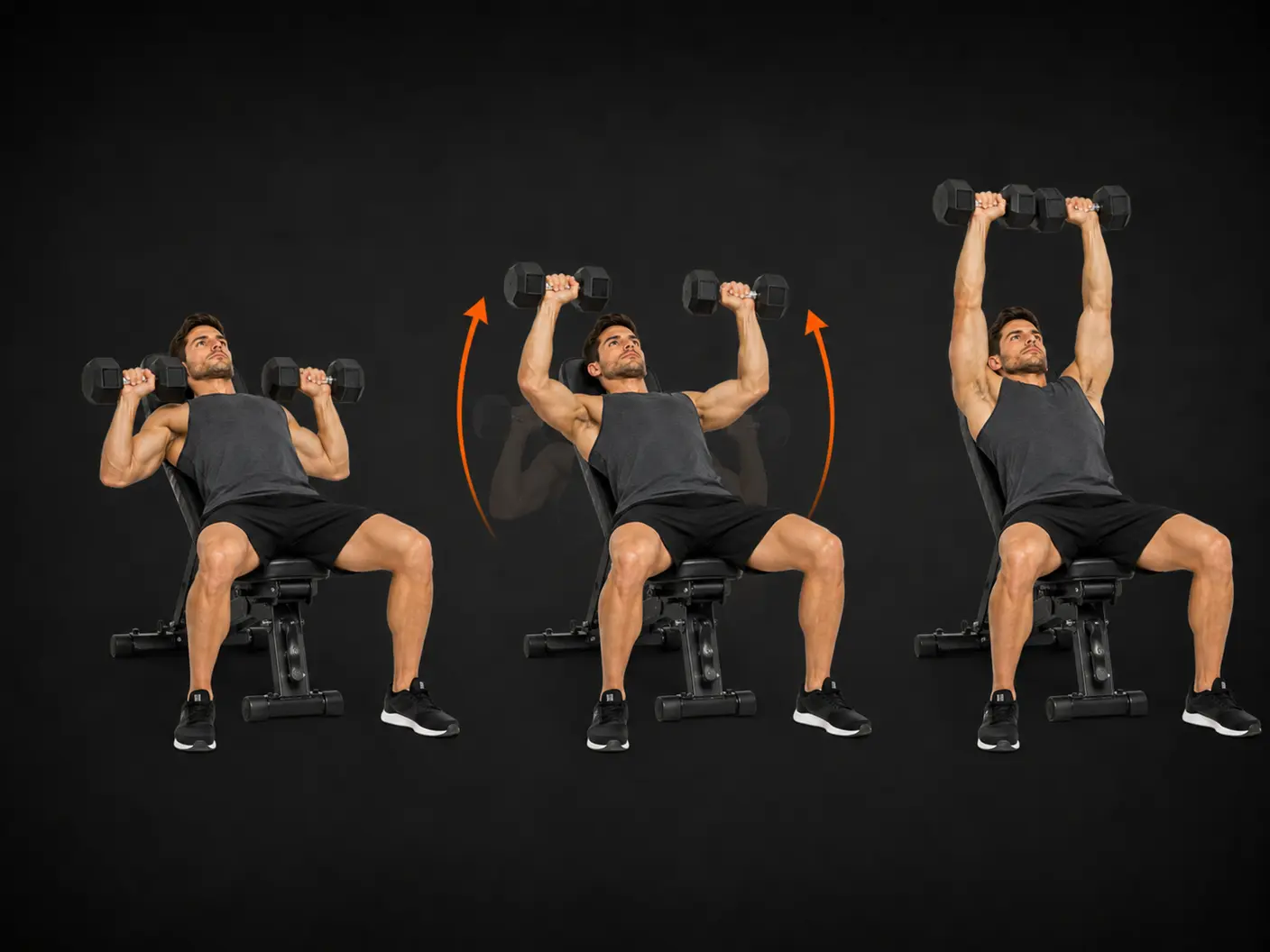
The incline dumbbell bench press is a compound horizontal push performed on a bench set to approximately 30 degrees, placing the emphasis squarely on the clavicular (upper) portion of the pectoralis major. Each arm moves independently, which demands greater stabilisation from the anterior deltoid and triceps compared with a barbell equivalent. It suits intermediate trainees looking to develop upper chest thickness and pressing strength with a fuller range of motion than a flat variation allows.
How to do it
Set the bench to 30°. Sit with dumbbells on the thighs; kick back and lie up. Set the shoulder blades. Dumbbells start at the outer chest, elbows ~45°. Press up and slightly inward; meet at the top. Lower into a deep stretch across the clavicular pecs.
Coaching cues
- 30° incline
- Press and meet
- Deep stretch
- Shoulder blades down
Why train it
- The 30-degree incline directs mechanical tension toward the clavicular pectoralis major, making it one of the more effective positions for developing upper chest thickness.
- Independent dumbbell loading means each side must work without compensation from the other, which helps to identify and gradually reduce left-to-right strength imbalances.
- The free path of the dumbbells allows the lifter to lower into a deep stretch across the upper chest at the bottom of each rep, increasing the range of motion through which the muscle is loaded.
- As both a hypertrophy and strength tool, it sits naturally in a wide range of programmes — from dedicated chest sessions to upper-body push days structured around compound movements.
Common mistakes
- Flaring the elbows to 90 degrees — keep them at roughly 45 degrees to the torso to reduce unnecessary stress on the shoulder joint and maintain tension in the pectorals.
- Letting the shoulder blades wing forward as you press — set them down and back before the first rep and hold that position throughout to create a stable base for the movement.
- Pressing straight up rather than slightly inward — allow the dumbbells to converge at the top so the pectoralis major completes its full contraction, rather than leaving the movement at the midpoint.
- Using the thigh-kick to rush into the starting position without setting the shoulders — take a moment after lying back to retract and depress the shoulder blades before unracking the load.
Primary: Pectoralis Major.
Secondary: Anterior Deltoid, Triceps Brachii.
Equipment
Good for
Easier variation
Seated machine incline press — removes stabilisation demand.
Similar movements
Frequently asked
- What muscles does the incline dumbbell bench press work?
- The primary muscle trained is the clavicular (upper) head of the pectoralis major. The anterior deltoid and triceps contribute as secondary movers throughout the press.
- What angle should the bench be set to?
- A 30-degree incline is the recommended setting for this exercise. Steeper angles shift demand increasingly toward the anterior deltoid and away from the upper chest, so staying close to 30 degrees keeps the focus where it is intended.
- How many sets and reps should I do for hypertrophy?
- For hypertrophy, three to four sets of eight to twelve repetitions at a challenging but technically sound load is a well-established starting point. Rest two minutes between sets to allow sufficient recovery for consistent performance.
- Is the incline dumbbell bench press suitable for beginners?
- It is classified as an intermediate movement, partly because the coordination required to kick the dumbbells back safely and maintain shoulder blade position under load takes time to develop. Beginners may benefit from building a foundation on simpler pressing variations before adding this exercise.
- What are good alternatives if I do not have an incline bench?
- This exercise specifically requires dumbbells and an incline bench, so a direct swap without similar equipment is not straightforward. If an incline bench is unavailable, check with a qualified coach about which flat or adjustable alternatives might serve a comparable purpose within your programme.
Want this movement in a plan built for you?
Adaptiv programmes the right exercises for your goal, equipment and experience — then adapts them as you train.
Build my programme