Knee Push-Up
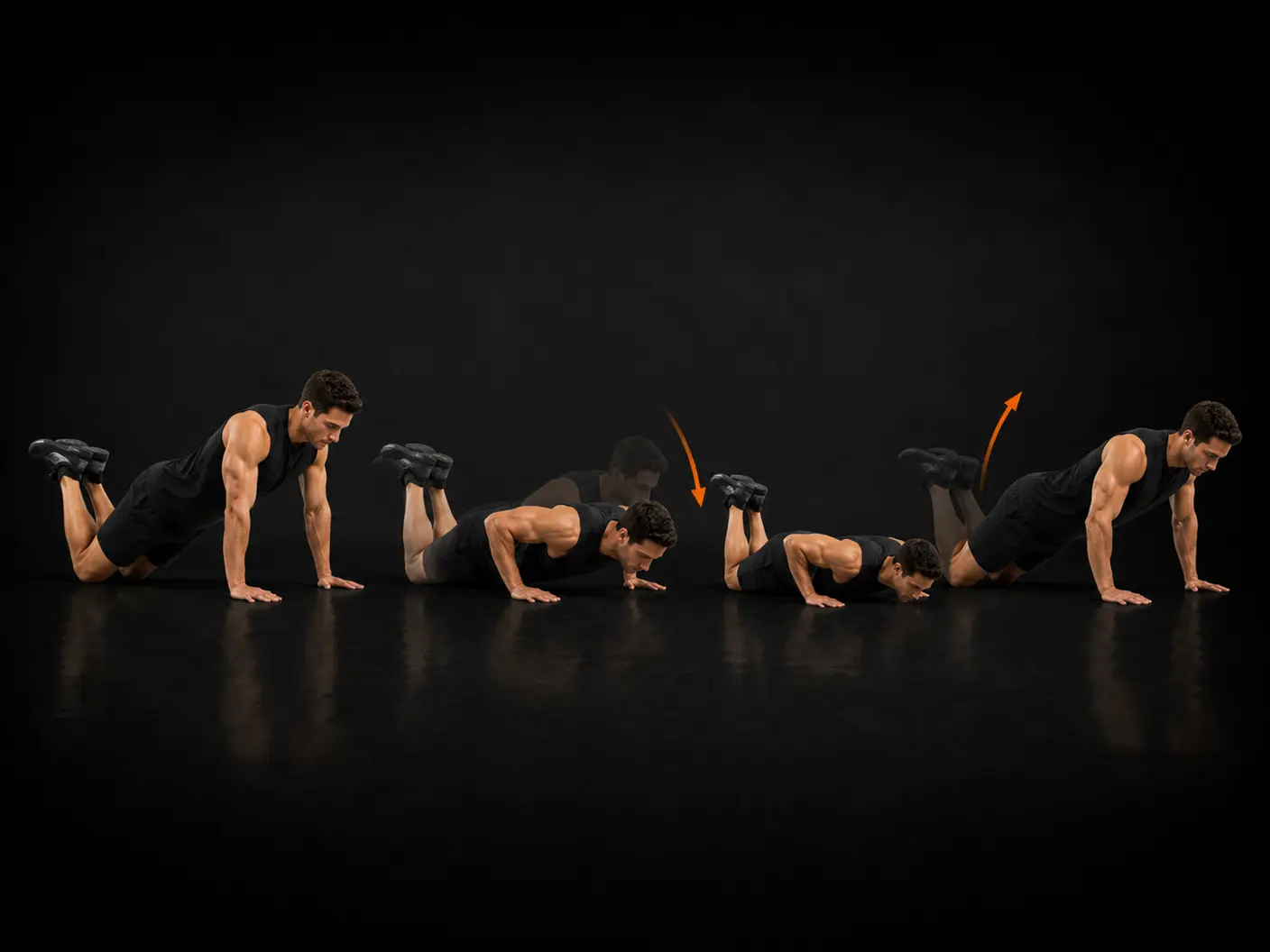
The knee push-up is a foundational horizontal pressing movement that trains the chest, triceps, and anterior deltoid through a shortened lever version of the standard push-up. By keeping the knees on the floor, the load is reduced without compromising the pressing mechanics, making it a practical starting point for those building upper-body pushing strength. It suits beginners, those returning from a lay-off, or anyone working towards a full push-up.
How to do it
Kneel on all fours, then drop the hips forward so the torso, hips, and knees form a straight line. Hands slightly wider than shoulder-width. Lower the chest toward the floor, elbows at ~45°. Press the floor away, protracting the shoulder blades at the top. Keep the hips from sagging or piking.
Coaching cues
- Straight line from knees to head
- Elbows 45°
- Chest to the floor
- Protract at the top
Why train it
- It develops pressing strength in the pectoralis major and triceps brachii using only bodyweight, requiring no equipment and minimal space.
- The reduced lever length makes the movement accessible at lower strength levels, allowing consistent practice of sound push-up mechanics before progressing to the full variation.
- Maintaining a straight line from knees to head throughout each rep builds the habit of core bracing and hip position that transfers directly to the standard push-up.
- Protracting the shoulder blades at the top of each rep encourages serratus anterior engagement, contributing to healthy scapular movement patterns.
Common mistakes
- Letting the hips sag toward the floor — brace the core and squeeze the glutes to maintain a straight line from knees to head throughout the movement.
- Flaring the elbows out to 90° — keep them at approximately 45° to the torso to reduce unnecessary stress on the shoulder joint and keep the chest as the primary mover.
- Not reaching full depth — lower the chest until it makes contact with, or comes close to, the floor on every rep to train the full available range of motion.
- Piking the hips upward as fatigue sets in — if the position cannot be maintained, stop the set rather than allowing the hips to rise, as this removes the training stimulus from the intended muscles.
Primary: Pectoralis Major, Triceps Brachii.
Secondary: Anterior Deltoid, Rectus Abdominis.
Equipment
Good for
Easier variation
Wall push-up — even less load; fully vertical hands-on-wall position.
Similar movements
Frequently asked
- What muscles does the knee push-up work?
- The primary muscles trained are the pectoralis major and triceps brachii. The anterior deltoid and core musculature work as secondary contributors to support the movement and maintain body position.
- How many sets and reps should I do for the knee push-up?
- For general fitness and strength development, three to four sets of eight to fifteen reps is a practical starting range. Once you can complete the upper end of that range with clean form, it is a sound indicator that progression to the standard push-up is appropriate.
- Is the knee push-up effective, or should I just do a full push-up?
- The knee push-up is a legitimate progression tool rather than a lesser exercise. If you cannot yet perform a full push-up with consistent form, the knee variation allows you to accumulate quality pressing volume while building the requisite strength.
- What is the progression from a knee push-up?
- The standard full push-up is the direct progression, as it uses the same mechanics with a longer lever and greater load demand. Ensure you can perform at least ten to twelve clean knee push-ups before moving to the full variation.
- Can the knee push-up be used as a warm-up?
- Yes, a few sets of controlled knee push-ups at moderate rep ranges can serve as an effective warm-up for horizontal pressing sessions, preparing the shoulders, chest, and triceps for heavier work to follow.
Want this movement in a plan built for you?
Adaptiv programmes the right exercises for your goal, equipment and experience — then adapts them as you train.
Build my programme