Incline Push-Up
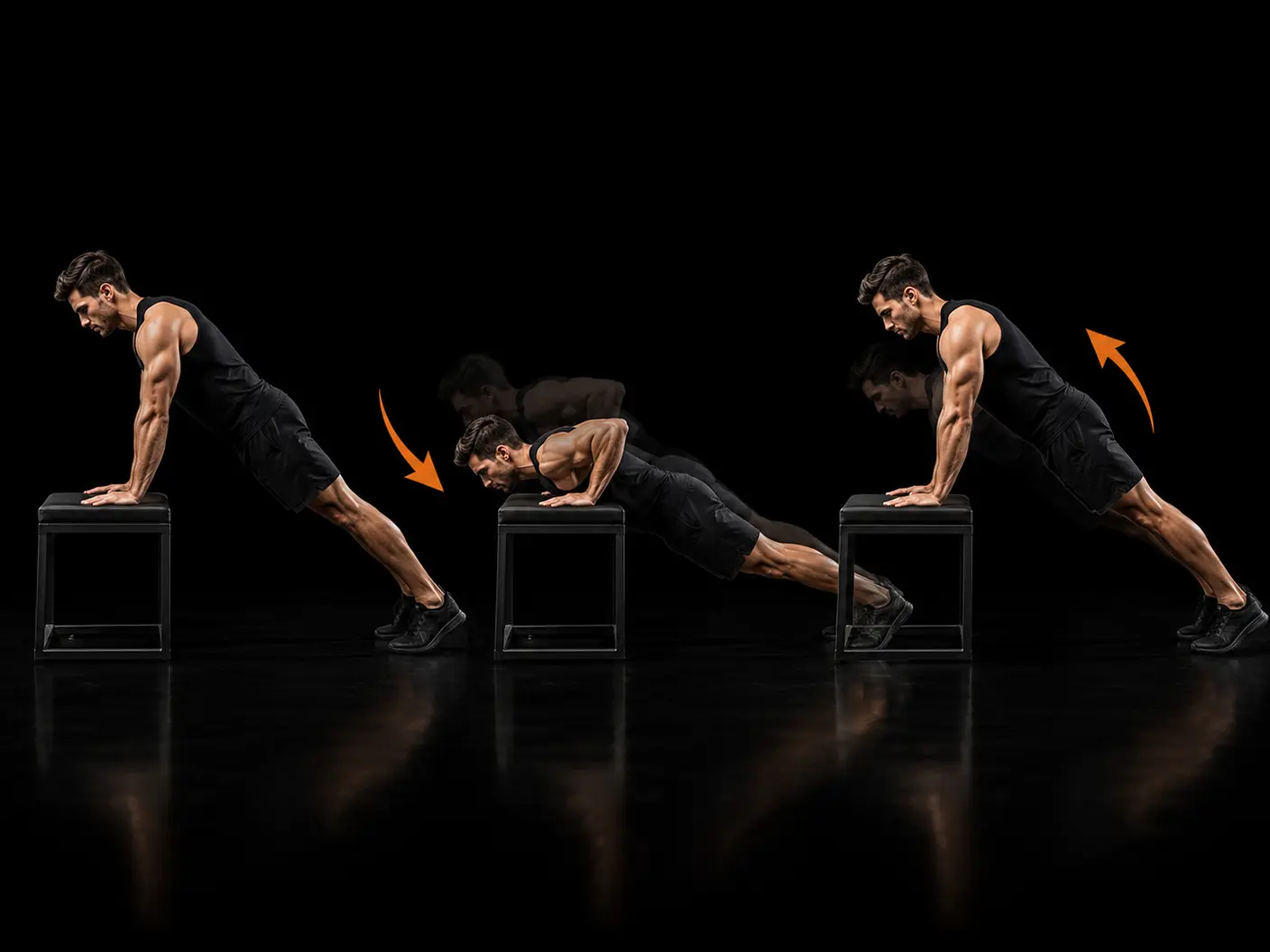
The incline push-up is a compound horizontal push exercise performed with the hands elevated on a bench or box, reducing the proportion of bodyweight loaded compared with a standard floor push-up. It trains the pectoralis major, triceps, and anterior deltoid through a full pressing range of motion while demanding the same whole-body plank tension as its flat counterpart. It suits beginners building a foundation in upper-body pressing, those returning from a training break, or anyone working toward a full push-up with sound mechanics.
How to do it
Place hands on a bench or box. Step back into a plank position; straight line from head to heels. Lower the chest toward the bench, elbows ~45°. Press the bench away, protracting at the top.
Coaching cues
- Plank from head to heels
- Elbows 45°
- Chest to the bench
- Protract at the top
Why train it
- The elevated hand position reduces the effective load, making it an accessible entry point for developing genuine pressing strength before progressing to harder variations.
- Because it is a compound movement involving the chest, triceps, and anterior deltoid simultaneously, it produces meaningful upper-body training stimulus with minimal equipment.
- Maintaining a rigid plank throughout every rep reinforces core and full-body tension habits that transfer directly to floor push-ups, dips, and barbell pressing.
- The movement is easily progressed by lowering the hand elevation over time, giving coaches and athletes a clear, measurable pathway toward more demanding horizontal push variations.
Common mistakes
- Allowing the hips to sag toward the floor — brace the trunk and squeeze the glutes so the body forms a straight line from head to heels throughout the set.
- Flaring the elbows out to 90° — keep them tracking at roughly 45° from the torso to reduce shoulder stress and keep the pectorals working efficiently.
- Only performing a partial range of motion — lower the chest all the way to the bench on every rep to ensure the pectoralis major is trained through its full range.
- Forgetting to protract at the top — once the elbows are fully extended, push the bench away and spread the shoulder blades apart to complete the rep and engage the serratus anterior.
Primary: Pectoralis Major, Triceps Brachii.
Secondary: Anterior Deltoid.
Equipment
Good for
Easier variation
Wall push-up — higher incline further reduces load.
Similar movements
Frequently asked
- What muscles does the incline push-up work?
- The primary muscles are the pectoralis major and triceps, with the anterior deltoid acting as a secondary contributor. The core musculature also works isometrically to maintain plank position throughout each rep.
- How many sets and reps should I do?
- For general fitness and hypertrophy, 3–4 sets of 10–20 reps is a practical range. Progress by increasing reps within that range before lowering the bench height to make the movement more demanding.
- How does the incline push-up differ from a standard push-up?
- Elevating the hands reduces the percentage of bodyweight you are pressing, making the incline version mechanically easier. The movement pattern, muscles worked, and technique cues are otherwise identical, so it serves as a direct stepping stone to the floor variation.
- Is the incline push-up useful if I can already do full push-ups?
- It can still have a place in a programme as a high-rep accessory or warm-up drill, but athletes who can perform multiple sets of full push-ups with good form will generally get a greater hypertrophy stimulus from the flat or decline variations.
- What equipment do I need?
- A sturdy bench or box is all that is required. The height of the surface determines the difficulty — a higher surface makes the movement easier, so adjust accordingly based on your current ability.
Want this movement in a plan built for you?
Adaptiv programmes the right exercises for your goal, equipment and experience — then adapts them as you train.
Build my programme