Wall Sit
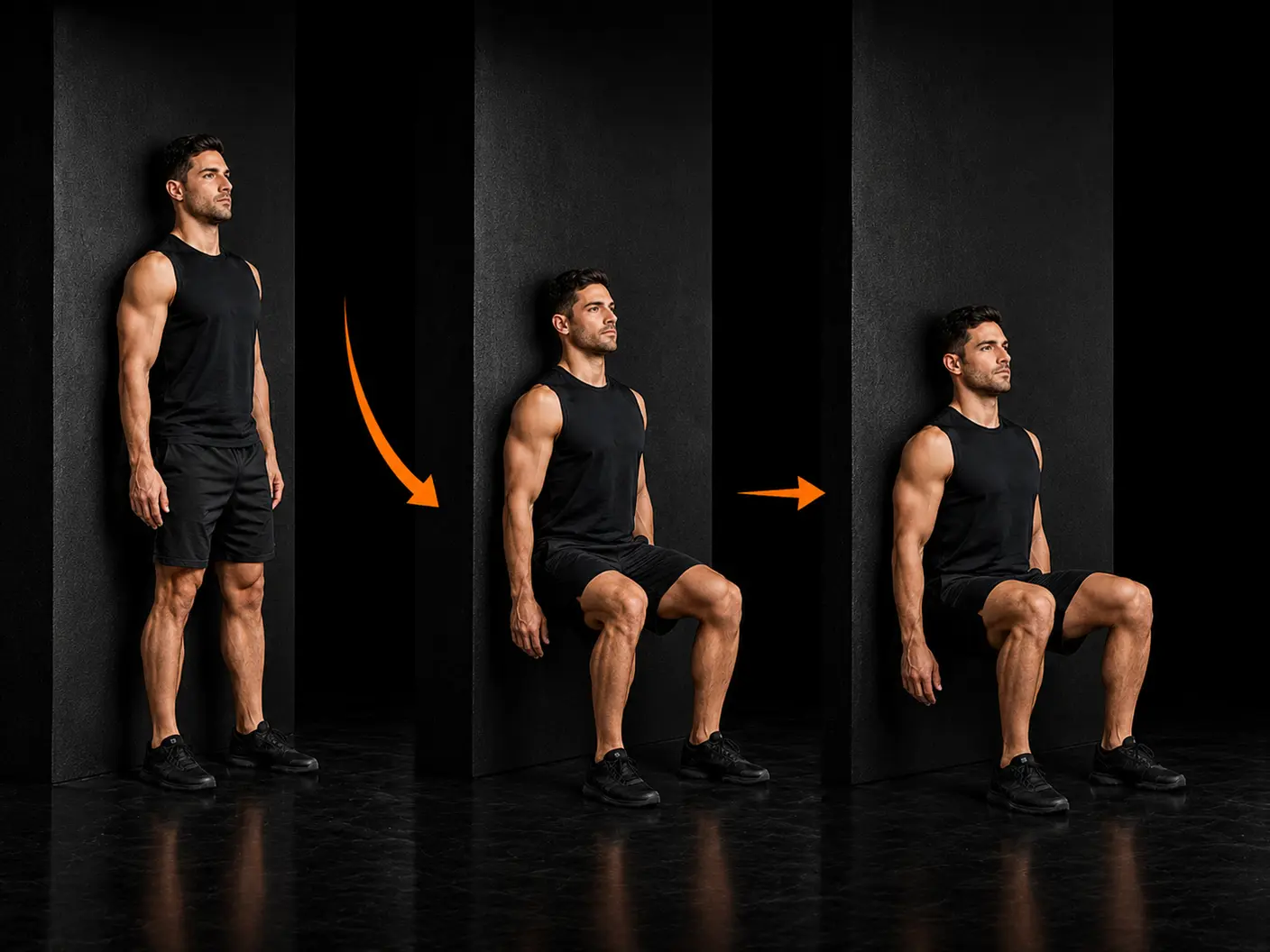
The wall sit is a static squat hold performed with the back flat against a wall and the thighs parallel to the floor, creating a 90° angle at the knee. It trains isometric strength endurance through the squat pattern, requiring the quadriceps, glutes, calves, and core to sustain tension under load over time. It suits beginners building lower-body endurance, those developing positional awareness in the squat, and general fitness trainees looking for an equipment-minimal option.
How to do it
Stand with your back against a wall. Walk the feet out until the thighs are parallel to the floor and knees at 90°. Keep the entire back and head flat against the wall. Arms can hang at the sides or hold a light plate. Hold for time, breathing normally.
Coaching cues
- Back flat on wall
- 90° at the knee
- Steady breathing
- Stay tall
Why train it
- Develops isometric quadriceps endurance, which underpins sustained lower-body output in sport and everyday activity.
- Requires only a wall, making it one of the most accessible lower-body exercises available regardless of training environment.
- The fixed wall contact encourages a neutral spine and upright torso, reinforcing positional habits that transfer to loaded squat variations.
- Holding for time provides a straightforward, measurable training stimulus that is easy to progress by simply increasing duration.
Common mistakes
- Allowing the knees to drift forward past the toes — walk the feet out further until the shins are vertical and the knees sit directly above the ankles.
- Letting the lower back peel away from the wall — press the entire spine flat against the surface throughout the hold to maintain correct spinal position.
- Holding the breath — breathe steadily and rhythmically for the duration of the set, as breath-holding elevates internal pressure unnecessarily during a prolonged hold.
- Sliding into a shallow hold above 90° — check that the thighs are genuinely parallel to the floor before beginning the timer, as a higher position significantly reduces the muscular demand.
Primary: Quadriceps.
Secondary: Gluteus Maximus, Gastrocnemius, Rectus Abdominis.
Equipment
Good for
Easier variation
Higher wall-sit angle (less knee flexion) — reduces time under tension demand.
Similar movements
Frequently asked
- What muscles does the wall sit work?
- The wall sit primarily targets the quadriceps, which work isometrically to hold the thigh parallel to the floor. The glutes, calves, and core provide secondary support throughout the hold.
- How long should I hold a wall sit?
- For general fitness, sets of 20–60 seconds are a practical starting point. As endurance improves, progress towards holds of 60–90 seconds or add multiple sets with short rest periods between them.
- How many sets and reps should I do?
- Because the wall sit is timed rather than counted in reps, 2–4 sets with 45–90 seconds of rest between them is a sensible structure. Adjust total volume based on where it sits in your session.
- Is the wall sit suitable as a substitute for barbell squats?
- The wall sit develops isometric endurance rather than dynamic strength, so it does not fully replicate the demands of a barbell squat. It works well as a supplementary exercise or in sessions where loaded equipment is unavailable, but it is not a direct replacement for compound loaded movements.
- Can I make the wall sit harder without equipment?
- Yes — increase the hold duration, add additional sets, or place a light plate across the thighs as the data notes. Slowing your breathing cadence to maintain composure under fatigue also adds a useful challenge without requiring any extra load.
Want this movement in a plan built for you?
Adaptiv programmes the right exercises for your goal, equipment and experience — then adapts them as you train.
Build my programme