Spanish Squat
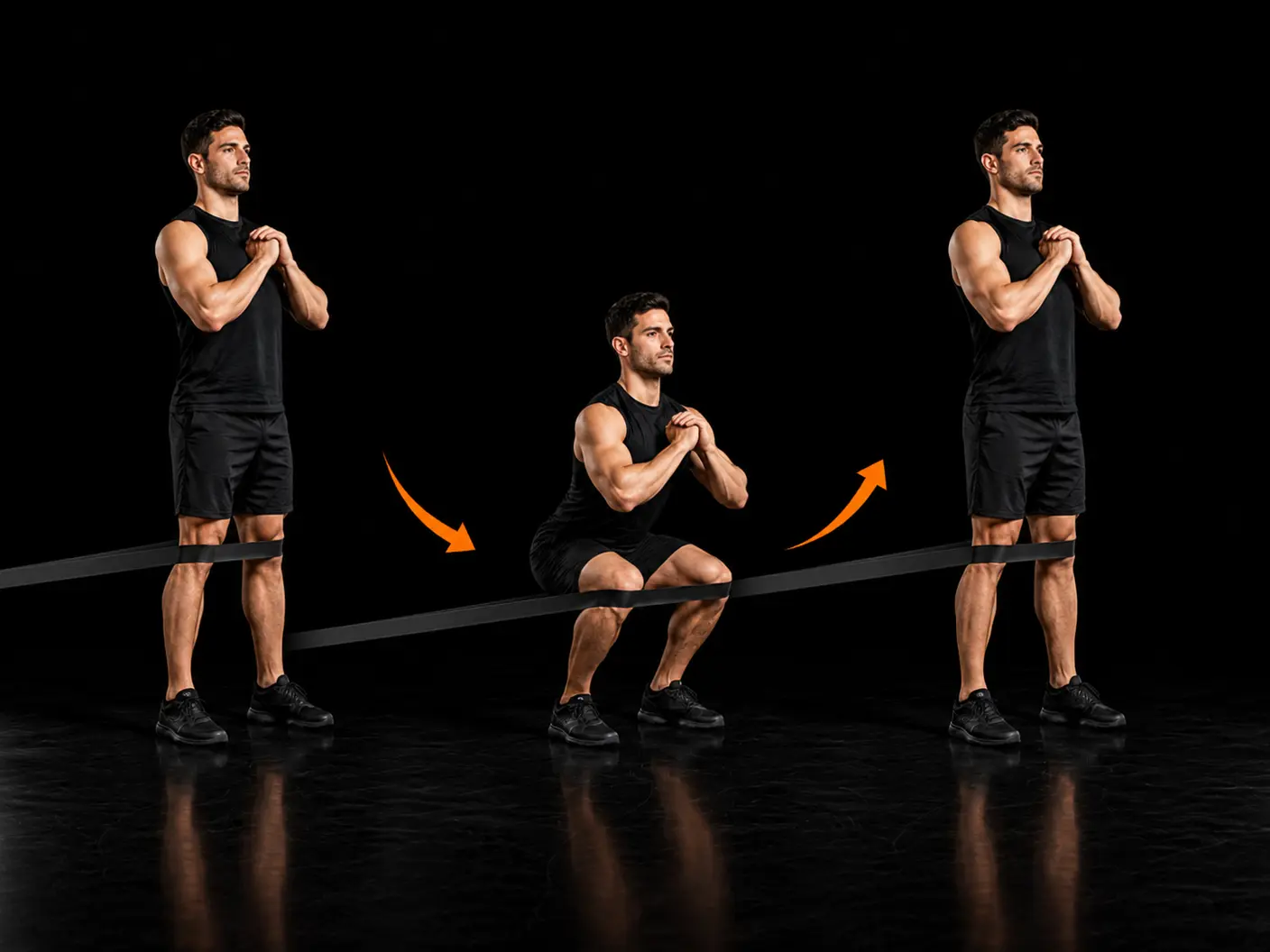
The Spanish squat is a band-assisted compound movement that uses a resistance band anchored to a rig to hold the knees back, allowing the torso to remain upright throughout the descent. This positional constraint places exceptional demand on the quadriceps while reducing the shear forces typically associated with forward shin travel. It suits intermediate trainees looking to develop quad hypertrophy, refine squat mechanics, or load the lower body with minimal spinal compression.
How to do it
Loop a heavy band around a rig at mid-thigh height and step into it, band behind the knees. Walk back until the band is taut. Feet shoulder-width. Sit straight down — the band pulls the knees back, allowing a vertical torso. Descend to ~90° knee flexion and drive up. Keep the shins near vertical.
Coaching cues
- Sit straight down
- Vertical torso
- Knees behind band
- Mid-foot drive
Why train it
- The band-enforced upright torso shifts the load strongly onto the quadriceps, making it an efficient choice for targeted quad hypertrophy within a lower-body programme.
- Because the band counterbalances the lifter rather than a barbell loading the spine, it offers a useful way to accumulate quad volume without significant axial loading.
- The movement reinforces vertical shin and torso positioning, which can improve movement quality that carries over to conventional squat variations.
- Requiring only a resistance band and a rig, it is straightforward to set up and adjust, making it practical within a busy training environment.
Common mistakes
- Leaning forward at the torso — resist the urge to hinge at the hip and instead sit straight down, letting the band support your balance throughout the descent.
- Allowing the knees to drift in front of the band — keep the shins near vertical and maintain contact pressure between the band and the back of the knees to preserve the intended loading pattern.
- Using a band that is too light — select a heavy band that provides meaningful resistance against the knees, as an insufficiently taut band undermines the upright torso position the exercise depends on.
- Rising onto the toes during the descent — drive through the mid-foot and keep the heels grounded to maintain stability and ensure the quadriceps remain the primary working muscle.
Primary: Quadriceps.
Secondary: Gluteus Maximus, Rectus Abdominis.
Equipment
Good for
Easier variation
Bodyweight wall-sit — same isometric quad demand with less depth and no band setup.
Similar movements
Frequently asked
- What muscles does the Spanish squat work?
- The primary muscle worked is the quadriceps. The glutes and core contribute as secondary muscles to stabilise the pelvis and maintain the upright position throughout the movement.
- How many sets and reps should I do for the Spanish squat?
- For hypertrophy, three to four sets of eight to fifteen repetitions with controlled tempo works well. For general fitness, three sets of ten to twelve is a practical starting point, with progression achieved by increasing band tension or slowing the eccentric phase.
- What is the difference between a Spanish squat and a regular squat?
- In a conventional squat the lifter must balance their own centre of mass, which typically involves some forward lean and shin travel. The Spanish squat uses a band anchored to a rig to pull the knees back, allowing a vertical torso and near-vertical shins without the lifter needing to counterbalance a load behind them.
- Is the Spanish squat suitable for beginners?
- It is classified as an intermediate movement because the band setup and positional demands require a degree of body awareness to execute correctly. Beginners would benefit from establishing sound goblet squat and box squat mechanics first before progressing to this variation.
- What can I use as an alternative to the Spanish squat?
- If a rig and band are unavailable, a goblet squat held with a counterbalance or a heel-elevated squat can similarly encourage an upright torso and quad-dominant loading, though neither replicates the exact constraint the band provides.
Want this movement in a plan built for you?
Adaptiv programmes the right exercises for your goal, equipment and experience — then adapts them as you train.
Build my programme