Leg Extension
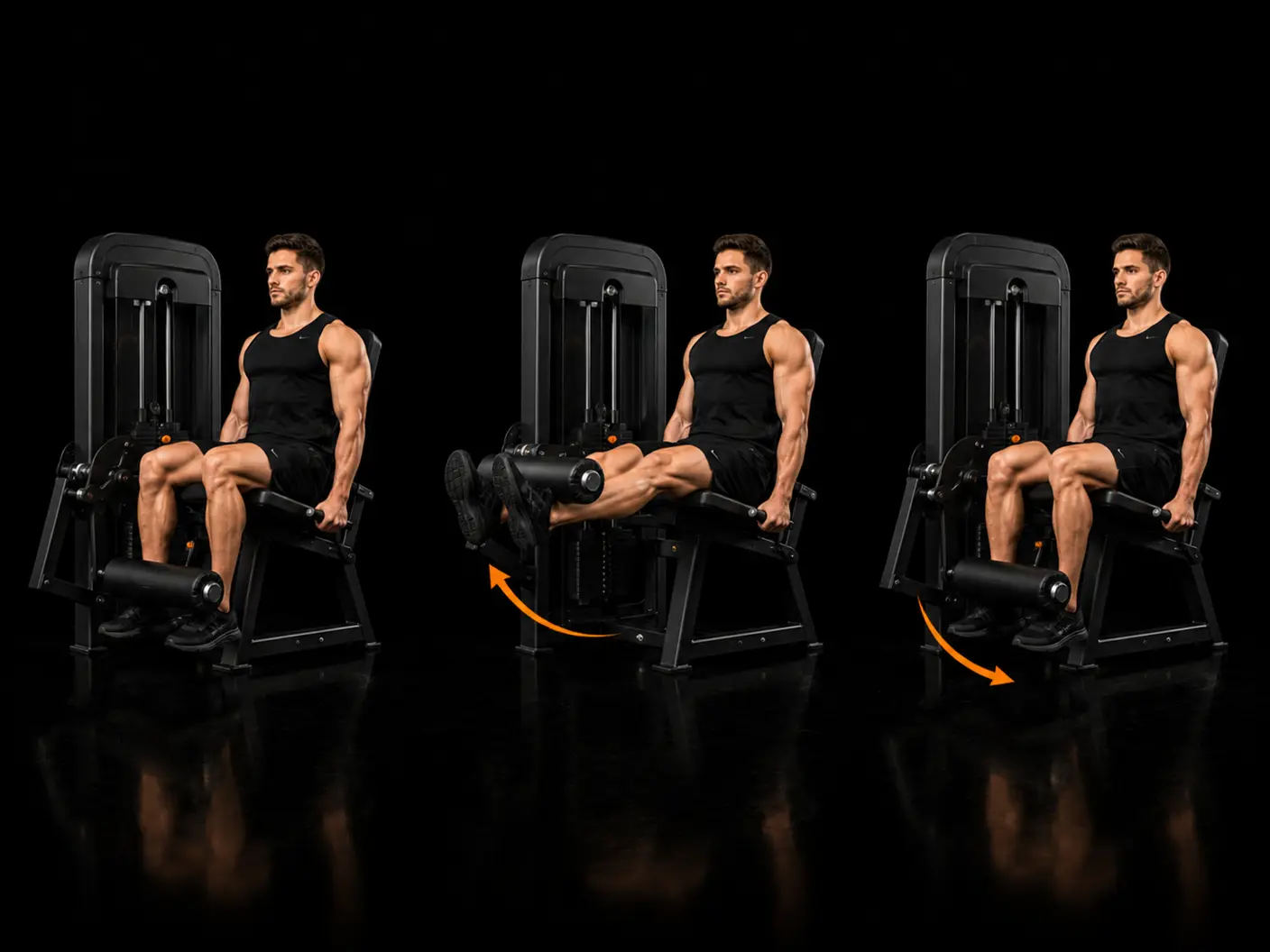
The leg extension is a machine-based isolation exercise that targets the quadriceps through knee extension alone, removing the hip and posterior chain involvement found in compound lower-body movements. Performed on a dedicated leg extension machine, it allows precise loading of all four quadriceps heads across their functional range. It suits a broad population — from those building foundational quad mass to individuals reintroducing knee extension work in a rehabilitation context.
How to do it
Sit in the machine with the back flat against the pad. Adjust the seat so the knee joint aligns with the machine's pivot. Set the ankle pad just above the ankle joint. Grip the handles. Extend the knees to raise the weight until the legs are nearly straight. Pause briefly. Lower under control with a 2–3 second eccentric — do not let the stack slam.
Coaching cues
- Full extension
- Pause at the top
- Slow eccentric
- Knee aligns with pivot
Why train it
- It isolates all four heads of the quadriceps directly, making it a reliable tool for targeted hypertrophy when compound movements alone leave volume gaps.
- The machine-guided path removes balance demands, allowing full attentional focus on muscular contraction and controlled tempo.
- A slow, deliberate eccentric phase accumulates meaningful time under tension in the quadriceps without loading the spine or requiring significant technical skill.
- It fits naturally into both general fitness programmes and structured rehabilitation protocols where controlled, isolated knee extension is the specific goal.
Common mistakes
- Failing to align the knee with the machine's pivot point — adjust the seat depth until the knee joint sits directly in line with the axis of rotation before loading.
- Using momentum to swing the weight up — initiate each repetition with a deliberate muscular contraction and keep the movement smooth throughout the full range.
- Skipping the pause at the top — hold the fully extended position briefly to maximise quad activation before beginning the eccentric phase.
- Allowing the weight stack to drop on the descent — control the lowering phase over 2–3 seconds to maintain tension and avoid impact stress through the joint.
Primary: Quadriceps.
Equipment
Good for
Easier variation
Seated terminal knee extension with a band — lighter, joint-friendly alternative.
Similar movements
Frequently asked
- What muscles does the leg extension work?
- The leg extension works the quadriceps exclusively — specifically the rectus femoris, vastus lateralis, vastus medialis, and vastus intermedius. No significant secondary musculature is recruited, which is precisely what makes it useful as an isolation movement.
- How many sets and reps should I do for the leg extension?
- For hypertrophy, 3–4 sets of 10–15 repetitions with a controlled tempo works well for most trainees. Prioritise a full range of motion, a brief pause at peak extension, and a 2–3 second eccentric over simply moving as much weight as possible.
- Is the leg extension suitable for rehabilitation?
- It is commonly used in rehabilitation settings to reintroduce isolated quadriceps loading, but the appropriate range of motion, load, and progression depend on the individual's specific circumstances. If you are returning from a knee injury or surgery, consult a qualified physiotherapist or sports medicine professional before including it in your programme.
- What is a good alternative to the leg extension if I don't have access to the machine?
- Without a leg extension machine, terminal knee extensions using a resistance band offer a similar isolated knee extension stimulus and can be performed almost anywhere. Sissy squats and Spanish squats also emphasise the quadriceps in a knee-dominant pattern, though they involve more of the body than true machine-based isolation.
- Should I use the leg extension as a primary or accessory exercise?
- Given its isolation nature and single-joint pattern, the leg extension is best programmed as an accessory movement after compound lower-body work such as squats or leg press. It is well suited to adding direct quad volume at the end of a session without significantly increasing systemic fatigue.
Want this movement in a plan built for you?
Adaptiv programmes the right exercises for your goal, equipment and experience — then adapts them as you train.
Build my programme