Bodyweight Squat Hold
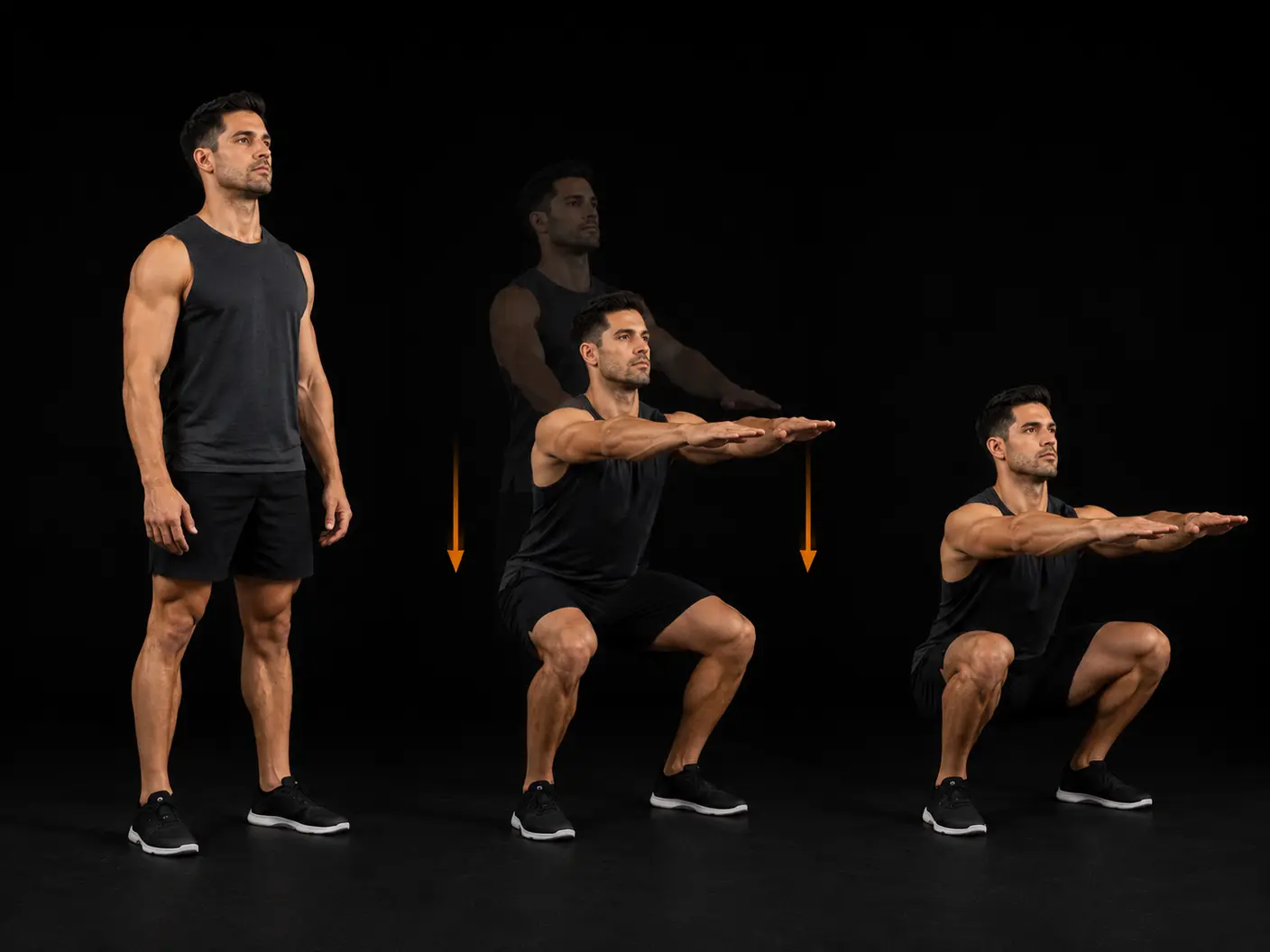
The bodyweight squat hold is a static variation of the squat pattern in which you lower to parallel or below and sustain that position for a set duration without external support. It trains positional strength and joint awareness across the hips, knees, and ankles simultaneously, making it a reliable diagnostic and developmental tool. It suits beginners building squat mechanics, as well as more experienced trainees using it for active recovery, mobility work, or postural reinforcement.
How to do it
Assume a shoulder-width squat stance, toes slightly out. Descend into a parallel or below-parallel squat. Hold this position without external support. Keep the chest tall, knees tracking over the toes, weight through the mid-foot. Breathe steadily and maintain the position for time.
Coaching cues
- Chest tall
- Knees out
- Weight through mid-foot
- Breathe steadily
Why train it
- Develops positional strength and body awareness at the bottom of the squat, reinforcing the mechanics that carry over to all loaded squat variations.
- Challenges the quadriceps and glutes under sustained time under tension without the need for any equipment.
- Trains steady breathing under mild physical stress, which supports bracing habits useful in more demanding compound lifts.
- Provides a low-impact way to assess and improve ankle, knee, and hip mobility within a functional range of motion.
Common mistakes
- Heels rising off the floor — shift your weight back towards the mid-foot and consider elevating your heels temporarily if ankle mobility is a limiting factor.
- Chest collapsing forward — keep your sternum tall and your gaze level throughout the hold rather than allowing the torso to round towards the thighs.
- Knees caving inward — actively drive the knees out in line with the toes for the entire duration of the hold, not just at the point of descent.
- Holding the breath — breathe steadily and rhythmically throughout, as breath-holding increases unnecessary tension and reduces how long the position can be maintained.
Primary: Quadriceps, Gluteus Maximus.
Secondary: Hamstrings, Rectus Abdominis, Gastrocnemius.
Equipment
Good for
Easier variation
Box squat — use a box as a depth marker and landing surface.
Similar movements
Frequently asked
- What muscles does the bodyweight squat hold work?
- The primary muscles loaded are the quadriceps and glutes, which work isometrically to maintain the position. The hamstrings, calves, and core contribute as secondary stabilisers throughout the hold.
- How long should I hold a bodyweight squat?
- For beginners, 20 to 30 seconds is a practical starting point. As positional strength and mobility improve, durations of 60 seconds or more become a reasonable progression target.
- How do I programme the bodyweight squat hold?
- Two to four sets of 20 to 60 seconds fits well within a warm-up, mobility block, or active recovery session. It can also be used at the start of a leg session to reinforce mechanics before adding load.
- Is the bodyweight squat hold suitable if I struggle with standard squats?
- Yes — the static nature removes the complexity of the descent and ascent, allowing you to focus entirely on position. It is particularly useful for identifying which part of the squat pattern needs attention, such as ankle mobility or knee tracking.
- What are good alternatives to the bodyweight squat hold?
- The goblet squat hold adds a counterbalance that can make the bottom position easier to maintain, while a box squat hold uses a surface to set depth consistently. If mobility is the primary goal, a supported squat hold using a doorframe or rack allows you to work into the position with less muscular demand.
Want this movement in a plan built for you?
Adaptiv programmes the right exercises for your goal, equipment and experience — then adapts them as you train.
Build my programme