Vertical Jump
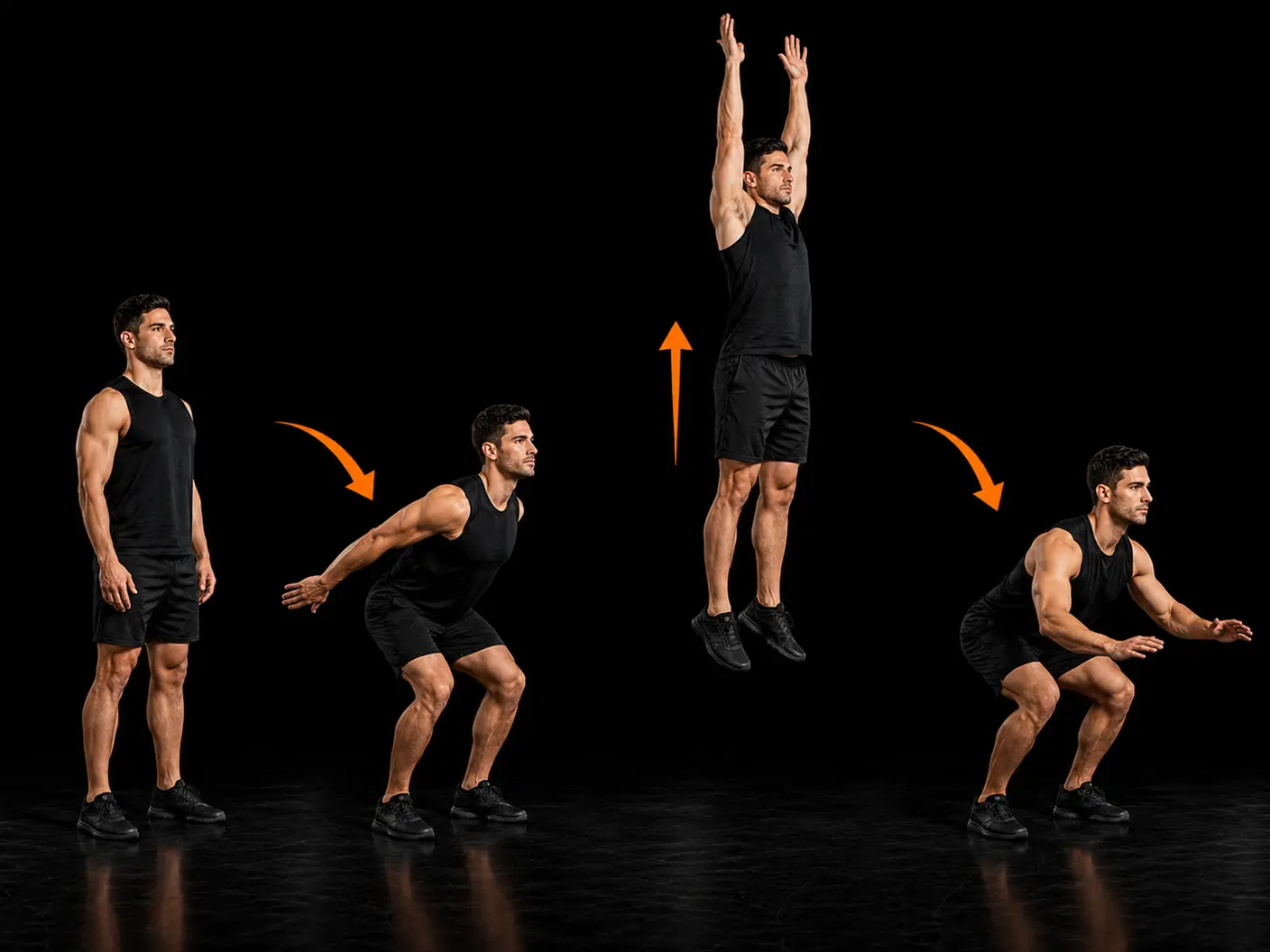
The vertical jump is a bodyweight plyometric exercise that trains explosive triple extension — the simultaneous powerful drive through the ankles, knees, and hips. It develops the rate of force development and elastic strength that underpin most athletic movements, from sprinting to change of direction. It suits intermediate trainees who have a solid foundation in lower-body strength and landing mechanics.
How to do it
Stand with feet shoulder-width. Swing the arms back and dip into a quarter-squat. Explosively jump vertically as high as possible by extending the ankles, knees, and hips simultaneously (triple extension). Arms swing overhead to assist. Land softly on both feet in a quarter-squat, absorbing the impact through the hips and knees.
Coaching cues
- Triple extension
- Arms drive up
- Maximum effort
- Soft landing
Why train it
- Develops explosive power in the glutes, quadriceps, hamstrings, and calves by demanding maximum neuromuscular output in a short timeframe.
- Trains triple extension mechanics that transfer directly to athletic activities such as sprinting, jumping sports, and court-based movements.
- Challenges the core and hip flexors as stabilising structures throughout the take-off and flight phases, reinforcing full-body coordination.
- Requires no equipment, making it a practical power-training option that can be programmed into warm-ups, conditioning blocks, or athletic performance sessions.
Common mistakes
- Skipping the arm swing — initiate the movement by swinging the arms back during the dip, then drive them forcefully overhead at take-off to maximise vertical displacement.
- Landing stiff-legged — absorb impact by receiving the ground in a soft quarter-squat, allowing the hips and knees to decelerate the body rather than the joints taking a rigid load.
- Using a shallow or rushed countermovement — take a deliberate dip into the quarter-squat to load the posterior chain and make full use of the stretch-shortening cycle.
- Neglecting full triple extension — ensure the ankles, knees, and hips all reach full extension at the peak of take-off rather than leaving the heels down or the hips only partially open.
Primary: Gluteus Maximus, Quadriceps, Hamstrings, Gastrocnemius.
Secondary: Rectus Abdominis, Hip Flexors.
Equipment
Good for
Easier variation
Squat jump — lower intent, same pattern at reduced height.
Similar movements
Frequently asked
- What muscles does the vertical jump work?
- The primary muscles are the glutes, quadriceps, hamstrings, and calves, which drive triple extension at take-off. The core and hip flexors work as secondary contributors, stabilising the torso and coordinating the limbs throughout the movement.
- How many sets and reps should I do for vertical jumps?
- For power development, three to five sets of three to six maximal-effort jumps with full recovery between sets is a common approach. Because each repetition should be performed at maximum intent, keeping volumes low preserves quality and reduces the risk of fatigue degrading mechanics.
- Is the vertical jump suitable for building muscle?
- The vertical jump is primarily programmed for athletic performance and power development rather than hypertrophy. While it does load the lower-body musculature, those looking to build muscle mass will typically find resistance-based exercises more effective for that goal.
- What are good alternatives to the vertical jump?
- Box jumps, broad jumps, and jump squats are closely related plyometric alternatives that share the triple-extension pattern. If impact on landing is a concern, trap bar deadlifts and power cleans can develop similar explosive qualities with a different force profile — though a qualified professional should advise on any specific physical considerations.
- How do I know if I am ready for vertical jumps?
- A useful benchmark is the ability to perform a controlled bodyweight squat to at least a quarter-squat depth with good alignment, and to land a step-down from a low height softly and under control. If landing mechanics feel unstable or the lower body lacks basic strength, consolidating those qualities first will make plyometric training both safer and more productive.
Want this movement in a plan built for you?
Adaptiv programmes the right exercises for your goal, equipment and experience — then adapts them as you train.
Build my programme