Squat Jump
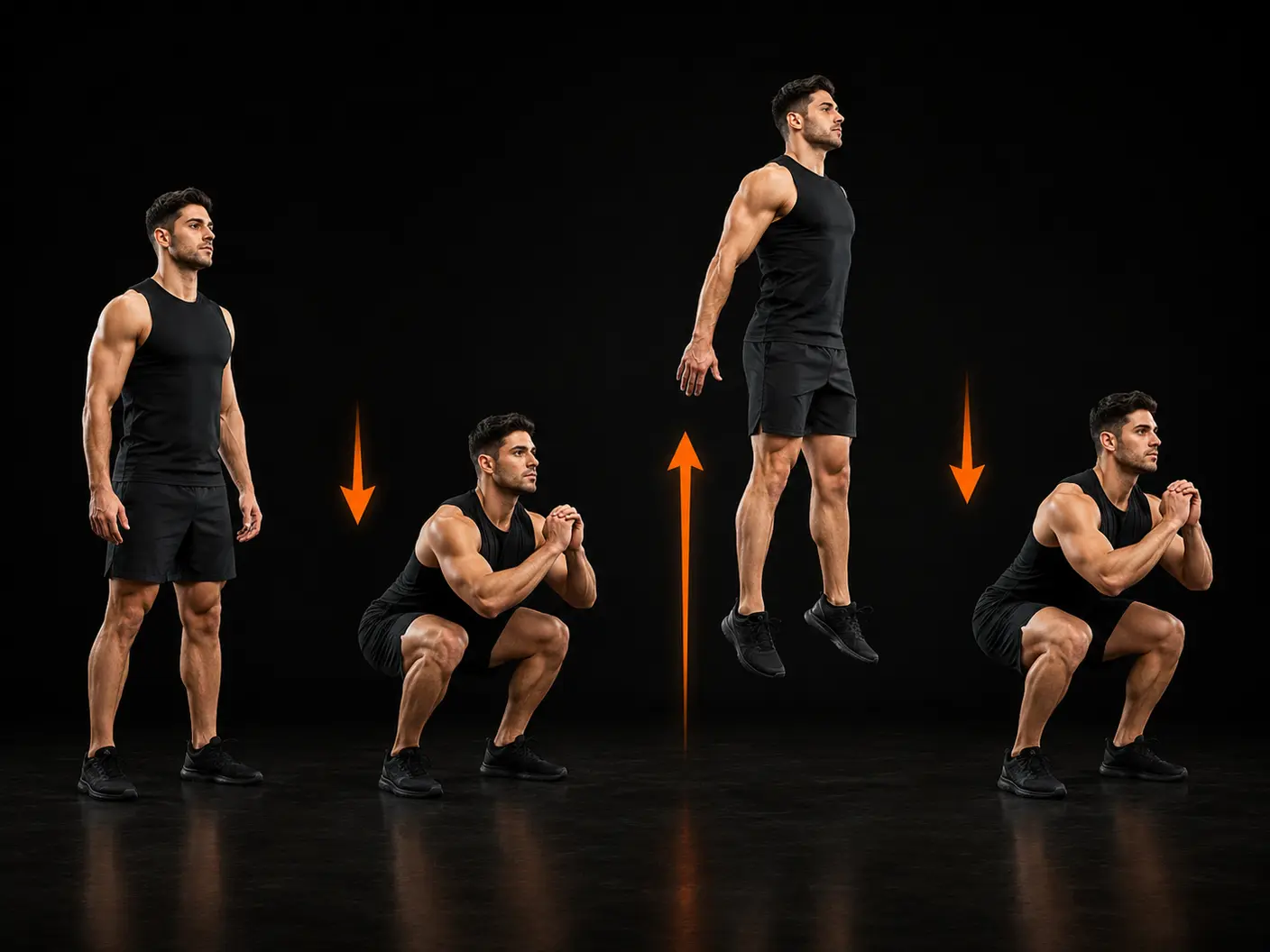
The squat jump is a bodyweight plyometric exercise that trains explosive lower-body power through rapid triple extension of the hips, knees, and ankles. It bridges the gap between strength and athleticism, demanding that force be produced quickly rather than simply in large quantities. It suits intermediate trainees who have a solid foundation in basic squatting mechanics and are looking to develop speed-strength or improve body composition.
How to do it
Stand feet shoulder-width. Drop into a quarter-squat with the arms back. Explosively extend hips, knees, and ankles while swinging the arms up; jump straight up. Land softly in a quarter-squat and immediately repeat.
Coaching cues
- Arms drive through
- Triple extension
- Soft landing
- Repeated effort
Why train it
- Triple extension across the hips, knees, and ankles develops the explosive power that underpins sprinting, jumping, and change-of-direction ability in sport.
- The high muscular demand and elevated heart rate response make squat jumps an efficient tool for energy expenditure when programmed into circuits or interval-based sessions.
- Repeated landing and take-off cycles train the stretch-shortening cycle, improving the rate at which the lower body can absorb and redirect force.
- Because no equipment is required, squat jumps can be programmed consistently regardless of training environment or available kit.
Common mistakes
- Cutting the jump short by barely leaving the floor — commit to full hip, knee, and ankle extension on every rep to realise the power stimulus the exercise is designed to deliver.
- Neglecting the arm swing — the arms should drive back during the quarter-squat and swing upward explosively at take-off, contributing meaningfully to jump height and rhythm.
- Landing with stiff, straight legs — absorb each landing by settling into a controlled quarter-squat to manage impact forces and prepare immediately for the next rep.
- Allowing the torso to collapse forward on landing — keep the chest up and the core braced throughout to maintain alignment and protect the lower back.
Primary: Gluteus Maximus, Quadriceps, Hamstrings, Gastrocnemius.
Secondary: Rectus Abdominis.
Equipment
Good for
Easier variation
Bodyweight squat at speed — no jumping.
Similar movements
Frequently asked
- What muscles do squat jumps work?
- Squat jumps primarily work the glutes, quadriceps, hamstrings, and calves, which collectively drive the triple extension at take-off and absorb force on landing. The core acts as a secondary stabiliser throughout each rep.
- How many sets and reps should I do for squat jumps?
- For athletic power development, 3–5 sets of 5–8 reps with full recovery between sets is a common approach, prioritising quality over volume. For fat loss or conditioning work, higher-rep intervals of 20–40 seconds fit well within circuit formats, though landing mechanics should remain controlled.
- Are squat jumps suitable for beginners?
- Squat jumps are rated as intermediate difficulty, so a reasonable foundation in bodyweight squatting and basic landing mechanics is advisable before adding the explosive component. Beginners would benefit from developing consistent squat form and single-leg stability before progressing to repeated plyometric effort.
- What are good alternatives to the squat jump?
- If you want a lower-impact alternative that still trains the glutes, quads, hamstrings, and calves in a compound pattern, standard bodyweight squats or step-ups reduce the plyometric demand while maintaining the movement pattern. Box jumps are a logical progression if you want to increase the power challenge.
- Can squat jumps help with fat loss?
- Squat jumps are listed as a primary tool for fat loss goals because they engage large muscle groups simultaneously and elevate heart rate significantly, making them metabolically demanding relative to their simplicity. They are best used as part of a structured programme rather than in isolation.
Want this movement in a plan built for you?
Adaptiv programmes the right exercises for your goal, equipment and experience — then adapts them as you train.
Build my programme