Box Jump
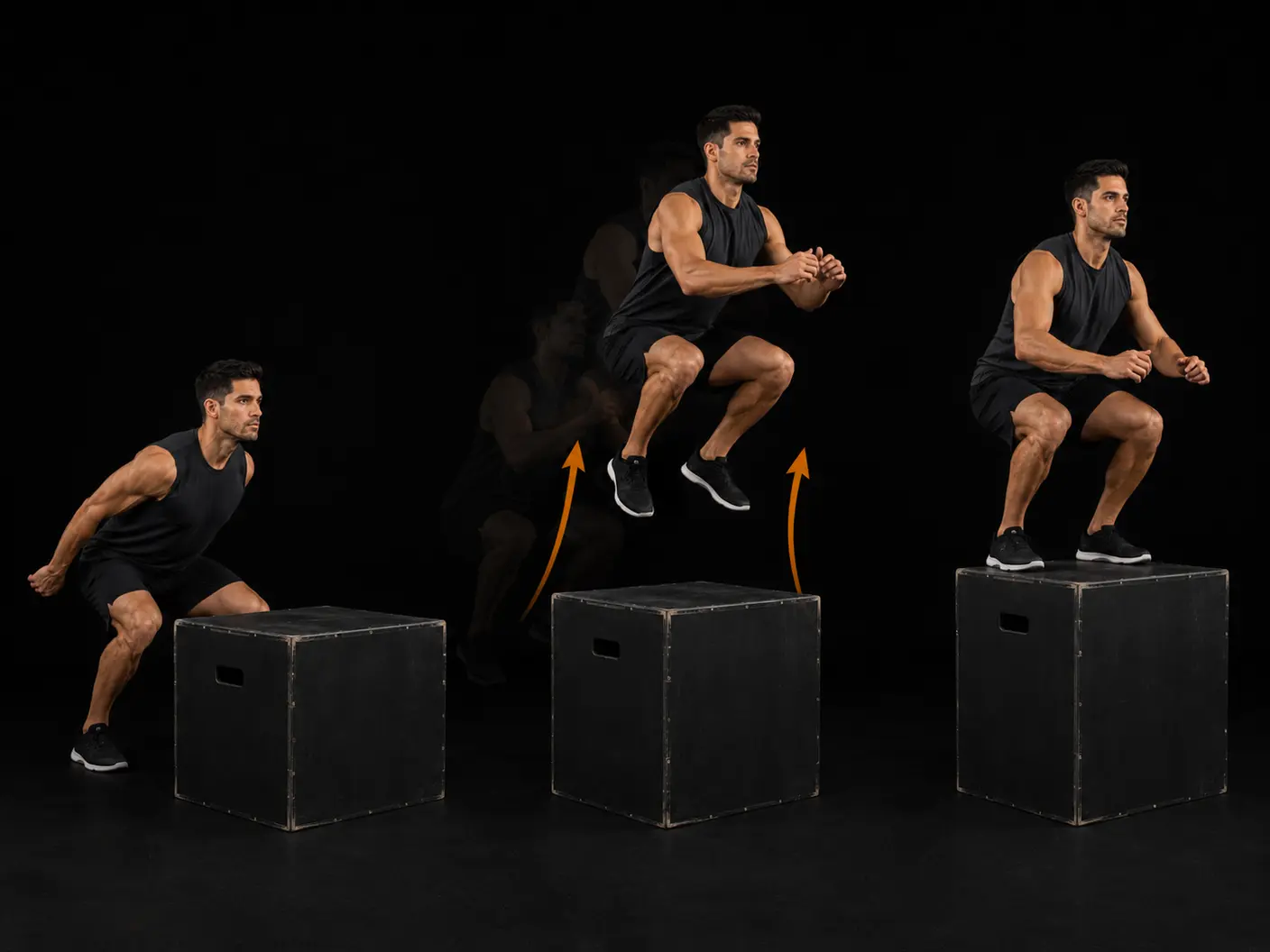
The box jump is a plyometric compound movement that trains explosive power through the lower body, demanding rapid force production and a controlled landing. It follows a jump-land pattern built on triple extension — the simultaneous extension of the ankles, knees, and hips — making it a direct measure of athletic output. It suits intermediate lifters and athletes who have a solid strength base and want to develop speed-strength qualities.
How to do it
Stand 1–2 feet from a box, feet shoulder-width. Swing the arms back, counter-move by dipping the hips. Swing the arms forward and jump vertically onto the box; triple extension. Land softly in a quarter-squat on top of the box with hips back. Step down — never jump down.
Coaching cues
- Jump up, step down
- Soft landing
- Triple extension
- Arms swing into it
Why train it
- Develops lower-body explosive power by training the glutes, quads, hamstrings, and calves to produce maximal force in a short ground-contact time.
- The triple-extension demand transfers directly to athletic skills such as sprinting, jumping, and change of direction, making it a staple in sport-specific conditioning programmes.
- The ballistic nature of the movement elevates heart rate quickly, which supports caloric expenditure and is well-suited to fat-loss-focused conditioning blocks.
- Reinforces a controlled, soft landing pattern that trains deceleration mechanics — a quality as important to performance and joint health as the jump itself.
Common mistakes
- Using arm swing as the primary driver rather than the hips — initiate the counter-movement by loading the hips back and use the arms to complement that force, not replace it.
- Landing with a stiff, upright posture — absorb the landing in a quarter-squat with hips pushed back, distributing force across the hips and knees rather than driving it into the joints.
- Jumping down from the box instead of stepping down — always step down one foot at a time to avoid accumulating unnecessary eccentric impact across a session.
- Choosing a box height that exceeds current ability — select a height that allows a clean, controlled landing in a quarter-squat; pulling the knees excessively high to clear the edge is a clear sign the box is too tall.
Primary: Gluteus Maximus, Quadriceps, Hamstrings, Gastrocnemius.
Secondary: Rectus Abdominis, Hip Flexors.
Equipment
Good for
Easier variation
Lower box height — reduces demand and risk.
Similar movements
Frequently asked
- What muscles do box jumps work?
- Box jumps primarily work the glutes, quadriceps, hamstrings, and calves, which drive the triple extension through the jump and control the landing. The core and hip flexors contribute as secondary stabilisers throughout the movement.
- How many sets and reps should I do for box jumps?
- For power development, 3–5 sets of 3–6 reps is a well-established range, as quality of effort degrades quickly with fatigue on plyometric work. Rest fully between sets — typically 2–3 minutes — so each jump reflects maximal intent rather than accumulated tiredness.
- What box height should a beginner start with?
- Start with a height that allows you to land cleanly in a quarter-squat with hips back and feet flat — for most people this is between 40 cm and 50 cm. The governing factor is landing quality, not the height itself.
- Can box jumps help with fat loss?
- Box jumps can contribute to a fat-loss programme because their high-intensity, full-body demand elevates heart rate and energy expenditure efficiently. They are most effective in this context when incorporated into structured conditioning blocks rather than used in isolation.
- What is a good alternative to box jumps if I do not have a plyometric box?
- Broad jumps or vertical jumps onto a soft surface train the same triple-extension pattern and explosive intent without requiring a box. If the goal is power development, ensure you still practise a controlled, soft landing regardless of the variation you choose.
Want this movement in a plan built for you?
Adaptiv programmes the right exercises for your goal, equipment and experience — then adapts them as you train.
Build my programme