Depth Jump
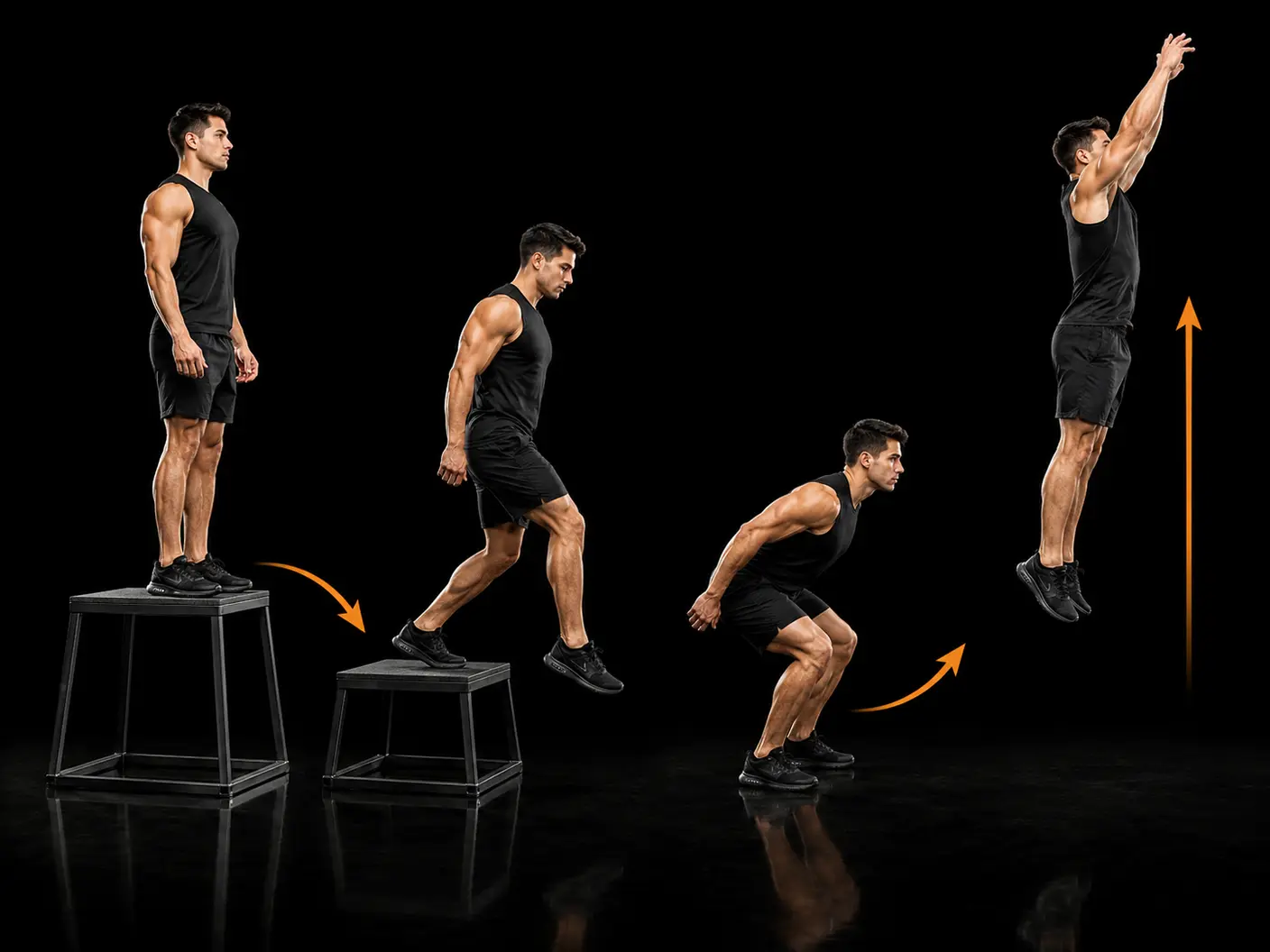
The depth jump is an advanced plyometric exercise in which the athlete steps off a raised box and immediately converts the landing force into a maximal vertical jump, training the stretch-shortening cycle under significant load. It is classified as a compound movement, recruiting the glutes, quads, hamstrings, calves, and Achilles tendon in a rapid, coordinated sequence. It suits experienced athletes who already possess a solid foundation of strength and basic plyometric competence.
How to do it
Stand on a box (12–24 inches). Step off the edge (do not jump off). Land on both feet; immediately on contact, jump vertically as high as possible. Minimise ground contact time. Land softly from the vertical jump.
Coaching cues
- Step off the box
- Minimise contact time
- Explode up
- Soft landing
Why train it
- It develops reactive strength by training the stretch-shortening cycle at high intensity, improving the speed at which the neuromuscular system can absorb and redirect force.
- Minimising ground contact time directly translates to athletic qualities such as sprint acceleration, change of direction, and jump performance.
- The movement places meaningful demand on the Achilles tendon and calf complex, reinforcing the elastic properties that underpin efficient lower-limb mechanics.
- Because it recruits glutes, quads, and hamstrings simultaneously in a high-velocity context, it bridges the gap between maximal strength and sport-specific power expression.
Common mistakes
- Jumping off the box rather than stepping — step calmly off the edge so that the drop itself generates the eccentric load, not a pre-loaded leap.
- Spending too long on the ground — if contact time is prolonged, the elastic energy is dissipated as heat rather than converted into the jump, so focus on reacting the instant the feet touch down.
- Landing with stiff, locked-out legs — allow a brief, controlled flexion through the ankles, knees, and hips to absorb force safely before redirecting it upward.
- Using a box that is too high before the movement pattern is established — start at the lower end of the 12–24 inch range and progress height only when ground contact time is consistently minimal and landing mechanics are clean.
Primary: Gluteus Maximus, Quadriceps, Hamstrings, Gastrocnemius.
Secondary: Rectus Abdominis.
Equipment
Good for
Easier variation
Drop-and-stick — land from the box without the rebound jump.
Similar movements
Frequently asked
- What muscles does the depth jump work?
- The primary muscles are the glutes, quads, hamstrings, calves, and Achilles tendon. The core acts as a secondary stabiliser throughout the landing and take-off phases.
- How many sets and reps should I do for depth jumps?
- Because of the high neuromuscular demand, depth jumps are typically programmed in low volumes — 3–5 sets of 3–6 repetitions is a common starting point. Quality and intent on every rep matters far more than accumulating volume.
- What height box should I use?
- A box between 12 and 24 inches is the standard working range. Begin at the lower end to establish sound mechanics and progress height gradually, as a higher drop does not automatically produce a better training stimulus if ground contact time and landing quality deteriorate.
- Is the depth jump suitable for beginners?
- No — this exercise is classified as advanced. A solid base of lower-body strength and experience with foundational plyometrics such as broad jumps and squat jumps should be in place before attempting depth jumps.
- What are good alternatives if I am not ready for depth jumps yet?
- Box jumps and jump squats are lower-intensity plyometric options that build the strength and coordination needed to progress toward depth jumps. Practising controlled landing mechanics from a step-down before adding the reactive jump component is also a sensible preparatory step.
Want this movement in a plan built for you?
Adaptiv programmes the right exercises for your goal, equipment and experience — then adapts them as you train.
Build my programme