Broad Jump (Standing Long Jump)
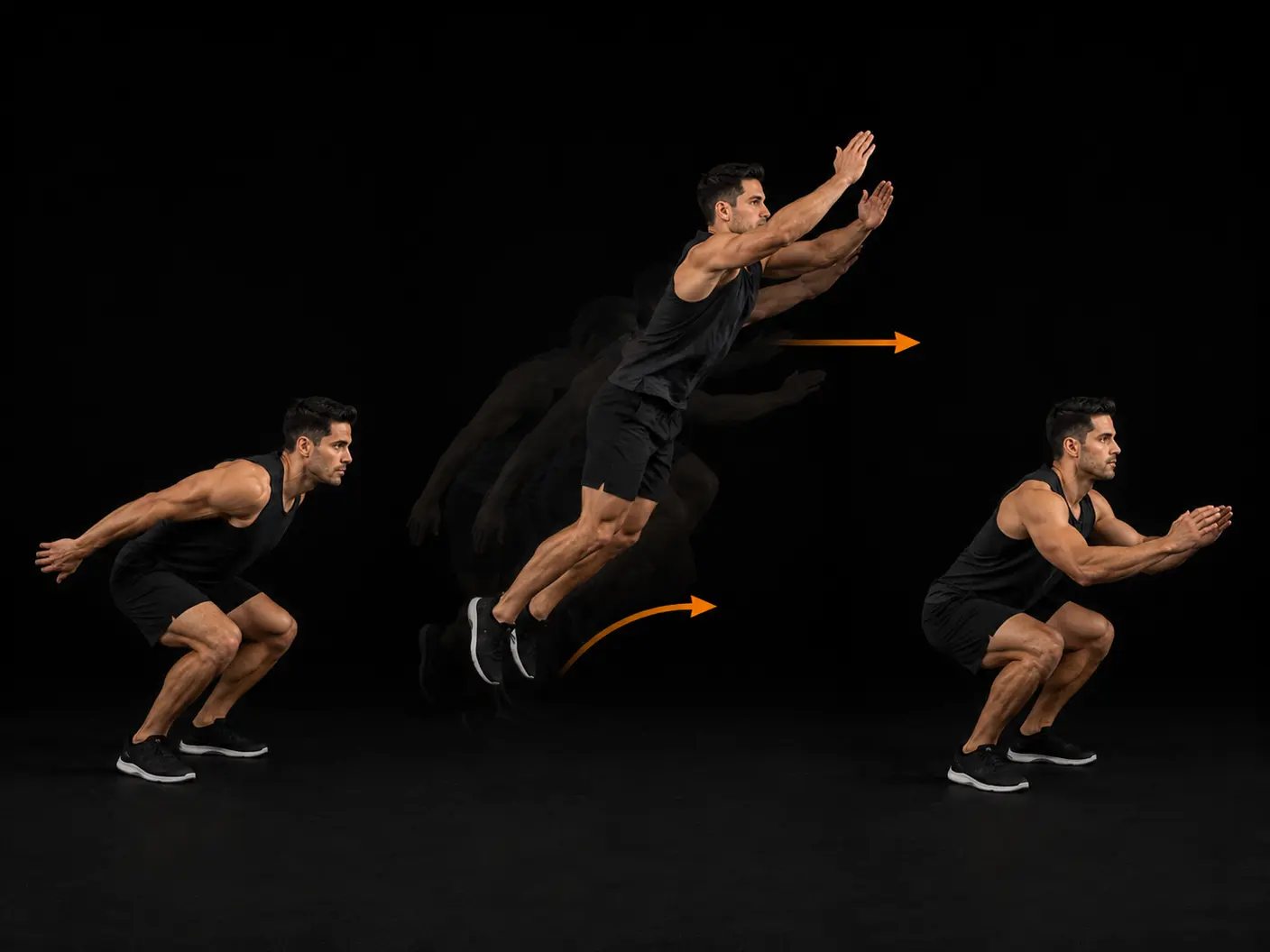
The broad jump, also known as the standing long jump, is a horizontal plyometric exercise that trains explosive power through a full triple extension of the ankles, knees, and hips. It challenges the lower body to generate maximum force in a single effort, while demanding coordinated arm drive and a controlled landing. It suits intermediate athletes looking to develop athletic power, improve rate of force development, or benchmark lower-body explosiveness.
How to do it
Stand with feet shoulder-width. Swing the arms back and dip into a quarter-squat. Explosively jump forward for distance; arms swing through. Land softly on both feet in a quarter-squat. Stick the landing or absorb through a stride.
Coaching cues
- Arms drive through
- Triple extension
- Soft landing
- Stick or absorb
Why train it
- Develops horizontal power through the glutes, quads, hamstrings, and calves working in unison during triple extension, translating directly to sprinting and change-of-direction performance.
- Trains the stretch-shortening cycle by coupling a rapid quarter-squat dip with an explosive concentric drive, improving the speed at which muscles can generate force.
- Requires no equipment beyond open space, making it a practical power training option for warm-ups, field sessions, or home environments.
- The landing phase demands eccentric control and core stability, reinforcing the body's ability to safely absorb ground reaction forces — a key quality in reducing injury risk in sport.
Common mistakes
- Neglecting arm drive — swing the arms back fully during the dip and drive them forward aggressively at take-off to contribute momentum and improve jump distance.
- Cutting triple extension short — ensure the ankles, knees, and hips all reach full extension at take-off rather than leaving the hips low, which bleeds power from the jump.
- Landing stiff-legged — absorb the landing by accepting ground contact in a quarter-squat position, distributing force through the hips, knees, and ankles rather than locking out the joints.
- Losing balance on landing — hold the stuck position for a full second to demonstrate genuine control; an immediate stumble forward indicates the landing mechanics need dedicated attention.
Primary: Gluteus Maximus, Quadriceps, Hamstrings, Gastrocnemius.
Secondary: Rectus Abdominis.
Equipment
Good for
Easier variation
Broad jump for technique only (short distance) — groove the pattern.
Similar movements
Frequently asked
- What muscles does the broad jump work?
- The primary muscles are the glutes, quadriceps, hamstrings, and calves, all of which drive the triple extension at take-off. The core works as a secondary stabiliser throughout the movement, particularly during the landing phase.
- How many sets and reps should I do for broad jumps?
- For power development, 3–5 sets of 3–6 jumps per session is a well-supported approach, with full recovery of 2–3 minutes between sets. Plyometric quality deteriorates quickly with fatigue, so keeping the volume moderate and the rest generous is more productive than chasing high rep counts.
- Where should broad jumps sit in a training session?
- Place them early in the session, after a thorough warm-up but before strength or conditioning work, when the neuromuscular system is fresh. Using them when fatigued compromises both the power output you are training for and the quality of the landing mechanics.
- Is the broad jump suitable for beginners?
- It is classified as intermediate, primarily because effective execution requires an established ability to land and absorb force safely under load. A beginner would benefit from first developing competence in bilateral squatting patterns and basic landing mechanics before progressing to maximal horizontal jumps.
- What are good alternatives to the broad jump if I lack the space?
- The countermovement jump or box jump trains a similar triple-extension power pattern in a vertical plane and requires considerably less floor space. If you are specifically after horizontal power development, bounding or broad jump variations with a reduced effort level can be performed in a shorter runway once technique is established.
Want this movement in a plan built for you?
Adaptiv programmes the right exercises for your goal, equipment and experience — then adapts them as you train.
Build my programme