V-Up
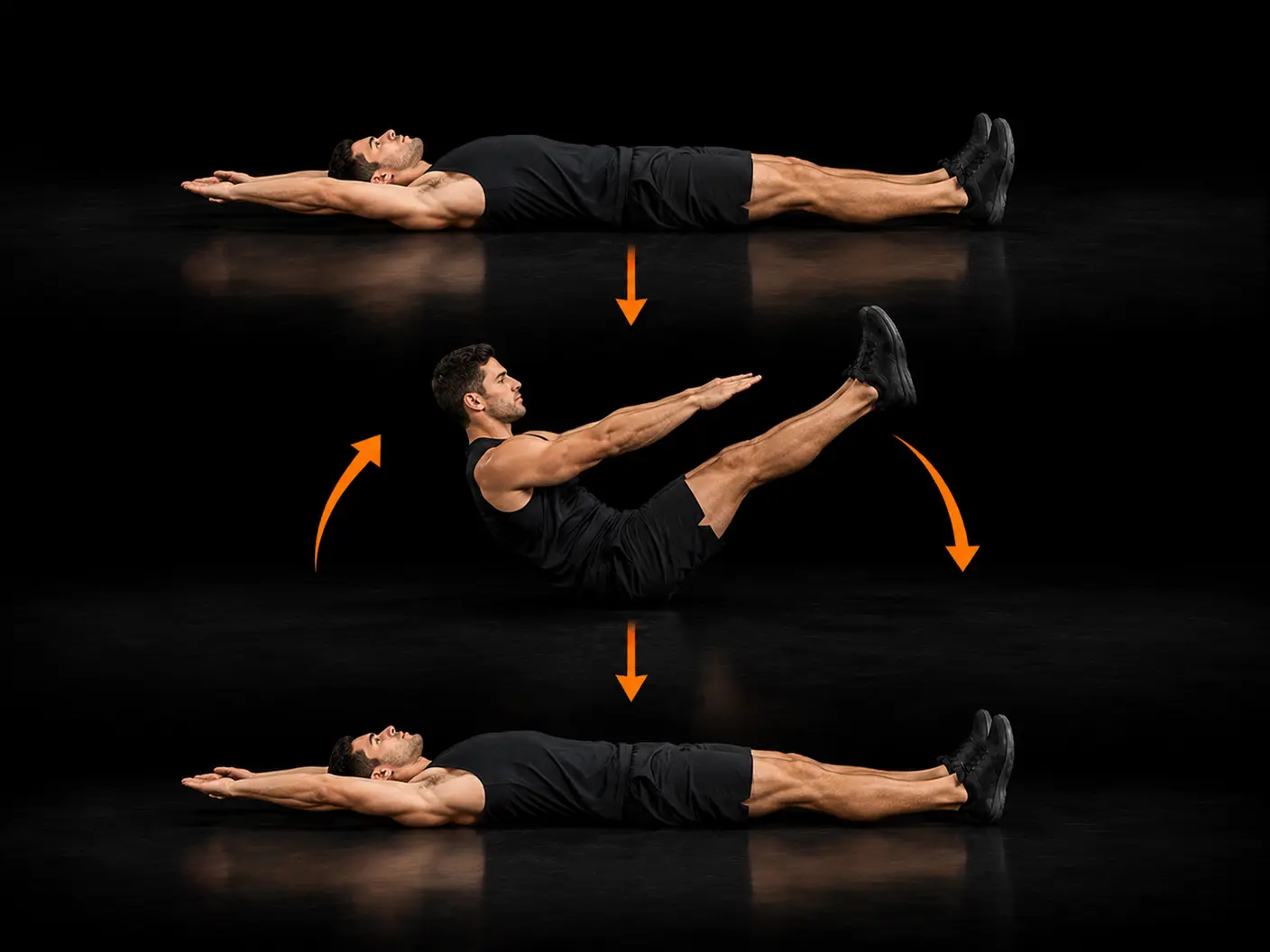
The V-up is a bodyweight core exercise that trains anti-extension by demanding simultaneous elevation of the legs and upper body from a supine position. The movement challenges the rectus abdominis and hip flexors to coordinate a full-range contraction, forming a V shape at the peak of each rep. It suits intermediate trainees who have already built foundational core control and are looking to increase demand on the anterior chain.
How to do it
Lie flat on your back with arms extended overhead and legs straight. Simultaneously lift the legs and upper body, reaching the hands toward the feet to form a V shape. Lower back to the starting position under control — do not let the arms or feet rest on the floor between reps.
Coaching cues
- Lift everything at once
- Reach for the feet
- Keep legs straight
- Control the descent
Why train it
- Training both the upper and lower portions of the rectus abdominis within a single movement makes the V-up an efficient option for core development without any equipment.
- The requirement to synchronise leg and torso elevation develops the coordination between the hip flexors and abdominals that underpins athletic movements such as sprinting and jumping.
- Maintaining straight legs throughout increases the lever arm, placing a greater mechanical demand on the core and quadriceps than bent-knee alternatives.
- Keeping the hands and feet off the floor between reps sustains tension throughout the set, increasing time under load compared with movements that allow a full reset.
Common mistakes
- Lifting the legs and torso at different times — initiate both simultaneously so the body forms a clean V at the top rather than a sequential curl.
- Bending the knees to make the movement easier — keep the legs straight throughout to preserve the lever arm and ensure the intended muscles are being challenged.
- Using momentum to swing into the top position — control the ascent and descent so each rep is driven by muscular effort rather than a rocking action.
- Allowing the arms and feet to rest on the floor at the bottom — hover them just above the surface between reps to maintain tension across the anterior chain.
Primary: Rectus Abdominis, Hip Flexors.
Secondary: Obliques, Quadriceps.
Equipment
Good for
Easier variation
Tuck-up — bend the knees to shorten the lever arm and reduce hip flexor demand.
Similar movements
Frequently asked
- What muscles does the V-up work?
- The primary muscles are the rectus abdominis and hip flexors, which drive the simultaneous elevation of the torso and legs. The obliques assist with trunk control and the quadriceps work to keep the legs extended throughout the movement.
- How many sets and reps should I do for the V-up?
- For general fitness, three sets of ten to fifteen controlled reps works well as part of a core circuit. If athletic performance is the goal, keeping reps in the eight to twelve range with a focus on movement quality and tempo is more productive than chasing higher numbers at the expense of form.
- Is the V-up suitable for beginners?
- The V-up is rated as an intermediate movement, and it requires a solid foundation of core control before attempting it. Beginners would be better served by mastering hollow-body holds or lying leg raises first, progressing to the V-up once they can maintain a neutral spine under load.
- What are good alternatives to the V-up?
- Lying leg raises and hollow-body holds train a similar anti-extension pattern with less coordination demand, making them useful regressions. For a progression, tuck-to-pike variations on a gymnastics ring or hanging leg raises increase the challenge further.
- Can the V-up help with athletic performance?
- The movement develops the anterior chain coordination and hip flexor strength that contribute to running, jumping, and change-of-direction tasks. It is best used as one component within a broader programme rather than a standalone solution for athleticism.
Want this movement in a plan built for you?
Adaptiv programmes the right exercises for your goal, equipment and experience — then adapts them as you train.
Build my programme