Tuck Jump
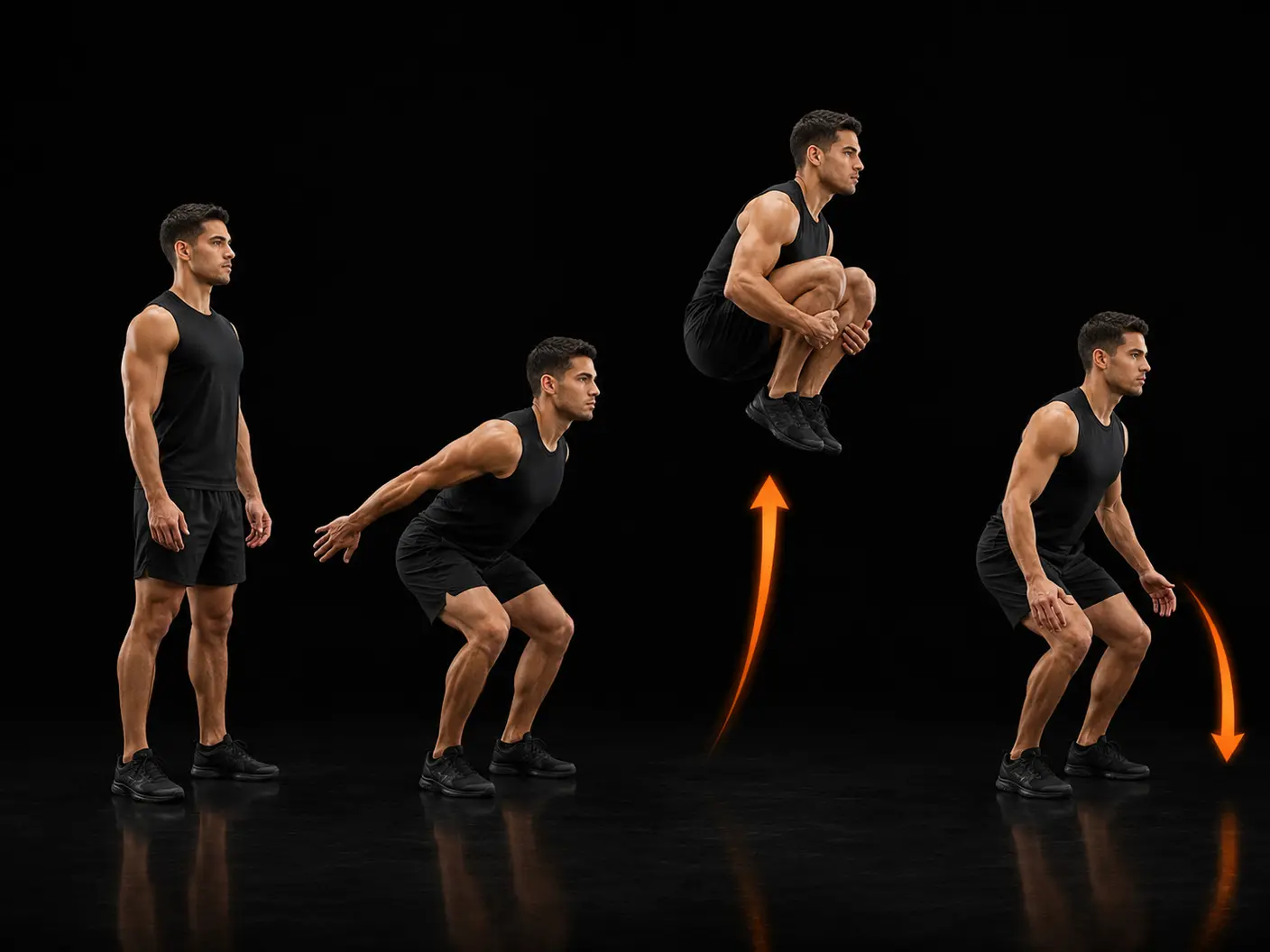
The tuck jump is a bodyweight plyometric exercise that trains explosive lower-body power through a rapid stretch-shortening cycle. From a shallow quarter-squat dip, the athlete drives vertically and tucks the knees toward the chest at the top of the flight phase before landing and repeating. It suits intermediate trainees with a solid foundation in landing mechanics who are looking to develop athletic power or improve lower-body reactivity.
How to do it
Stand feet shoulder-width. Dip into a quarter-squat and jump vertically, tucking the knees toward the chest at peak. Land softly and immediately jump again. Maintain quality — this is a power exercise, not conditioning.
Coaching cues
- Tuck the knees high
- Soft landing
- Fast contact
- Quality over reps
Why train it
- Develops explosive quad and calf drive by demanding maximal vertical force production within a very short ground-contact window.
- The knee tuck at peak height actively challenges the hip flexors under a dynamic load, reinforcing their role in athletic movement patterns.
- Repeated jump-land-jump cycles elevate metabolic demand, making the tuck jump an efficient inclusion in fat-loss or conditioning circuits when quality is maintained.
- Because no equipment is required, the movement can be programmed anywhere and loaded progressively by managing rest intervals, rep quality, and volume.
Common mistakes
- Letting the chest drop on the tuck — keep the torso upright so the knees travel toward the chest, not the chest toward the knees.
- Landing with straight, stiff legs — absorb each landing through the ankles, knees, and hips to protect the joints and set up the next jump efficiently.
- Prioritising volume over quality — this is a power exercise, so reduce reps or extend rest as soon as ground contact slows or the tuck height drops.
- Using a deep squat dip before take-off — a quarter-squat is sufficient; a deeper countermovement wastes time and shifts the emphasis away from reactive power.
Primary: Quadriceps, Hip Flexors, Gastrocnemius.
Secondary: Rectus Abdominis, Gluteus Maximus.
Equipment
Good for
Easier variation
Squat jump without the tuck.
Similar movements
Frequently asked
- What muscles does the tuck jump work?
- The primary muscles are the quadriceps, hip flexors, and calves, which drive the jump and pull the knees up during flight. The glutes and core work secondarily to stabilise the hips and maintain posture through each rep.
- How many sets and reps should I do for tuck jumps?
- For power development, two to four sets of five to eight high-quality reps with 90–120 seconds of rest between sets is a practical starting point. Because this is a power exercise rather than a conditioning drill, stop a set the moment height or mechanics deteriorate rather than chasing a rep target.
- Are tuck jumps suitable for fat loss?
- Yes, when programmed within a circuit or as a finisher, the high metabolic cost of repeated explosive efforts makes tuck jumps a useful tool alongside a calorie-appropriate diet. They are more effective for fat loss when combined with broader programme structure than when used in isolation.
- What are good alternatives to the tuck jump?
- If the tuck jump is too demanding, squat jumps remove the knee-tuck requirement and allow you to build vertical power first. Box jumps are another intermediate option that reduces the landing impact by stepping down rather than absorbing the descent in place.
- Do I need any equipment for tuck jumps?
- No — tuck jumps require only bodyweight and enough overhead clearance to jump freely. A sprung floor or exercise mat is worth using if available, as it provides a more forgiving surface for the repeated landings.
Want this movement in a plan built for you?
Adaptiv programmes the right exercises for your goal, equipment and experience — then adapts them as you train.
Build my programme