Triceps Kickback
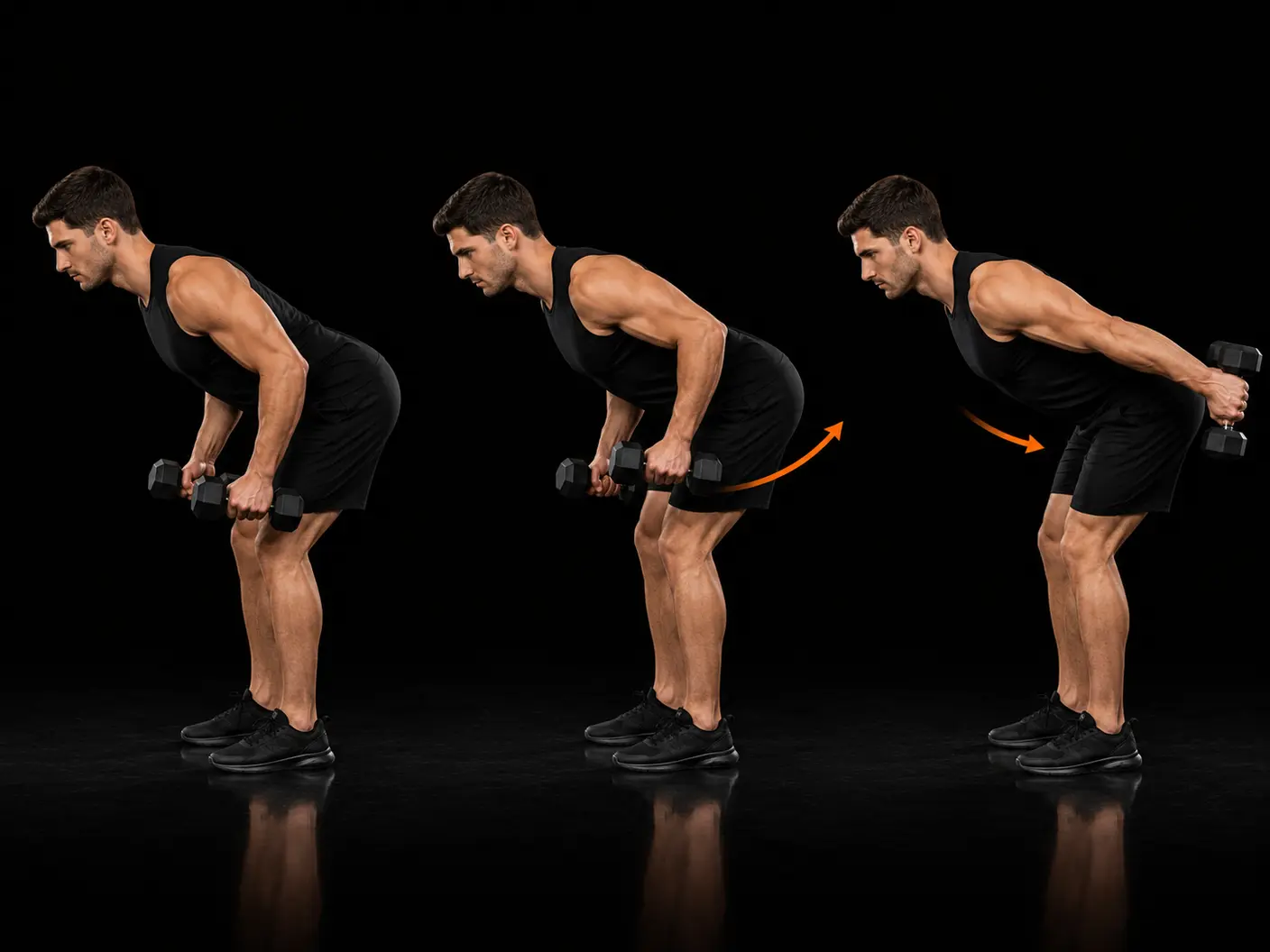
The triceps kickback is a single-joint isolation exercise that targets the triceps brachii through elbow extension, performed in a hinged position with the upper arm pinned parallel to the torso. It is well suited to hypertrophy-focused training where direct triceps volume is the priority, and its low load requirement makes it accessible to a wide range of trainees. Cables and dumbbells both work effectively, with cables offering more consistent tension through the range of motion.
How to do it
Hinge at the hips, flat back. Upper arm parallel to the torso, elbow at 90°. Extend the forearm back to lockout; upper arm stays glued to the torso. Pause; squeeze. Return under control.
Coaching cues
- Upper arm stays glued
- Full lockout
- Slow eccentric
- Strict form
Why train it
- Isolates the triceps brachii with minimal involvement from larger muscle groups, making it efficient for accumulating direct arm volume.
- The lateral head receives focused stimulus at full lockout, which is difficult to replicate with compound pressing movements alone.
- A slow, controlled eccentric phase — easy to enforce here given the light loads used — promotes mechanical tension and muscle damage, both relevant drivers of hypertrophy.
- Its low technical demand makes it a practical option early in a training career or as a finishing movement at the end of an upper-body session.
Common mistakes
- Letting the upper arm drift away from the torso — keep it pinned parallel to the body throughout so the triceps, not momentum, do the work.
- Swinging the forearm rather than extending it — use a weight you can control fully, and pause briefly at lockout to confirm the muscle is doing the job.
- Rounding the lower back in the hinged position — establish a flat back and braced torso before the set begins, and hold that position for every rep.
- Rushing the return — allow the forearm to travel back to 90° under control rather than letting gravity drop it, as the eccentric phase contributes meaningfully to the training stimulus.
Primary: Triceps Brachii.
Equipment
Good for
Easier variation
Cable kickback — constant tension through the range.
Similar movements
Frequently asked
- Which muscles does the triceps kickback work?
- The primary muscle is the triceps brachii, with particular emphasis on the lateral head. The medial head contributes as a secondary mover throughout the extension.
- What sets and reps should I use for the triceps kickback?
- For hypertrophy, three to four sets of ten to fifteen repetitions per arm, with two minutes of rest between sets, is a well-supported approach. Select a load that allows full lockout and a controlled eccentric on every rep without compromising your torso position.
- Dumbbells or cables — which is better for kickbacks?
- Both are valid. Dumbbells are more accessible and straightforward to set up, while cables maintain tension at the top of the movement where dumbbells tend to go slack. If both are available, cables offer a slight mechanical advantage for hypertrophy purposes.
- Are triceps kickbacks suitable for beginners?
- Yes — the movement is rated foundational and requires no complex coordination. The priority is establishing a stable hinge position and keeping the upper arm still, both of which are learnable with modest coaching attention.
- What are good alternatives if I cannot do kickbacks?
- Overhead triceps extensions or cable pushdowns train the triceps brachii through elbow extension and are reasonable substitutes. Each variation has a slightly different resistance profile and long-head bias, so the best choice depends on your equipment and programming context.
Want this movement in a plan built for you?
Adaptiv programmes the right exercises for your goal, equipment and experience — then adapts them as you train.
Build my programme