Tibialis Raise
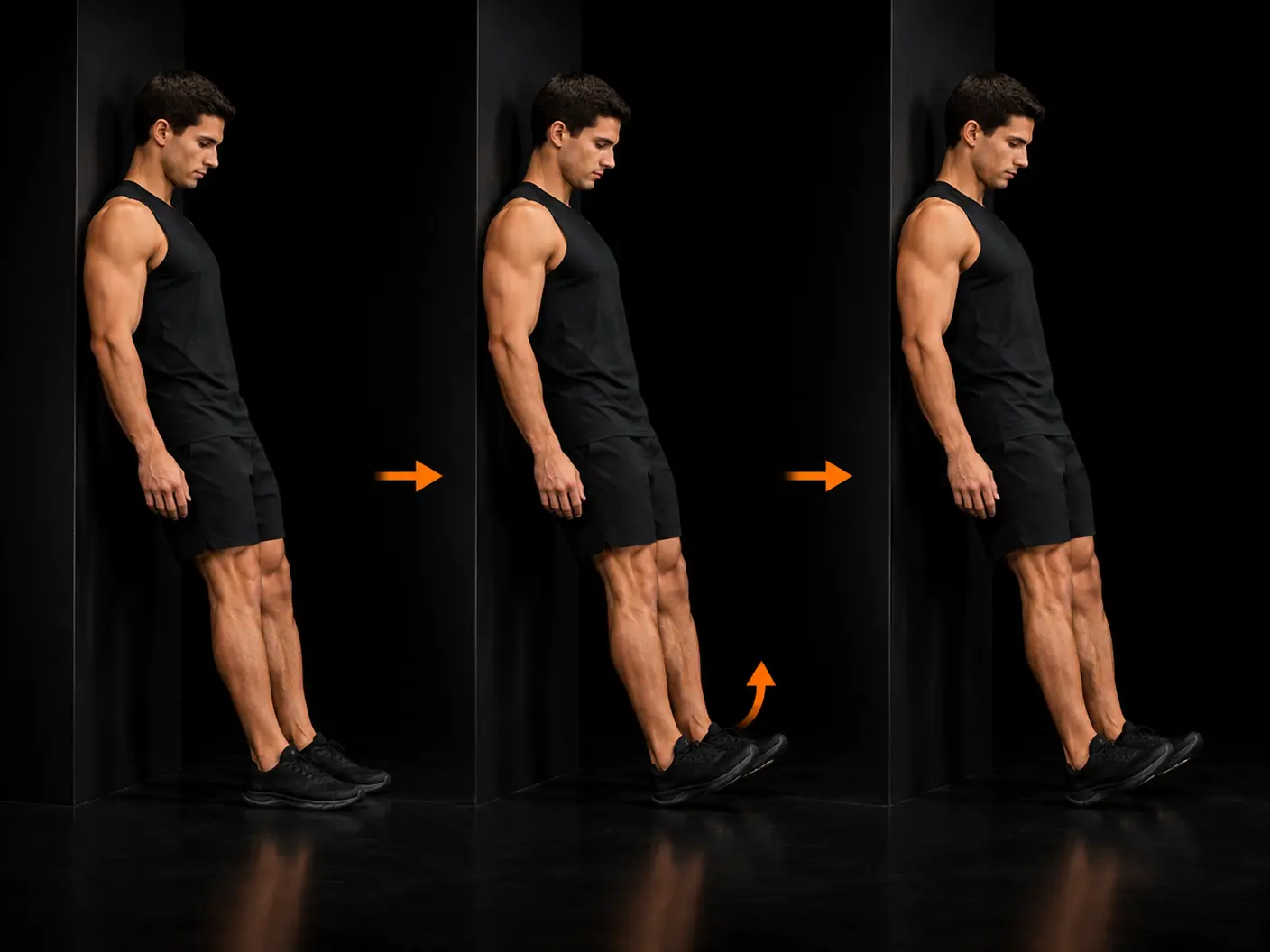
The tibialis raise is an isolation exercise targeting the tibialis anterior — the muscle that runs along the front of the shin and controls dorsiflexion of the foot. Performed with heels braced against a wall, it trains the often-neglected anterior lower leg through a controlled lifting and lowering of the toes and forefoot. It suits athletes, runners, and general fitness trainees looking to address shin strength and lower-leg balance.
How to do it
Stand with heels against a wall, feet a few inches away. Pull the toes and balls of the feet up toward the shins as high as possible. Pause at peak contraction. Lower under control. Add a tib bar or plate on the toes for loaded progression.
Coaching cues
- Pull toes up
- Heels pressed to wall
- Pause at peak
- Slow eccentric
Why train it
- Directly strengthens the tibialis anterior, a muscle frequently underdeveloped relative to the calf complex in most training programmes.
- Improving dorsiflexion strength supports ankle stability and movement quality in squatting, running, and cutting patterns.
- The exercise requires no equipment in its bodyweight form, making it straightforward to integrate into warm-ups, cooldowns, or accessory blocks.
- Load can be progressively increased using a tib bar or a weight plate placed across the toes, allowing structured overload over time.
Common mistakes
- Allowing the heels to lift away from the wall — keep them firmly pressed to the surface throughout each repetition to isolate the tibialis anterior properly.
- Rushing the lowering phase — control the descent slowly rather than letting the foot drop, as the eccentric portion is where significant adaptation occurs.
- Failing to reach a full peak contraction — pull the toes as high as possible toward the shin and hold briefly before lowering, rather than using a partial range of motion.
- Letting the feet splay outward — keep the feet roughly parallel so the load is distributed evenly across the anterior lower leg rather than shifting to the toe extensors on one side.
Primary: Tibialis Anterior.
Equipment
Good for
Easier variation
Seated tibialis raise — less stability demand.
Similar movements
Frequently asked
- What muscles does the tibialis raise work?
- The primary muscle trained is the tibialis anterior, which runs along the front of the shin and is responsible for pulling the toes and forefoot upward. The toe extensors act as secondary muscles during the movement.
- How many sets and reps should I do for tibialis raises?
- For general fitness and injury resilience, 2–3 sets of 15–25 repetitions works well, particularly when using bodyweight or light load. As strength improves and load is added via a tib bar or plate, sets of 10–15 with a controlled tempo are appropriate.
- Can I do tibialis raises without a tib bar?
- Yes — the bodyweight version performed against a wall is an effective starting point and requires no equipment at all. Once that becomes too easy, a standard weight plate rested across the toes provides a practical loaded alternative before progressing to a dedicated tib bar.
- Are tibialis raises useful for runners?
- Runners often experience shin discomfort linked to weakness or fatigue in the tibialis anterior, and strengthening this muscle is a recognised part of lower-leg conditioning for running. If you are currently managing shin pain, consult a qualified professional before adding this exercise to your programme.
- Where should tibialis raises sit in a training session?
- They work well as part of a lower-leg accessory block, a targeted warm-up for the anterior lower leg, or a cooldown addition after running or lower-body training. Given their isolation nature and low systemic demand, placement is flexible.
Want this movement in a plan built for you?
Adaptiv programmes the right exercises for your goal, equipment and experience — then adapts them as you train.
Build my programme