Banded Dorsiflexion
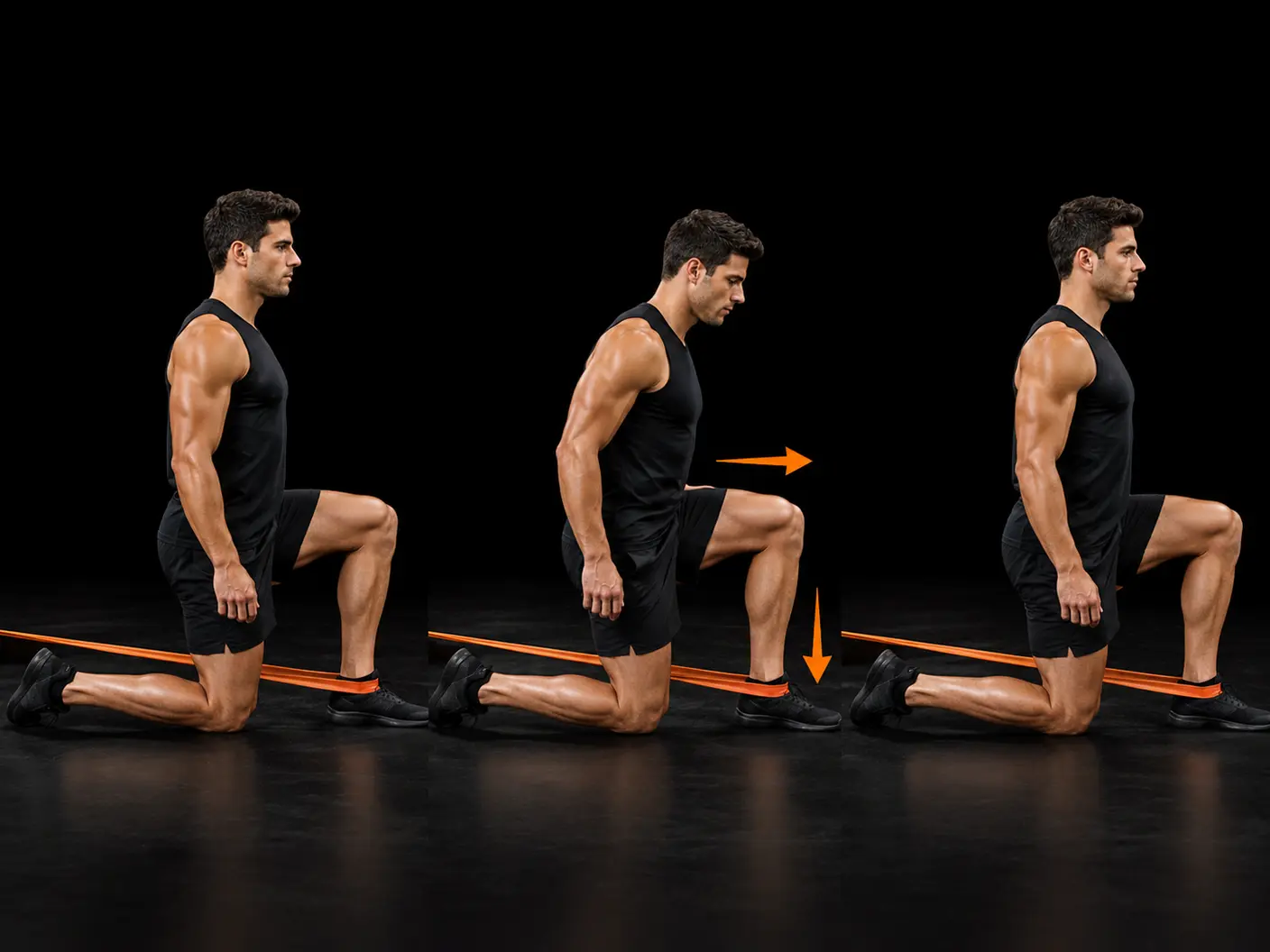
Banded dorsiflexion is a mobility drill that uses resistance band traction to improve the range of motion at the ankle joint, specifically the ability to drive the shin forward over the foot — a movement known as dorsiflexion. The band, anchored low to a rig or rack, provides anterior traction on the ankle as you push the knee forward, helping to reduce joint compression and encourage greater range. It suits anyone from general fitness trainees to athletes who need adequate ankle mobility for squatting, lunging, or change-of-direction work.
How to do it
Anchor a resistance band low on a rig. Loop the band around one ankle and step back until it is taut. Place the foot flat with toes forward. Drive the knee forward over the toes in a half-kneeling or standing lunge, creating a dorsiflexion bias that the band's traction assists. Hold briefly at maximum range; return and repeat.
Coaching cues
- Knee over toes
- Heel stays down
- Drive the knee forward
- Hold at end range
Why train it
- Directly improves ankle dorsiflexion range, which underpins the depth and mechanics of foundational movements such as squats and lunges.
- The band's traction effect helps the talus glide posteriorly as intended, allowing the shin to travel further forward without compensatory heel rise.
- Activating the tibialis anterior and foot intrinsics during the drill builds ankle stability alongside mobility, making gains more functional.
- Because the drill is low-load and easily controlled, it can be used effectively as part of a warm-up or as a standalone recovery session.
Common mistakes
- Heel rising off the floor — concentrate on keeping the heel firmly planted throughout; if it lifts, reduce the range and rebuild from there.
- Knee collapsing inward — track the knee directly over the second and third toes throughout the forward drive to maintain correct joint alignment.
- Allowing the band to sit too high on the ankle — position the band as close to the joint line as possible so the traction acts directly on the talocrural joint.
- Rushing through the end range — hold briefly at the point of maximum shin travel to allow the joint to adapt, rather than bouncing in and out of range.
Primary: Tibialis Anterior.
Secondary: Gastrocnemius.
Equipment
Good for
Easier variation
Unloaded ankle mobility drill — calf raises on a step to improve range of motion passively.
Similar movements
Frequently asked
- What muscles does banded dorsiflexion work?
- The primary muscles engaged are the tibialis anterior and the ankle stabilisers, which drive and control the forward shin movement. The calf muscles work eccentrically to manage the range, while the foot intrinsics activate to stabilise the arch throughout the drill.
- How many sets and reps should I do for banded dorsiflexion?
- A common starting point is two to three sets of ten to fifteen slow, controlled repetitions per side, holding one to two seconds at end range. Used as a warm-up drill, one to two sets is typically sufficient; used as a dedicated mobility session, three sets allows more meaningful adaptation over time.
- What equipment do I need for banded dorsiflexion?
- You need a resistance band and a rig or rack with a low anchor point — ideally at or near floor level so the band applies traction horizontally across the ankle joint. A light to medium resistance band is generally appropriate; a band that is too heavy can restrict the forward drive rather than assist it.
- Is banded dorsiflexion suitable for improving squat depth?
- Yes — limited ankle dorsiflexion is a common reason for the heel rising or the torso pitching forward in a squat. By improving the range available at the ankle, this drill can contribute meaningfully to cleaner squat mechanics over time, provided technique is also addressed.
- Are there alternatives if I do not have a band or rig?
- A wall ankle stretch — placing the foot close to a wall and driving the knee forward until it touches — trains a similar pattern without equipment. It lacks the traction component of the banded version, but it remains a useful drill for developing dorsiflexion range in a foundational context.
Want this movement in a plan built for you?
Adaptiv programmes the right exercises for your goal, equipment and experience — then adapts them as you train.
Build my programme