T-Bar Row
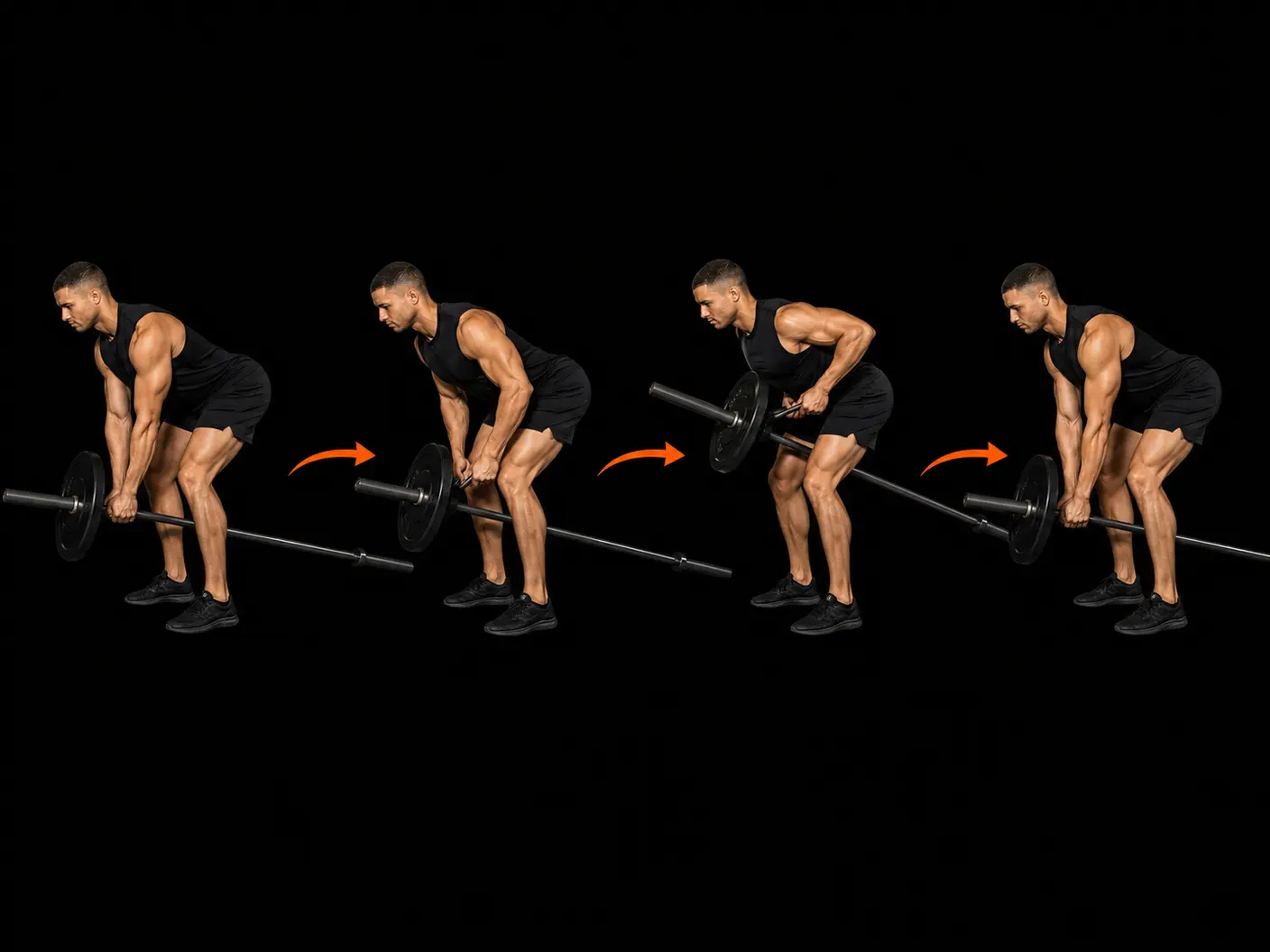
The T-bar row is a compound horizontal pulling exercise performed over a fixed bar, either on a dedicated T-bar machine or via a landmine attachment. It trains the mid-back musculature through a mechanically strong hip-hinge position, loading the middle trapezius, rhomboids, and latissimus dorsi simultaneously. The movement suits intermediate lifters who have established a solid hip hinge and are looking to develop back thickness and pulling strength.
How to do it
Straddle the bar, hinge to a 45° torso angle with a slight knee bend. Grip the handles neutral or wide. Pack the lats. Row the weight to the lower chest; drive elbows back. Pause briefly. Lower with control.
Coaching cues
- Hinge and hold
- Row to the ribs
- Elbows back
- Squeeze the mid-back
Why train it
- The fixed bar path reduces the coordination demand compared to a barbell row, allowing the lifter to focus effort on the target muscles of the mid-back.
- Loading the middle trapezius and rhomboids under a full range of motion builds the back thickness that supports posture and upper-body structural integrity.
- The neutral or wide grip options allow the lifter to emphasise different regions of the back, giving the exercise useful flexibility within a hypertrophy programme.
- Because the torso is braced against gravity at a fixed 45° angle, the erectors receive meaningful isometric work alongside the primary pulling muscles.
Common mistakes
- Jerking the weight up with momentum — initiate every rep by retracting the scapulae first, then drive the elbows back in a controlled arc.
- Letting the torso rise during the set — establish your 45° hinge before the first rep and hold that angle throughout, resisting the urge to turn the row into a deadlift.
- Pulling to the stomach rather than the lower chest — keep the row path tight and direct, finishing with the handles at the ribs to maintain full range of motion on the target muscles.
- Allowing the elbows to flare wide — keep them tracking back and close to the body to ensure the rhomboids and middle trapezius are doing the work rather than the shoulders.
Primary: Trapezius, Rhomboids, Latissimus Dorsi.
Secondary: Posterior Deltoid, Biceps Brachii, Erector Spinae.
Equipment
Good for
Easier variation
Chest-supported T-bar — eliminates lower-back demand.
Similar movements
Frequently asked
- What muscles does the T-bar row work?
- The primary muscles are the middle trapezius, rhomboids, and latissimus dorsi. The rear deltoid, biceps, and spinal erectors contribute as secondary movers and stabilisers throughout the lift.
- How many sets and reps should I do for the T-bar row?
- For hypertrophy, 3–4 sets of 8–12 repetitions with a controlled tempo works well. For strength development, 4–5 sets in the 4–6 rep range at heavier loads are more appropriate, provided technique is not compromised.
- What is the difference between a T-bar row machine and a landmine setup?
- A dedicated T-bar machine typically provides a chest pad for additional torso support, which reduces erector demand and can be useful when isolating the mid-back under fatigue. A landmine attachment requires the lifter to maintain their own hip-hinge position throughout, making it a slightly more demanding variation overall.
- What are good alternatives to the T-bar row?
- The bent-over barbell row and the chest-supported dumbbell row train a comparable horizontal pulling pattern and the same primary muscles. The chest-supported variation is worth considering if lower-back fatigue is limiting your T-bar row performance.
- Is the T-bar row suitable for building a stronger deadlift?
- The movement does reinforce the hip-hinge position and develops the erectors and mid-back musculature that support deadlift mechanics, so it has reasonable carry-over as an accessory exercise. It should complement rather than replace pulling from the floor within a strength-focused programme.
Want this movement in a plan built for you?
Adaptiv programmes the right exercises for your goal, equipment and experience — then adapts them as you train.
Build my programme