Single-Arm Dumbbell Row
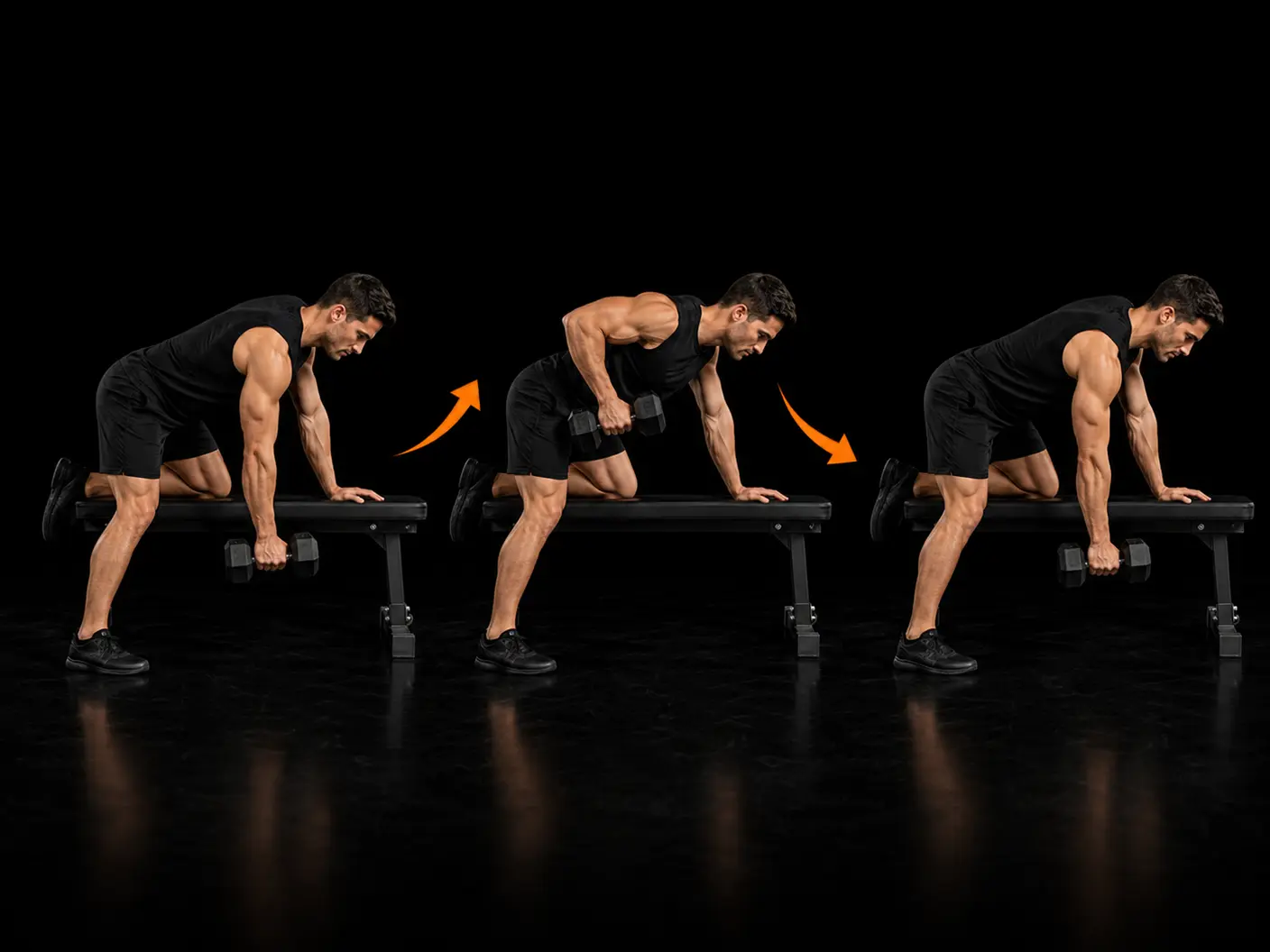
The single-arm dumbbell row is a compound horizontal pulling exercise performed with one knee and hand braced on a bench, allowing the working arm to move through a full range of motion unilaterally. It trains the latissimus dorsi, middle trapezius, and rhomboids as primary movers, with the rear deltoid, biceps, and forearms contributing as synergists. The supported position and moderate technical demand make it well suited to intermediate trainees building back thickness and addressing side-to-side strength asymmetries.
How to do it
Place one knee and one hand on a bench, torso parallel to the floor. Dumbbell in the opposite hand, arm hanging. Pull the dumbbell to the hip by driving the elbow back. Do not twist the torso. Pause briefly. Lower to a full stretch.
Coaching cues
- Row to the hip
- Drive the elbow back
- No torso twist
- Full stretch
Why train it
- Training each arm independently allows the stronger side to compensate less, making it an effective tool for identifying and correcting left-to-right pulling imbalances.
- The bench-supported position stabilises the torso, letting you focus load directly on the target musculature rather than dissipating effort through unnecessary movement.
- Pulling the dumbbell to the hip and pausing briefly at the top maximises lat engagement and time under tension, which directly supports hypertrophy in the upper and mid-back.
- A full lowering phase stretches the lat and surrounding musculature at the bottom of each rep, encouraging a greater range of motion than many cable or machine rowing alternatives.
Common mistakes
- Twisting the torso to row the dumbbell higher — keep the hips and shoulders square throughout and reduce the load if rotation is necessary to complete the rep.
- Rowing the dumbbell toward the chest rather than the hip — drive the elbow back and down so the dumbbell tracks toward the hip, which keeps the lat as the primary mover.
- Cutting the range of motion short at the bottom — allow the arm to extend fully at the end of each rep so the lat receives a complete stretch before the next pull.
- Shrugging the shoulder at the top of the pull — keep the shoulder depressed and focus on driving the elbow rather than elevating the whole shoulder girdle.
Primary: Latissimus Dorsi, Trapezius, Rhomboids.
Secondary: Posterior Deltoid, Biceps Brachii, Forearm Flexors.
Equipment
Good for
Easier variation
Chest-supported DB row — eliminates the rotational challenge.
Similar movements
Frequently asked
- What muscles does the single-arm dumbbell row work?
- The primary muscles are the latissimus dorsi, middle trapezius, and rhomboids. The rear deltoid, biceps, and forearms contribute as secondary muscles throughout the pull.
- How many sets and reps should I do for the single-arm dumbbell row?
- For hypertrophy, three to four sets of eight to twelve reps per arm is a common and well-supported range. For strength development, four to five sets of five to eight reps with heavier loading is appropriate, provided form remains controlled throughout.
- What are good alternatives to the single-arm dumbbell row?
- Seated cable rows, chest-supported dumbbell rows, and barbell bent-over rows all train the same horizontal pulling pattern. The chest-supported variation is particularly useful if lower-back fatigue is limiting your capacity on the bench-braced version.
- Is the single-arm dumbbell row suitable for building a thicker back?
- Yes — it is one of the more direct exercises for developing back thickness, particularly through the lat and mid-back region. The unilateral loading and full stretch at the bottom make it effective for hypertrophy when programmed with controlled tempos and adequate volume.
- Should the dumbbell row be performed with a neutral or overhand grip?
- A neutral grip, with the palm facing the body, is the standard and most comfortable position for this exercise and is consistent with the movement as described. It allows a natural elbow path and reduces unnecessary stress on the wrist and elbow joints.
Want this movement in a plan built for you?
Adaptiv programmes the right exercises for your goal, equipment and experience — then adapts them as you train.
Build my programme