Barbell Bent-Over Row
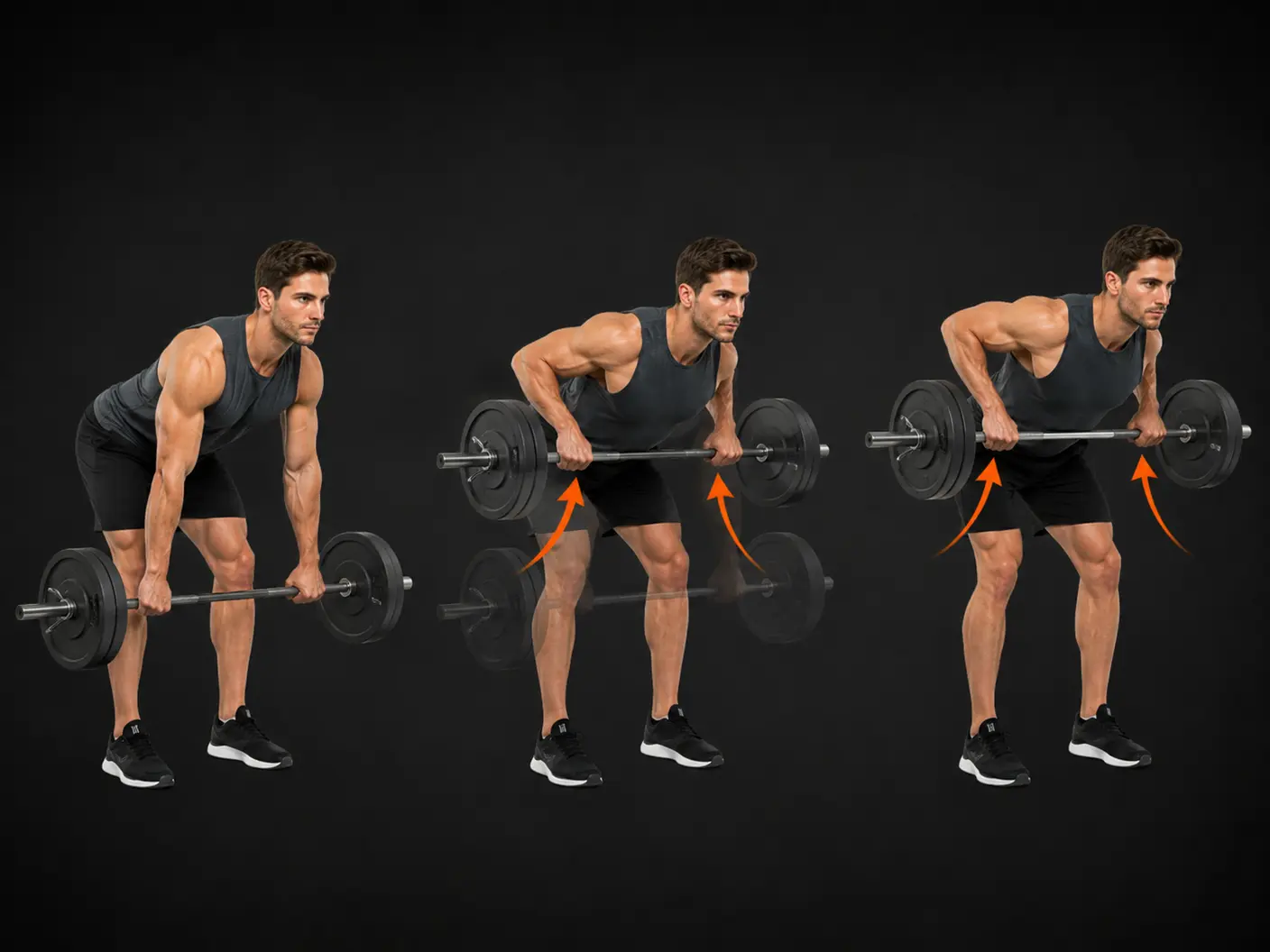
The barbell bent-over row is a compound horizontal pull performed with a hinged torso, drawing a loaded barbell from a dead hang to the lower ribs on each repetition. It develops thickness and strength across the upper and mid back — targeting the latissimus dorsi, middle trapezius, and rhomboids — while demanding significant isometric contribution from the erectors to maintain position under load. It suits intermediate to advanced lifters who have established a reliable hip hinge and the posterior chain endurance to hold a stable spine throughout a working set.
How to do it
Set up over the bar as if deadlifting. Hinge at the hips to ~45° torso angle, slight knee bend. Grip the bar just outside the knees, pronated. Pack the lats. Row the bar to the lower ribs by driving the elbows back. Pause briefly. Lower under control.
Coaching cues
- Hinge and hold
- Pull to lower ribs
- Drive elbows back
- Long spine
Why train it
- Builds substantial strength and mass across the lats, mid-traps, and rhomboids simultaneously, making it one of the most efficient upper-back movements available.
- The isometric demand placed on the erectors and spinal stabilisers during each set reinforces the hip-hinge position that underpins deadlifts and other foundational patterns.
- Driving the elbows back forcefully at the top of each rep recruits the rear deltoids and develops scapular retraction strength, which directly supports overhead pressing mechanics and shoulder health.
- Loading the movement with a barbell allows progressive overload across a wide range of rep schemes, making it equally viable for a strength block at low reps or a hypertrophy phase at moderate volume.
Common mistakes
- Jerking the torso upright to initiate the pull — keep the hips locked in the hinge throughout and let the arms do the work, not momentum from the lower back.
- Pulling the bar to the stomach rather than the lower ribs — a higher bar path shortens the range of motion and reduces lat engagement, so stay deliberate about the contact point.
- Allowing the upper back to round and the shoulder blades to wing forward — pack the lats before each rep and actively retract the scapulae as you drive the elbows back.
- Letting the torso rise well above 45° as fatigue accumulates — if you can no longer hold position, reduce the load rather than compensating with a more upright angle that shifts the work away from the intended muscles.
Primary: Latissimus Dorsi, Trapezius, Rhomboids.
Secondary: Posterior Deltoid, Biceps Brachii, Erector Spinae, Forearm Flexors.
Equipment
Good for
Easier variation
Chest-supported row — removes the lower-back demand.
Similar movements
Frequently asked
- What muscles does the barbell bent-over row work?
- The primary muscles are the latissimus dorsi, middle trapezius, and rhomboids. The rear deltoids, biceps, forearms, and erectors all contribute as secondary movers and stabilisers throughout the lift.
- What sets and reps should I use for the barbell bent-over row?
- For strength, three to five sets of three to six reps with heavier loading works well. For hypertrophy, three to four sets of six to twelve reps at a moderate weight allows enough volume and time under tension to drive adaptation — prioritise controlled lowering on every rep.
- Is the barbell bent-over row suitable for beginners?
- It is rated as an advanced movement because it requires a solid hip hinge, sufficient posterior chain endurance, and the body awareness to maintain a long spine under load. Beginners are generally better served by a dumbbell or cable row variant first, progressing to the barbell once those foundations are in place.
- What are good alternatives if I cannot yet perform the barbell bent-over row?
- Dumbbell bent-over rows reduce the balance and coordination demand while training the same horizontal pull pattern. Seated cable rows and chest-supported machine rows remove the isometric spinal requirement entirely, making them useful options while building the posterior chain endurance needed for the free-weight version.
- How does the barbell bent-over row fit into an athletic performance programme?
- It is well suited to athletic contexts because it develops pulling strength, scapular control, and hip-hinge endurance in a single movement. These qualities transfer to deceleration, contact sports, and any activity that requires a strong, stable posterior chain — making it a practical inclusion in performance-focused blocks alongside deadlifts and pressing work.
Want this movement in a plan built for you?
Adaptiv programmes the right exercises for your goal, equipment and experience — then adapts them as you train.
Build my programme