Pendlay Row
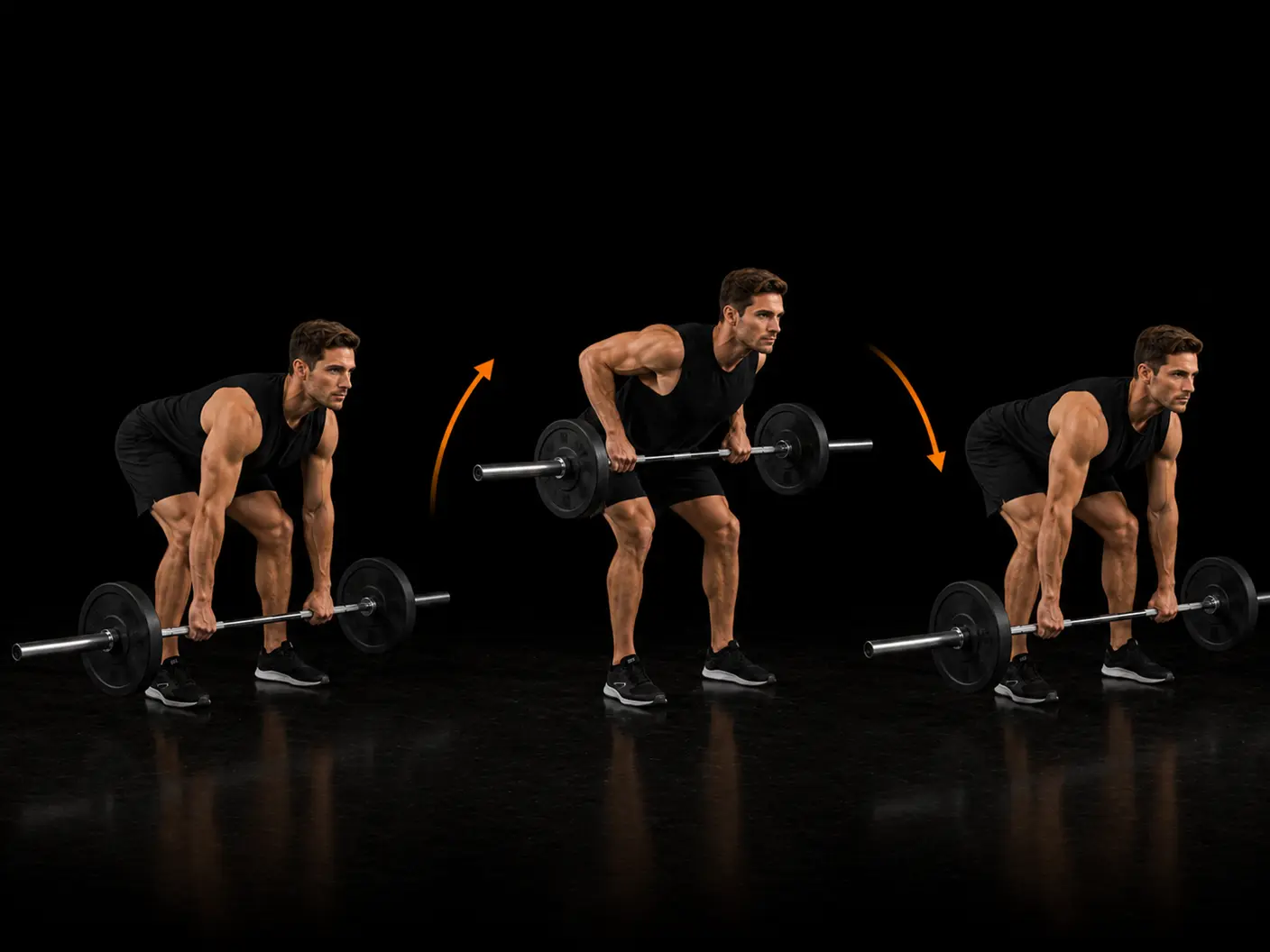
The Pendlay row is a strict barbell rowing variation performed from a dead stop on the floor, with the torso held parallel to the ground throughout each rep. Unlike a conventional bent-over row, every repetition begins from a complete reset, eliminating momentum and demanding a forceful, coordinated pull. It suits intermediate to advanced lifters pursuing genuine upper-back strength, hypertrophy, or athletic power development.
How to do it
Set the bar on the floor. Hinge to a torso roughly parallel to the floor. Grip just outside the knees. Explosively row the bar to the lower chest. Lower the bar to the floor between every rep — reset the position. Dead-stop reps only.
Coaching cues
- Torso parallel
- Bar to lower chest
- Dead stop each rep
- Explode off the floor
Why train it
- The dead-stop requirement removes momentum from the equation, ensuring the latissimus dorsi, middle trapezius, and rhomboids produce force from a true resting position each rep.
- Performing the row with the torso parallel to the floor places the upper-back musculature under a long range of motion, supporting hypertrophy across the lats, rhomboids, and rear deltoids.
- The explosive intent on every pull develops rate-of-force development in the horizontal plane, making it a practical accessory for athletes in sports demanding rapid upper-body power.
- Because the bar returns to the floor between reps, positional discipline is reinforced set after set, building the postural awareness that carries over to deadlifts and other hinge-based movements.
Common mistakes
- Raising the hips as the bar leaves the floor — keep the torso locked parallel throughout the pull rather than converting the row into a partial deadlift.
- Jerking the upper body to initiate the pull — the explosion should come from the upper back and arms, not from a counter-movement of the trunk.
- Pulling the bar to the abdomen rather than the lower chest — aim for contact just below the sternum to ensure full retraction of the scapulae at the top of each rep.
- Rushing through the dead stop — pause briefly with the plates on the floor, re-establish your brace and grip, then pull; skipping the reset defeats the purpose of the variation.
Primary: Latissimus Dorsi, Trapezius, Rhomboids.
Secondary: Posterior Deltoid, Biceps Brachii, Erector Spinae.
Equipment
Good for
Easier variation
Barbell bent-over row — same pattern with continuous tension.
Similar movements
Frequently asked
- What muscles does the Pendlay row work?
- The primary movers are the latissimus dorsi, middle trapezius, and rhomboids. The rear deltoids, biceps, and spinal erectors contribute as secondary muscles, with the erectors working isometrically to maintain the parallel torso position throughout each set.
- How many sets and reps should I do for the Pendlay row?
- For strength, 4–5 sets of 3–5 reps with heavier loading works well. For hypertrophy, 3–4 sets of 6–8 reps at a moderate load is more appropriate. Because each rep requires a dead stop, total set duration is longer than a conventional row, so err on the side of fewer reps per set when first programming it.
- What is the difference between a Pendlay row and a standard bent-over row?
- The key distinction is the dead stop: the Pendlay row starts and ends with the bar on the floor, eliminating any elastic rebound or momentum between reps. The torso is also held strictly parallel rather than at a more upright angle, which shifts demand further onto the upper back and reduces the contribution of the lower-body drive.
- Is the Pendlay row suitable for beginners?
- It is classified as an advanced movement due to the combined demands of hinge patterning, explosive pulling mechanics, and strict positional control. Beginners are better served building proficiency on the conventional bent-over row or a chest-supported row before progressing to this variation.
- Can I use the Pendlay row as an alternative to the deadlift?
- The two movements serve different purposes and are not direct alternatives. The Pendlay row is a horizontal pulling exercise that targets the upper back, whereas the deadlift is a lower-body and posterior-chain dominant pattern. They can complement each other well within the same programme, but one does not substitute for the other.
Want this movement in a plan built for you?
Adaptiv programmes the right exercises for your goal, equipment and experience — then adapts them as you train.
Build my programme