Meadows Row
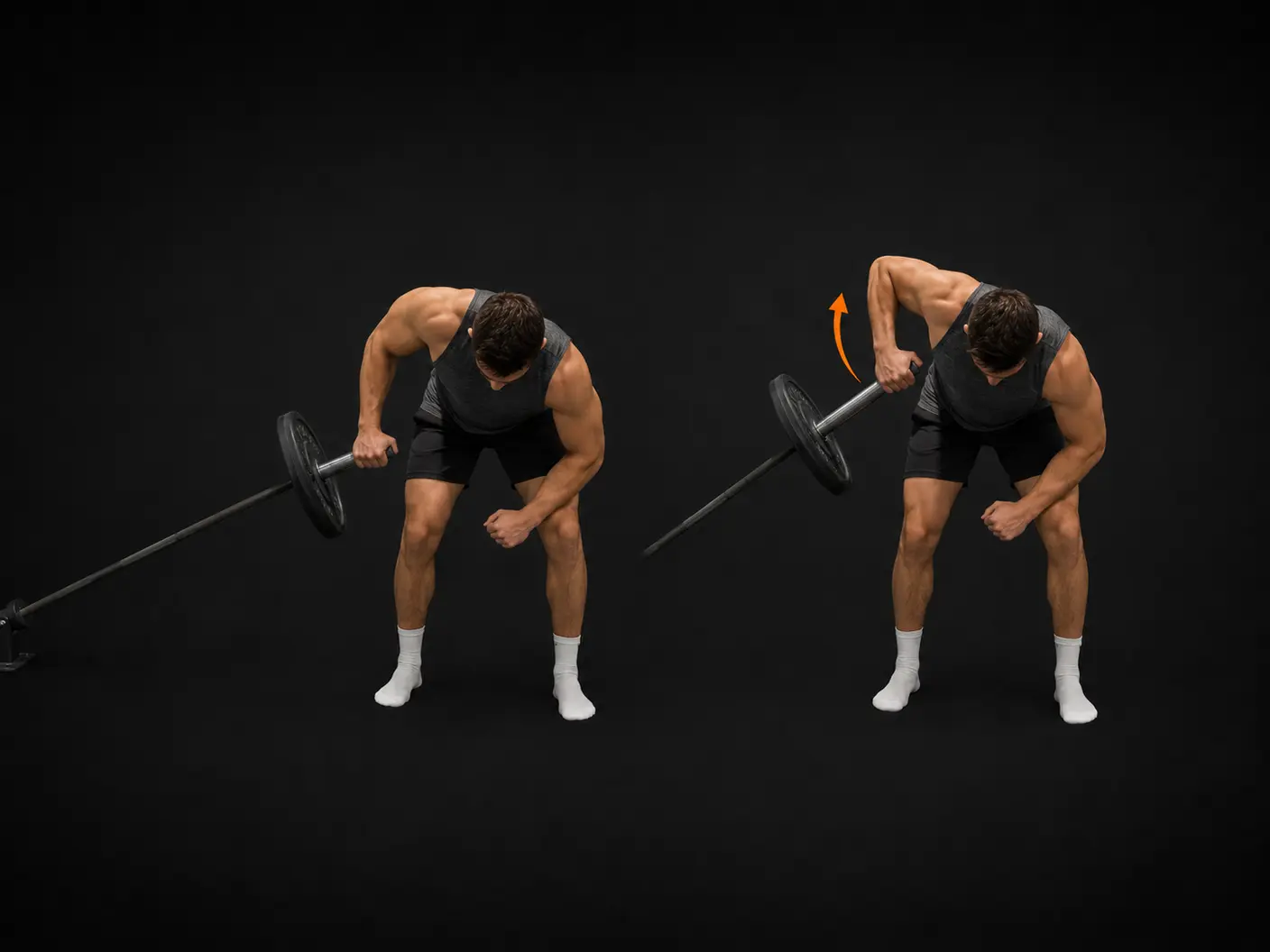
The Meadows row is a unilateral horizontal pulling movement performed with a barbell set in a landmine attachment. The fixed arc of the barbell guides the elbow into a high, sweeping path that places a pronounced stretch on the latissimus dorsi and teres major — making it particularly effective for building thickness through the mid-back. It suits intermediate trainees who are comfortable with the hip hinge and are looking to address side-to-side pulling asymmetries.
How to do it
Set a barbell in a landmine. Stand side-on to the free end, feet perpendicular to the bar. Hinge and grip the end of the bar with an overhand grip, near hand. Row the end to the hip by driving the elbow back and up. Pause. Lower under control.
Coaching cues
- Hinge and stagger
- Elbow back and up
- Squeeze the lat
- Controlled descent
Why train it
- The angled bar path produces a deep stretch on the lat at the bottom of each rep, increasing the range of motion compared with many standard dumbbell row variations.
- Training one side at a time allows you to identify and correct strength imbalances between the left and right sides of the back.
- The fixed landmine arc reduces the need for shoulder stabilisation in the frontal plane, letting you focus effort on the target muscles — the latissimus dorsi, middle trapezius, and teres major.
- The rear deltoid and biceps contribute as secondary movers, making the Meadows row an efficient compound option within a hypertrophy-focused pulling session.
Common mistakes
- Letting the torso rotate excessively — brace the core and keep the hips square to the floor throughout the pull so the lat does the work rather than momentum.
- Pulling with the bicep rather than initiating with the elbow — think of the hand as a hook and drive the elbow back and up first to ensure the back muscles lead the movement.
- Rushing the descent — lower the bar under control to maintain tension through the full range of motion, which is where much of the hypertrophic stimulus comes from.
- Standing too upright — hinge sufficiently at the hip so the torso angle allows the bar to travel freely along its arc without the shoulder being forced into an awkward position at the top.
Primary: Latissimus Dorsi, Trapezius, Teres Major.
Secondary: Posterior Deltoid, Biceps Brachii, Erector Spinae.
Equipment
Good for
Easier variation
Single-arm DB row — similar target, more common equipment.
Similar movements
Frequently asked
- What muscles does the Meadows row work?
- The primary muscles are the latissimus dorsi, middle trapezius, and teres major. The rear deltoid, biceps, and spinal erectors contribute as secondary movers throughout the lift.
- How many sets and reps should I do for the Meadows row?
- For hypertrophy, which is the primary goal this exercise is programmed for, three to four sets of eight to twelve reps per side is a sound starting point. Rest long enough between sides to maintain quality of movement rather than rushing through fatigue.
- What is a good alternative to the Meadows row?
- A single-arm dumbbell row targets a similar muscle group via the same horizontal pull pattern and is a reasonable substitute if a landmine attachment is unavailable. The Meadows row does, however, offer a longer effective range of motion due to the fixed arc of the barbell.
- Is the Meadows row suitable for beginners?
- The movement is classified as intermediate difficulty because it requires a confident hip hinge, adequate thoracic awareness, and the co-ordination to control a live barbell end. Beginners would typically benefit from building these foundations with dumbbell rows before progressing to this variation.
- Do I need a landmine attachment for the Meadows row?
- A dedicated landmine attachment is the standard setup, though some facilities secure the barbell sleeve in a corner as a temporary alternative. Whichever method you use, ensure the barbell is firmly fixed before loading and lifting.
Want this movement in a plan built for you?
Adaptiv programmes the right exercises for your goal, equipment and experience — then adapts them as you train.
Build my programme