Sumo Good Morning
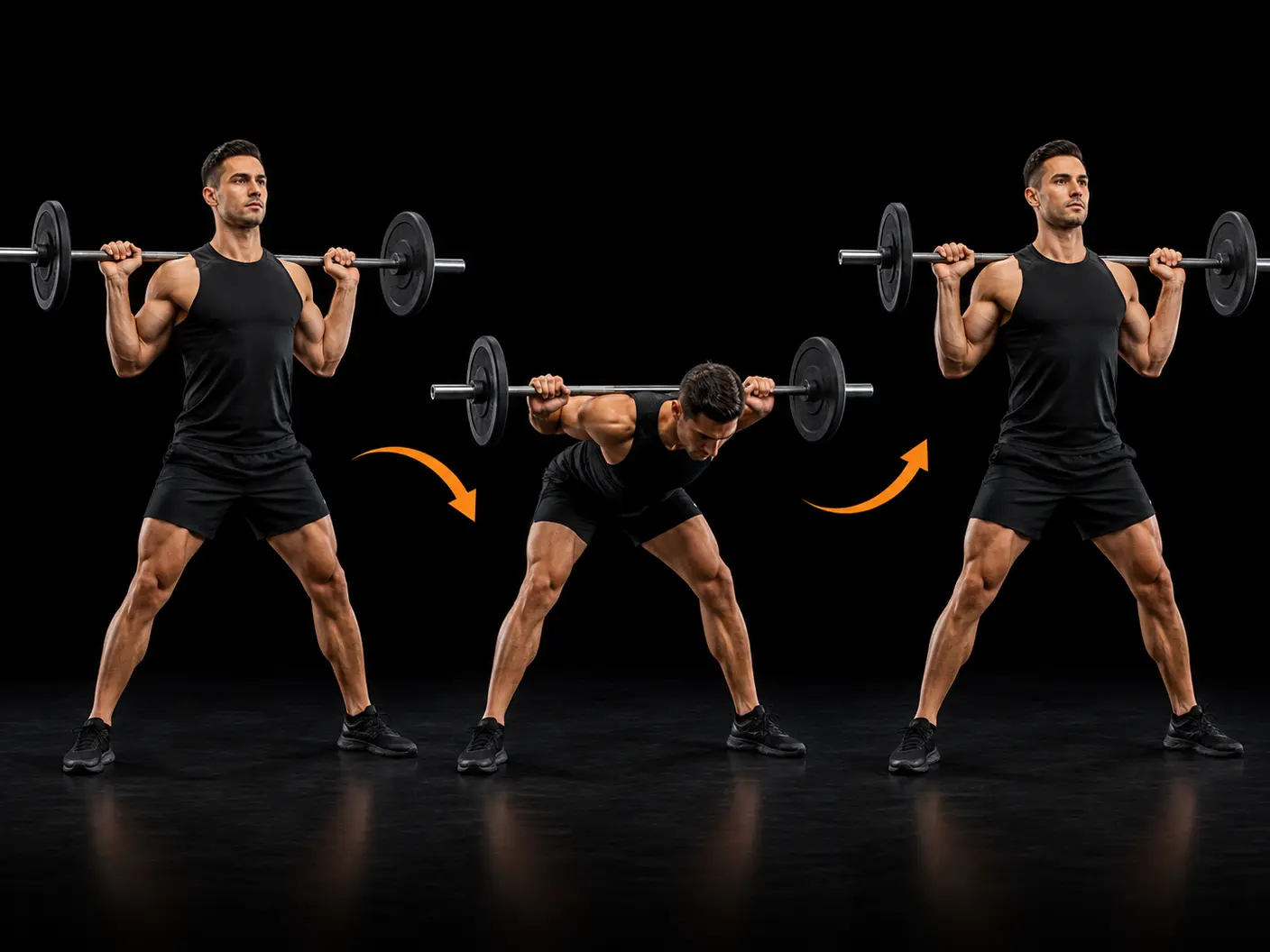
The sumo good morning is a barbell hip-hinge variation performed with a wide stance and externally rotated feet, placing significant demand on the glutes, adductors, and hamstrings simultaneously. The wide base distinguishes it from a conventional good morning by increasing adductor involvement and altering the line of pull through the posterior chain. It suits intermediate to advanced lifters looking to develop posterior chain strength and hypertrophy with a greater emphasis on the inner thigh musculature.
How to do it
Rack the bar on the upper back. Feet 1.5x shoulder-width, toes pointed out. Slight knee bend. Hinge at the hips, torso dropping toward parallel; knees stay out over the toes. Drive the hips forward to stand, squeezing glutes and adductors.
Coaching cues
- Knees out
- Hips back
- Long spine
- Squeeze to finish
Why train it
- The wide stance recruits the adductors as primary contributors alongside the glutes and hamstrings, making this one of the few barbell movements to load all three muscle groups together.
- Loading the hip hinge pattern under a barbell places substantial mechanical tension through the posterior chain, supporting both strength and hypertrophy adaptations over time.
- The movement reinforces the ability to maintain a long, neutral spine under load while hinging — a positional skill that transfers directly to deadlift and squat mechanics.
- Keeping the knees tracking out over the toes throughout the hinge trains hip external rotation control, which underpins stability in a wide range of lower-body compound lifts.
Common mistakes
- Rounding the lumbar spine — brace the core before the descent and focus on maintaining a long spine from tailbone to crown throughout the entire range of motion.
- Letting the knees collapse inward — actively drive the knees out over the toes as you hinge, mirroring the cue you would use in a sumo deadlift.
- Hinging too quickly without controlling the descent — lower the torso with deliberate tension rather than dropping passively, as the eccentric phase is where much of the training stimulus is built.
- Failing to complete hip extension at the top — squeeze the glutes and adductors fully as you stand, as a short finish reduces posterior chain activation and can place unnecessary stress on the lumbar spine.
Primary: Gluteus Maximus, Adductors, Hamstrings.
Secondary: Erector Spinae, Rectus Abdominis.
Equipment
Good for
Easier variation
Conventional good morning — reduces adductor demand.
Similar movements
Frequently asked
- What muscles does the sumo good morning work?
- The primary muscles are the glutes, adductors, and hamstrings. The erectors and core work as secondary stabilisers to maintain spinal position throughout the movement.
- How many sets and reps should I do for the sumo good morning?
- For strength, three to five sets of three to six reps with heavier loading works well. For hypertrophy, three to four sets of eight to twelve reps at a moderate load allows sufficient volume and time under tension.
- Is the sumo good morning suitable for beginners?
- This movement is classified as advanced due to the coordination required to maintain a neutral spine, control knee tracking, and manage a barbell on the upper back simultaneously. Beginners would be better served building the hip-hinge pattern with Romanian deadlifts or bodyweight variations first.
- What is the difference between a sumo good morning and a conventional good morning?
- The primary distinction is stance width and foot angle — the sumo variation uses a foot placement roughly one and a half times shoulder-width with toes pointed outward, which increases adductor recruitment compared to the narrower conventional version.
- What are good alternatives if I cannot perform the sumo good morning?
- Romanian deadlifts and cable pull-throughs train a similar hip-hinge pattern with less spinal loading. If the goal is specifically adductor involvement within a hinge, a sumo Romanian deadlift is a closer substitute that may be more manageable for those still developing positional strength.
Want this movement in a plan built for you?
Adaptiv programmes the right exercises for your goal, equipment and experience — then adapts them as you train.
Build my programme