Squat Thrust
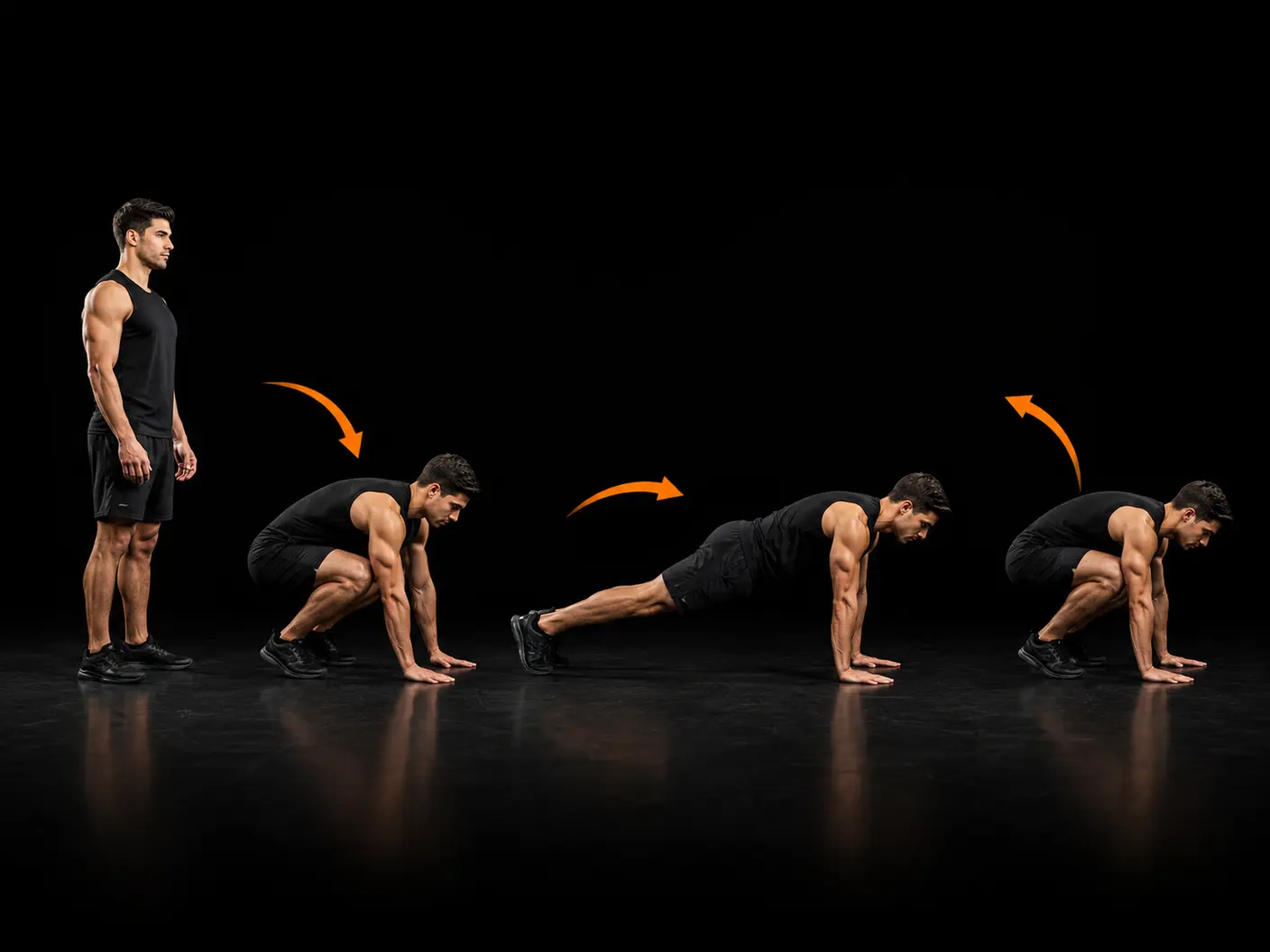
The squat thrust is a full-body compound movement that cycles through a hip hinge, a plank brace, and a return to standing — training power, coordination, and conditioning in a single continuous sequence. Often described as a burpee stripped of the push-up and finishing jump, it demands contribution from the quadriceps, glutes, shoulders, and core simultaneously. It suits intermediate trainees looking to build work capacity, support fat loss, or develop the movement literacy that underpins more complex athletic drills.
How to do it
Stand feet shoulder-width. Drop into a squat and place the hands on the floor outside the feet. Jump or step both feet back into a plank position. Jump or step both feet back to the squat position. Stand up. The squat thrust is a burpee without the push-up and jump at the top.
Coaching cues
- Hands outside the feet
- Plank position tight
- Drive feet back in
- Stand tall
Why train it
- Training multiple muscle groups — quadriceps, glutes, shoulders, and core — within one movement makes it time-efficient for general fitness and conditioning blocks.
- The repeated transition between plank and squat positions elevates heart rate rapidly, making it effective for fat loss protocols where metabolic demand is a priority.
- Driving the feet back into a controlled plank and returning under load develops the postural stability and hip-extension strength that carry over to athletic performance.
- Because no equipment is required, the squat thrust can be programmed anywhere, making it a reliable option when access to a gym is limited.
Common mistakes
- Placing the hands inside the feet rather than outside them — position the hands on the floor just beyond the outer edge of each foot to keep the hips in the correct squat alignment before the feet drive back.
- Allowing the hips to pike upward or sag in the plank position — brace the core actively and keep the body in a straight line from head to heel the moment the feet land behind you.
- Landing with the feet too far back, creating an over-extended lumbar position — aim for a plank where the shoulders sit directly above the wrists and the pelvis remains neutral.
- Collapsing the chest on the return step, which rounds the upper back on the way back to standing — drive the feet back to the outside of the hands and stand tall with the spine extended before resetting.
Primary: Quadriceps, Gluteus Maximus, Rectus Abdominis.
Secondary: Hamstrings, Gastrocnemius, Triceps Brachii, Anterior Deltoid.
Equipment
Good for
Easier variation
Walk the feet in and out — remove the jump from the movement.
Similar movements
Frequently asked
- What muscles does the squat thrust work?
- The primary muscles are the quadriceps, glutes, shoulders, and core. The hamstrings, calves, and triceps contribute as secondary movers throughout the plank transition and the drive back to standing.
- How many sets and reps should I do for squat thrusts?
- For conditioning and fat loss, 3–4 sets of 10–15 repetitions with short rest intervals of 30–45 seconds works well. For athletic performance work where quality of movement matters more than volume, keep sets to 3–4 and reps between 6–10, resting long enough to maintain crisp mechanics.
- What is the difference between a squat thrust and a burpee?
- A squat thrust omits both the push-up at the bottom and the jump at the top that define a full burpee. This makes it a lower-intensity option that still develops conditioning and full-body coordination without the additional upper-body pressing demand or impact load of the jump.
- Can beginners do squat thrusts?
- The movement is classified as intermediate, primarily because it requires the ability to maintain a stable plank and move fluidly between positions under mild fatigue. Beginners who are comfortable in a plank and can perform a basic bodyweight squat can work towards it by stepping the feet back one at a time rather than jumping.
- Are squat thrusts good for fat loss?
- They are well-suited to fat loss programmes because they recruit large muscle groups across the whole body in rapid succession, producing a high metabolic demand relative to the time spent working. They are most effective when structured as part of a circuit or interval protocol rather than used in isolation.
Want this movement in a plan built for you?
Adaptiv programmes the right exercises for your goal, equipment and experience — then adapts them as you train.
Build my programme