Burpee
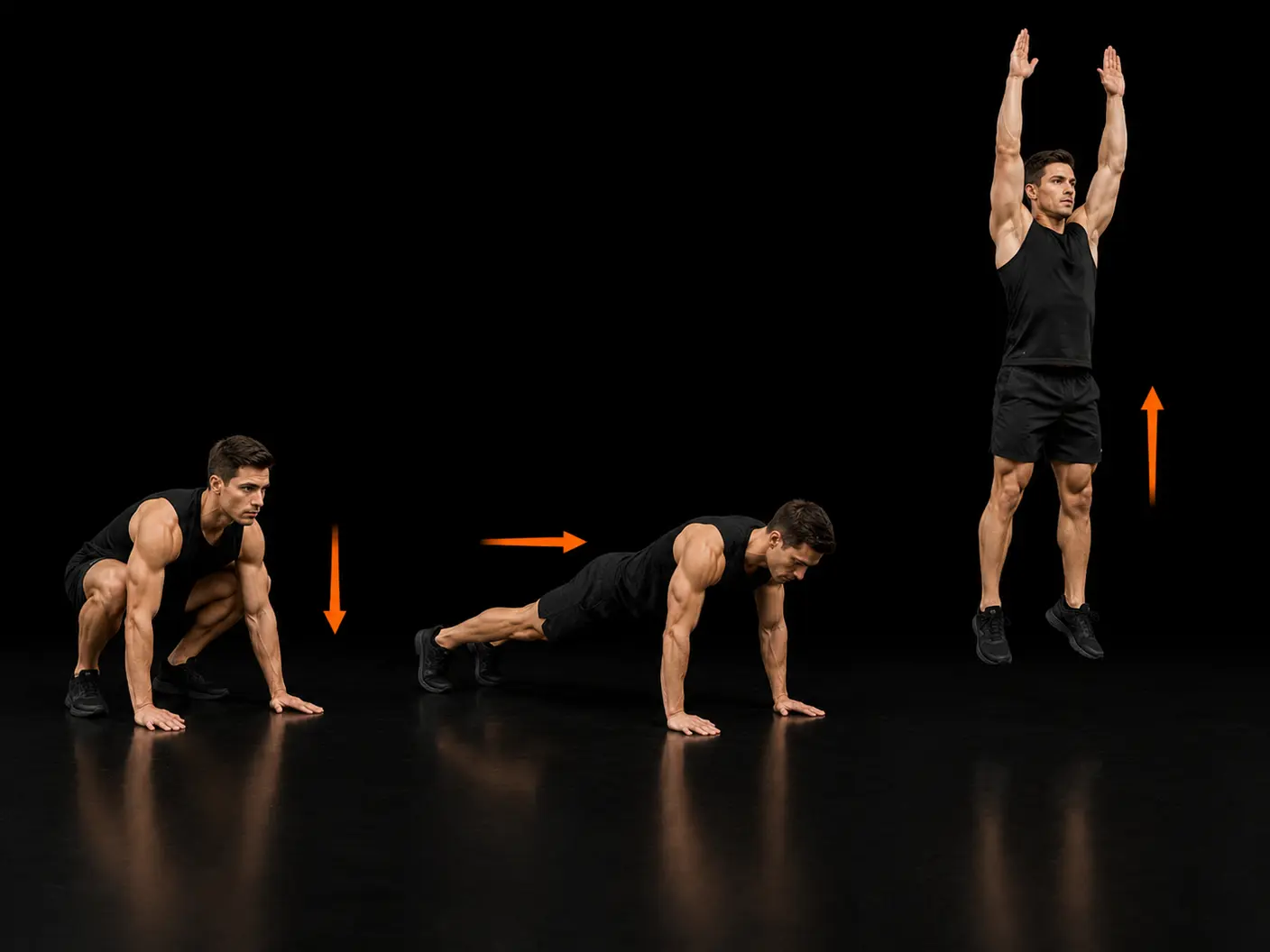
The burpee is a full-body conditioning movement that cycles through a squat, plank, push-up, and vertical jump in a single continuous sequence. It trains the conditioning pattern by demanding coordinated effort from the upper body, lower body, and core across multiple planes of movement. It suits intermediate trainees looking to build work capacity, support fat loss, or develop the kind of multi-joint athleticism that carries over to sport and general physical readiness.
How to do it
Stand tall, feet shoulder-width. Drop hands to the floor, jump or step the feet back to a push-up position and lower the chest to the floor. Press back up and jump the feet toward the hands. Explode upward into a vertical jump, reaching arms overhead. Land softly with knees slightly bent and immediately begin the next rep.
Coaching cues
- Chest to floor
- Drive through the arms
- Explosive jump
- Soft landing
Why train it
- The burpee elevates heart rate rapidly and sustains it across sets, making it an efficient tool for cardiovascular conditioning within a short training window.
- By engaging the quadriceps, pectorals, deltoids, hamstrings, glutes, triceps, and core in sequence, it delivers a high degree of muscular involvement without any equipment.
- The explosive jump component develops lower-body power and rate of force development, qualities that support athletic performance across many sports.
- Because it requires only bodyweight, it can be programmed in any environment and scaled in volume or tempo to suit a wide range of fitness levels.
Common mistakes
- Collapsing at the hips during the push-up phase — brace the core and maintain a rigid plank position so the body moves as a single unit.
- Performing a shallow chest touch rather than a true push-up — lower the chest fully to the floor and press back to a locked-out position before jumping the feet forward.
- Landing stiffly with straight legs after the jump — absorb the impact with soft knees slightly bent to protect the joints and prepare cleanly for the next repetition.
- Rushing the sequence and losing positional integrity — move at a pace that allows each phase to be completed properly rather than sacrificing mechanics for speed.
Primary: Quadriceps, Pectoralis Major.
Secondary: Hamstrings, Gluteus Maximus, Triceps Brachii, Rectus Abdominis, Anterior Deltoid.
Equipment
Good for
Easier variation
Step-out burpee — step feet back and forward individually; remove the jump if impact is an issue.
Similar movements
Frequently asked
- What muscles does a burpee work?
- The primary muscles worked are the quadriceps, pectorals, and deltoids, with secondary contribution from the hamstrings, glutes, triceps, and core. The movement recruits these muscles in sequence rather than simultaneously, which is what makes it effective as a full-body conditioning exercise.
- How many sets and reps of burpees should I do?
- For conditioning and fat loss, sets of 8–15 repetitions with short rest periods of 20–45 seconds work well, repeated for 3–5 rounds. For power and athletic performance, lower volumes of 5–8 reps with fuller recovery allow you to maintain the quality of each explosive jump.
- Are burpees suitable for beginners?
- Burpees are classified as an intermediate movement due to the coordination and work capacity required to maintain form across multiple phases. Beginners may find it more productive to build proficiency in the individual components — press-ups, jump squats, and plank holds — before combining them.
- What are good alternatives to burpees?
- If the goal is similar full-body conditioning without the push-up component, squat thrusts or tuck jumps can be substituted. If the jump is the limiting factor, a step-back burpee removing the vertical jump reduces impact while retaining much of the conditioning demand.
- Can burpees help with fat loss?
- Burpees are a primary tool for fat loss programming because they sustain a high metabolic demand across the set, particularly when rest periods are kept short. They are most effective as part of a structured programme that also accounts for nutrition and overall training volume.
Want this movement in a plan built for you?
Adaptiv programmes the right exercises for your goal, equipment and experience — then adapts them as you train.
Build my programme