Sprawl
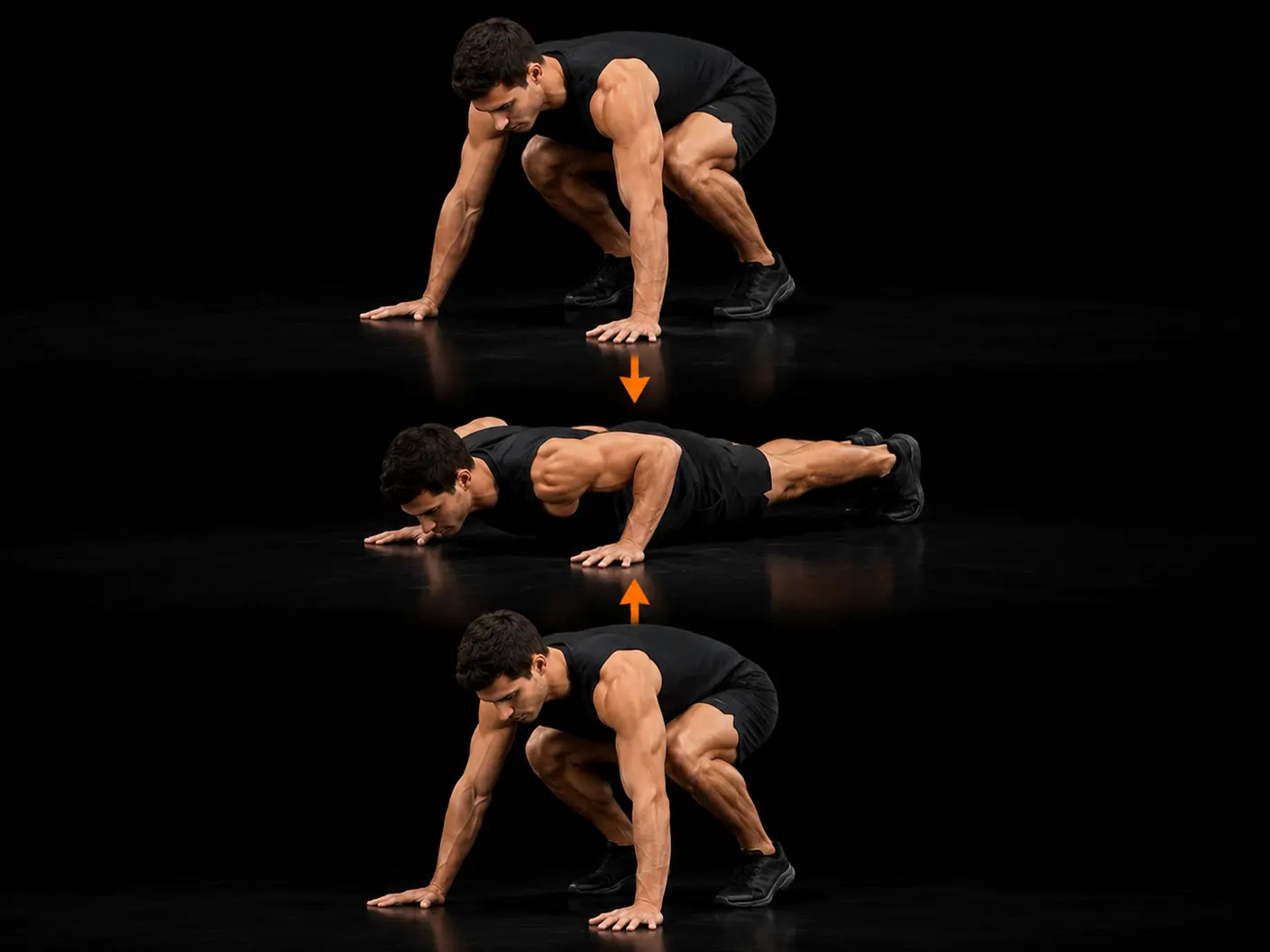
The sprawl is a bodyweight conditioning drill rooted in combat sports and functional athleticism. It trains the ability to transition explosively between standing and prone positions, demanding coordinated effort from the hip flexors, quadriceps, pectorals, deltoids, and core. It suits intermediate trainees looking to develop conditioning, reactive speed, and total-body athleticism.
How to do it
From a standing position, shoot the hips back explosively while placing both hands on the floor. Extend the legs back to a flat prone position — hips drop and make contact with the floor. Immediately drive the hips back up and push the hands off the floor to return to standing. Stay reactive and quick.
Coaching cues
- Hips back and flat
- Land controlled
- Explosive return
- Quick off the floor
Why train it
- The explosive hip-shooting mechanic places significant demand on the hip flexors and quadriceps, reinforcing power output through a full range of motion.
- Because the movement cycles through standing, floor contact, and return phases without rest, it taxes the cardiovascular system effectively, making it a practical tool for fat loss protocols.
- The sprawl trains reactive speed and body control simultaneously, qualities that transfer directly to sport, martial arts, and general athletic performance.
- As a bodyweight drill, it requires no equipment and can be incorporated into circuits, intervals, or warm-up sequences with minimal setup.
Common mistakes
- Letting the hips pike high as the legs extend back — actively drive the hips down to make full contact with the floor in the prone position, as the cue demands.
- Landing with stiff, uncontrolled arms — accept the floor with soft elbows and a stable shoulder position to protect the joints and maintain speed through the rep.
- Pausing at the bottom before returning — the drill is designed to be reactive, so the moment the hips contact the floor, immediately drive them back up and push off the hands.
- Losing the hip-back initiation on the descent — the movement begins by shooting the hips back, not dropping the chest; keep that sequence correct to maintain mechanics under fatigue.
Primary: Hip Flexors, Quadriceps.
Secondary: Pectoralis Major, Anterior Deltoid, Rectus Abdominis.
Equipment
Good for
Easier variation
Squat thrust — remove the full prone contact and keep the hips elevated throughout.
Similar movements
Frequently asked
- What muscles does the sprawl work?
- The primary muscles loaded are the hip flexors and quadriceps, which drive the explosive descent and the return to standing. The pectorals, deltoids, and core contribute as secondary stabilisers during the floor transition.
- How many sets and reps should I do for the sprawl?
- Because it is a conditioning movement, the sprawl is typically programmed by time or by rep clusters within circuits — for example, 5–10 repetitions per round across 3–5 rounds, or 20–30 second intervals with a work-to-rest ratio appropriate to your training goal. Adjust volume based on your current conditioning level.
- What is the difference between a sprawl and a burpee?
- The sprawl omits the press-up and the jump, focusing instead on the hip-shooting mechanic and rapid floor transition. This makes it faster and more specific to reactive athleticism, whereas the burpee adds upper-body pressing volume and a plyometric finish.
- Is the sprawl suitable for fat loss training?
- Yes — it is listed as a primary goal for this movement. The continuous cycling between standing and prone positions elevates heart rate efficiently, making it a useful drill within interval or circuit-based fat loss programmes.
- What are good alternatives to the sprawl if I find it too advanced?
- If the full sprawl feels too demanding, practise the descent and return in separate phases until the mechanics are solid. A controlled squat thrust, which follows a similar pattern at reduced speed, can also serve as a stepping stone before progressing to the reactive version.
Want this movement in a plan built for you?
Adaptiv programmes the right exercises for your goal, equipment and experience — then adapts them as you train.
Build my programme