Mountain Climber
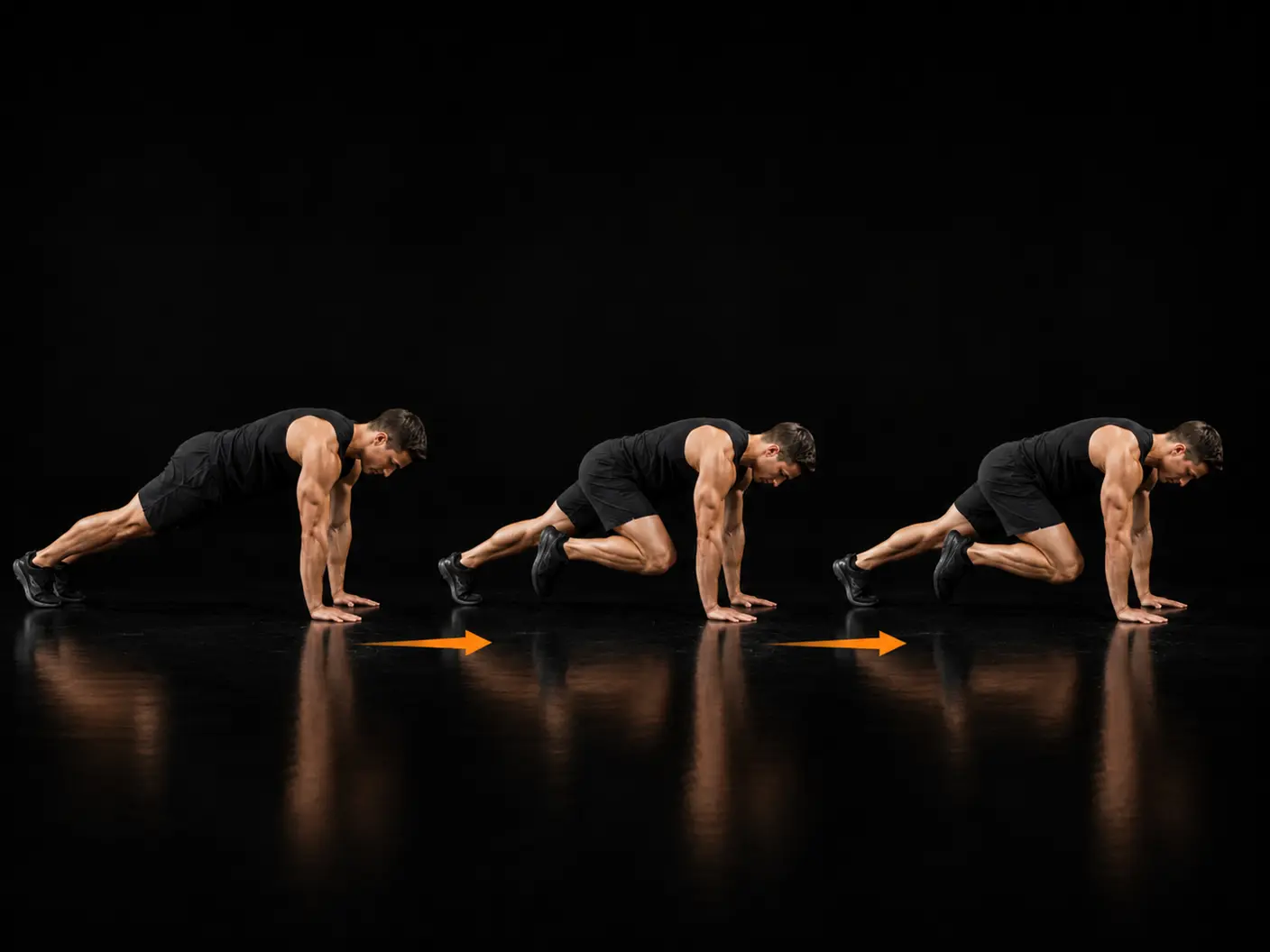
The mountain climber is a bodyweight conditioning exercise performed from a high plank position, alternating rapid knee drives toward the chest in a running-like pattern. It trains core stability, hip flexor strength, and cardiovascular endurance simultaneously within a single movement. It suits beginners building aerobic capacity and athletes seeking low-equipment conditioning work.
How to do it
Start in a push-up position with hands directly under shoulders and body forming a straight line. Drive one knee toward the chest, then quickly switch legs in an alternating running motion. Keep the hips level throughout — do not allow them to rise or pike. Maintain a braced, neutral spine and steady breathing.
Coaching cues
- Hips flat
- Drive the knee
- Core braced
- Shoulders over hands
Why train it
- Develops core stability under fatigue, requiring the trunk to resist extension and rotation while the legs move dynamically.
- Raises heart rate efficiently without equipment, making it a practical choice for fat loss and general fitness programming.
- Reinforces hip flexor strength through repeated, controlled knee drives that carry over to sprinting and other athletic movements.
- Requires no equipment and minimal space, allowing it to slot into warm-ups, circuits, or standalone conditioning blocks.
Common mistakes
- Allowing the hips to pike upward — consciously keep them level with the shoulders and heels throughout each repetition.
- Letting the shoulders drift behind the hands — maintain a stacked position with the shoulders directly over the wrists at all times.
- Holding the breath during the effort — establish a steady breathing rhythm so you can sustain output across the full set.
- Allowing the lower back to sag — brace the core before the first knee drive and hold that tension for the duration of the set.
Primary: Rectus Abdominis, Hip Flexors.
Secondary: Pectoralis Major, Anterior Deltoid, Quadriceps.
Equipment
Good for
Easier variation
Slow-tempo mountain climber — step each foot forward deliberately rather than running.
Similar movements
Frequently asked
- What muscles do mountain climbers work?
- The primary muscles trained are the core and hip flexors. The pectorals, deltoids, and quadriceps contribute as secondary stabilisers throughout the movement.
- How many sets and reps should I do for mountain climbers?
- For conditioning and fat loss, programme them by time rather than reps — 20 to 40 seconds of effort with 20 to 40 seconds of rest works well across three to five rounds. If you are using them as a warm-up, two rounds of 20 seconds is sufficient to elevate the heart rate and activate the core.
- Are mountain climbers suitable for beginners?
- Yes — they are rated as a foundational movement, so they are appropriate for those new to exercise. Focus on keeping the hips flat and the shoulders over the hands before increasing speed.
- What are good alternatives to mountain climbers?
- If you need a lower-impact option, slow, controlled knee drives in a static plank position reduce the cardiovascular demand while preserving the core stability stimulus. High knees performed standing offer a similar hip flexor and conditioning stimulus with no ground contact required.
- Can mountain climbers help with athletic performance?
- Yes — the repeated knee drive pattern builds hip flexor endurance and reinforces the braced trunk position that underpins sprinting and change-of-direction movements. They are best used as a conditioning complement to primary strength work rather than a standalone athletic development tool.
Want this movement in a plan built for you?
Adaptiv programmes the right exercises for your goal, equipment and experience — then adapts them as you train.
Build my programme