Bear Crawl
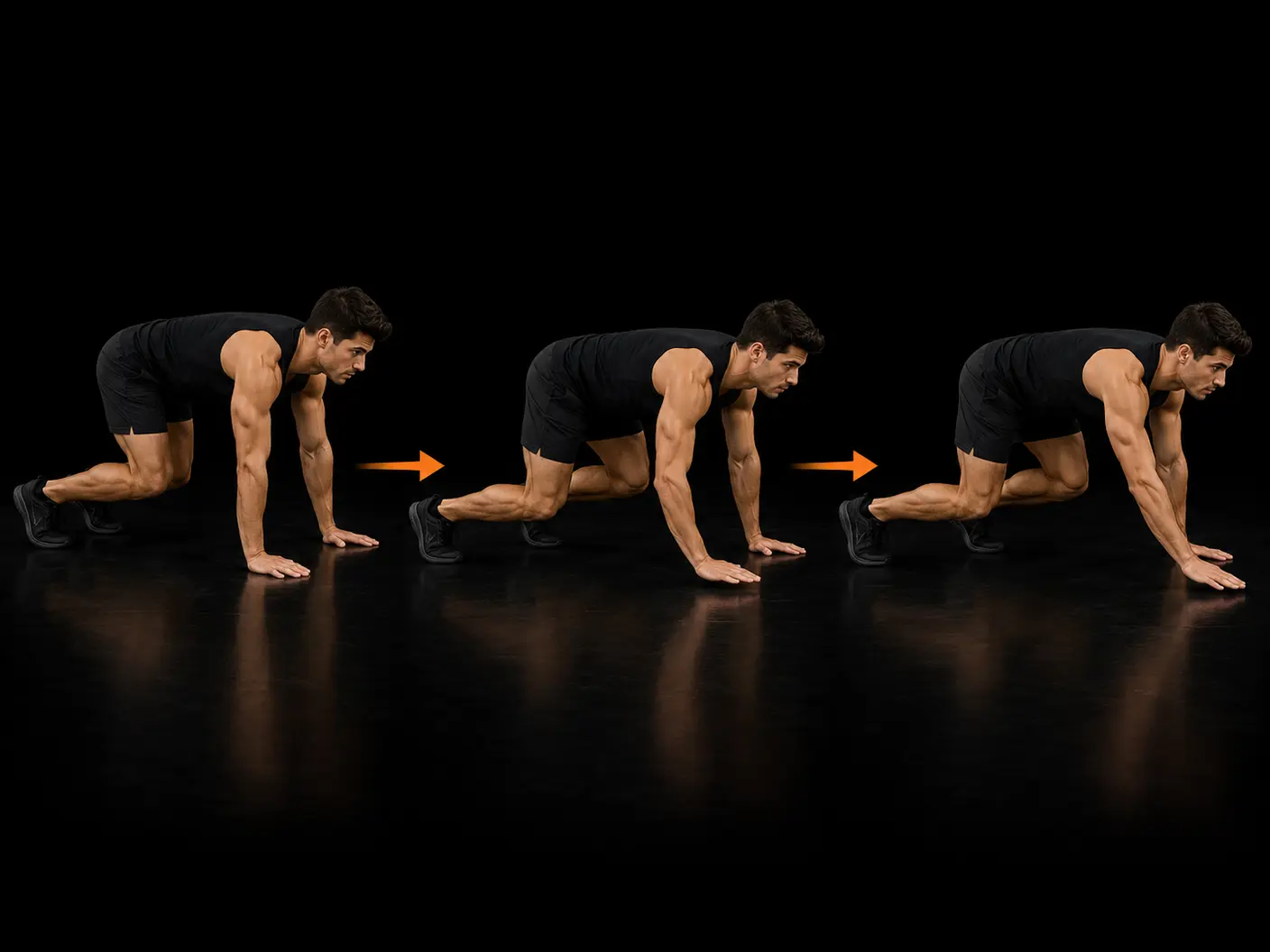
The bear crawl is a bodyweight conditioning drill performed on all fours with the knees hovering just above the floor, demanding simultaneous coordination across the upper and lower body. It trains the contralateral movement pattern — moving opposite hand and foot together — which underpins athletic locomotion and whole-body stability. It suits intermediate trainees looking to develop conditioning, core control, and movement quality without loading the spine.
How to do it
Start on all fours with knees hovering 1–2 inches off the floor and hips at shoulder height. Crawl forward by moving the right hand and left foot simultaneously, then the left hand and right foot. Keep the back flat and hips stable — resist any rotational movement. Breathe steadily and maintain the low, controlled position.
Coaching cues
- Knees hover low
- Hips level
- Move opposite limbs
- Back flat
Why train it
- Develops core stability under dynamic conditions, as the trunk must resist rotation and remain level throughout every stride.
- Trains the deltoids, triceps, and pectorals as weight-bearing structures rather than prime movers, building functional upper-body endurance.
- Elevates heart rate efficiently using only bodyweight, making it a practical conditioning tool within circuits or as active recovery between heavier sets.
- Reinforces contralateral coordination — the same cross-body movement pattern used in running, climbing, and field sport — supporting broader athletic performance.
Common mistakes
- Hips rising too high — keep them level with the shoulders rather than pushing the backside up into a pike position, which offloads the core and defeats the purpose of the drill.
- Letting the back round or sag — maintain a flat spine throughout by bracing the core before the first movement and sustaining that tension for the duration of the set.
- Moving same-side limbs together — always pair the right hand with the left foot and the left hand with the right foot, as this contralateral pattern is central to the drill's coordination and stability demands.
- Knees drifting too close to the floor or resting down — keep them hovering 1–2 inches above the ground for the entire set, as losing that hover removes the isometric demand from the quads and core.
Primary: Rectus Abdominis, Anterior Deltoid, Quadriceps.
Secondary: Hip Flexors, Gluteus Maximus, Triceps Brachii, Pectoralis Major.
Equipment
Good for
Easier variation
Bear crawl in place — practise the limb pattern without forward locomotion.
Similar movements
Frequently asked
- What muscles does the bear crawl work?
- The primary muscles are the core, deltoids, and quadriceps. The hip flexors, glutes, triceps, and pectorals contribute as secondary movers and stabilisers throughout the movement.
- How many sets and reps should I do for the bear crawl?
- Because the bear crawl is a locomotion drill, it is typically programmed by distance or duration rather than reps — 10–20 metres per set, or 20–40 seconds of continuous movement, works well for most intermediate trainees. Two to four sets within a conditioning circuit is a practical starting point.
- Is the bear crawl suitable for fat loss?
- Yes, it features among the primary goals this movement supports. It engages a large number of muscle groups simultaneously, sustains an elevated heart rate, and can be incorporated into high-density circuits to increase overall work output within a session.
- What are good alternatives to the bear crawl?
- Any contralateral bodyweight drill that loads the core in a quadruped position is a comparable alternative, such as bird-dog holds or crawl variations. If the goal is upper-body conditioning, plank shoulder taps or press-up complexes address some of the same muscles, though they do not replicate the locomotion component.
- How difficult is the bear crawl, and is it suitable for beginners?
- It is classified as an intermediate movement. Beginners may find it challenging to maintain a flat back, stable hips, and correct contralateral limb pattern simultaneously, particularly under fatigue. Those new to the drill should start with short distances at a slow, deliberate pace before building duration or speed.
Want this movement in a plan built for you?
Adaptiv programmes the right exercises for your goal, equipment and experience — then adapts them as you train.
Build my programme