Plank Shoulder Tap
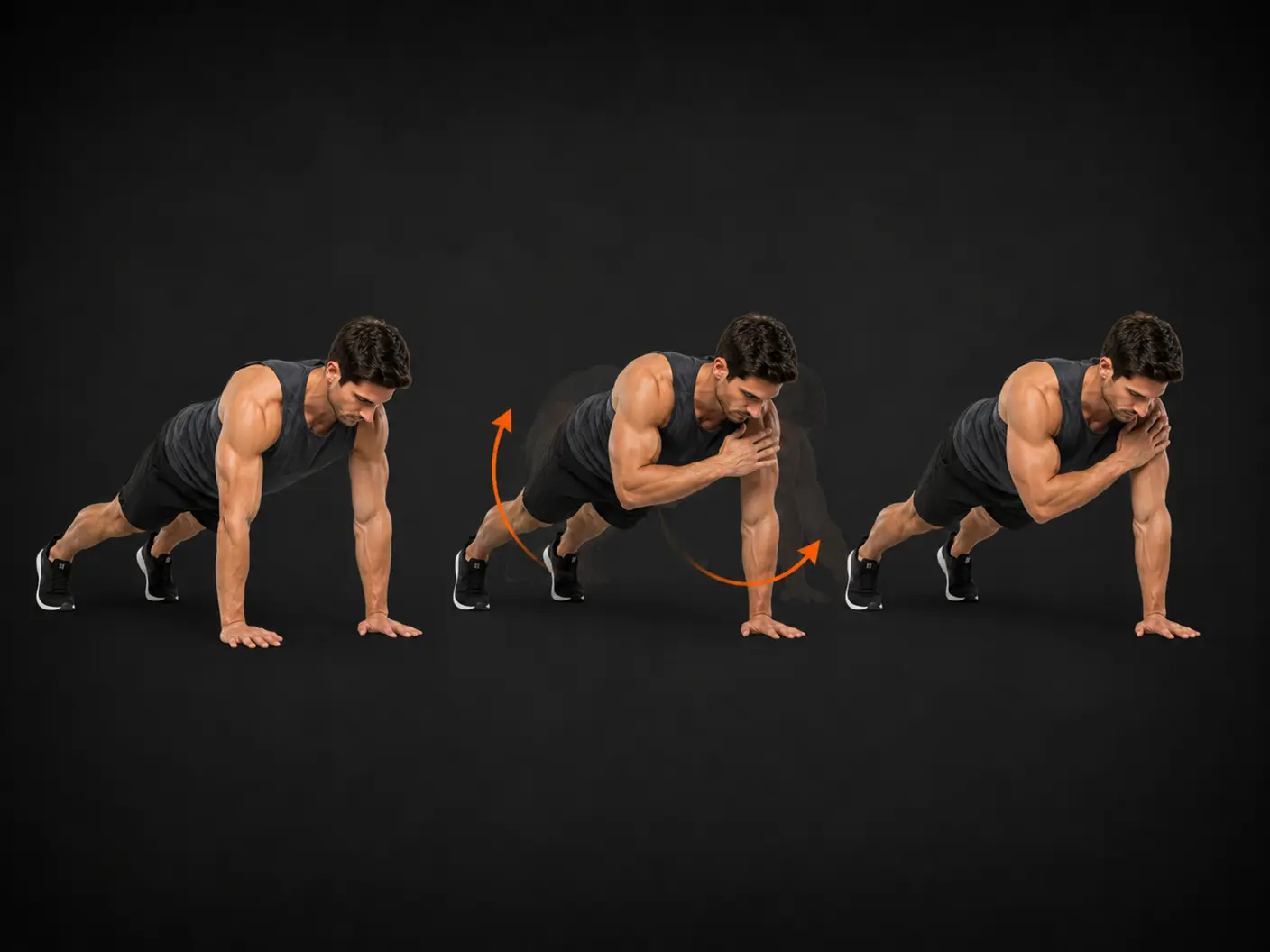
The plank shoulder tap is a bodyweight core exercise performed from a high plank position, in which each hand alternately leaves the floor to tap the opposite shoulder. It trains anti-rotation — the ability of the core to resist unwanted twisting forces rather than produce them. The movement suits intermediate trainees who have already built a base of plank endurance and are ready to challenge stability under a shifting load.
How to do it
Set up in a high plank, hands under the shoulders. Feet wide for stability. Lift one hand, tap the opposite shoulder, return. Alternate sides. Resist rotation of the hips throughout — hips do not shift side to side.
Coaching cues
- Hips do not shift
- Wide feet for stability
- Controlled taps
- Brace hard
Why train it
- Develops anti-rotational core strength by forcing the trunk to stay square each time the base of support is reduced to three points.
- Trains the obliques and rectus abdominis under dynamic conditions, bridging the gap between static holds and more complex loaded movements.
- Reinforces shoulder stability, as the planted arm must stabilise the entire body through each tap.
- Requires no equipment, making it straightforward to include in warm-ups, finishers, or home-based programmes.
Common mistakes
- Allowing the hips to shift from side to side — set the feet wider than shoulder-width and brace the core hard before each tap to keep the pelvis level throughout.
- Rushing the taps — slow each rep down so the challenge comes from controlled resistance rather than momentum carrying the movement.
- Letting the hips pike upward or sag toward the floor — maintain a rigid line from head to heel by squeezing the glutes and keeping the ribcage drawn in.
- Holding the breath during the tap — exhale on the lift and continue breathing steadily so intra-abdominal pressure remains consistent.
Primary: Rectus Abdominis, Obliques.
Secondary: Anterior Deltoid, Gluteus Maximus.
Equipment
Good for
Easier variation
Plank hold — remove the tap to learn the static position first.
Similar movements
Frequently asked
- What muscles does the plank shoulder tap work?
- The primary muscles are the rectus abdominis and obliques, which resist rotation as the hand leaves the floor. The shoulders and glutes work as secondary stabilisers to maintain position throughout.
- How many sets and reps should I do?
- Two to four sets of eight to twelve taps per side is a practical starting range for most intermediate trainees. Prioritise quality over volume — if the hips are shifting noticeably, reduce the reps until control improves.
- What is the difference between a plank shoulder tap and a standard plank?
- A standard plank maintains four points of contact throughout and trains static endurance. The shoulder tap removes one point of contact on every rep, introducing a rotational demand that the core must actively resist, making it a more dynamic and progressive variation.
- Is the plank shoulder tap suitable for beginners?
- It is rated as an intermediate movement because it requires a solid foundation of core endurance and shoulder stability. Beginners would benefit from building comfort in a high plank hold first before progressing to the shoulder tap.
- What are good alternatives if I find this too difficult?
- Returning to a standard high plank hold to build endurance is the most direct regression. Once that feels stable, you can practise lifting one hand just slightly off the floor without completing the tap, gradually increasing range of motion as control improves.
Want this movement in a plan built for you?
Adaptiv programmes the right exercises for your goal, equipment and experience — then adapts them as you train.
Build my programme