Half-Kneeling Pallof Press
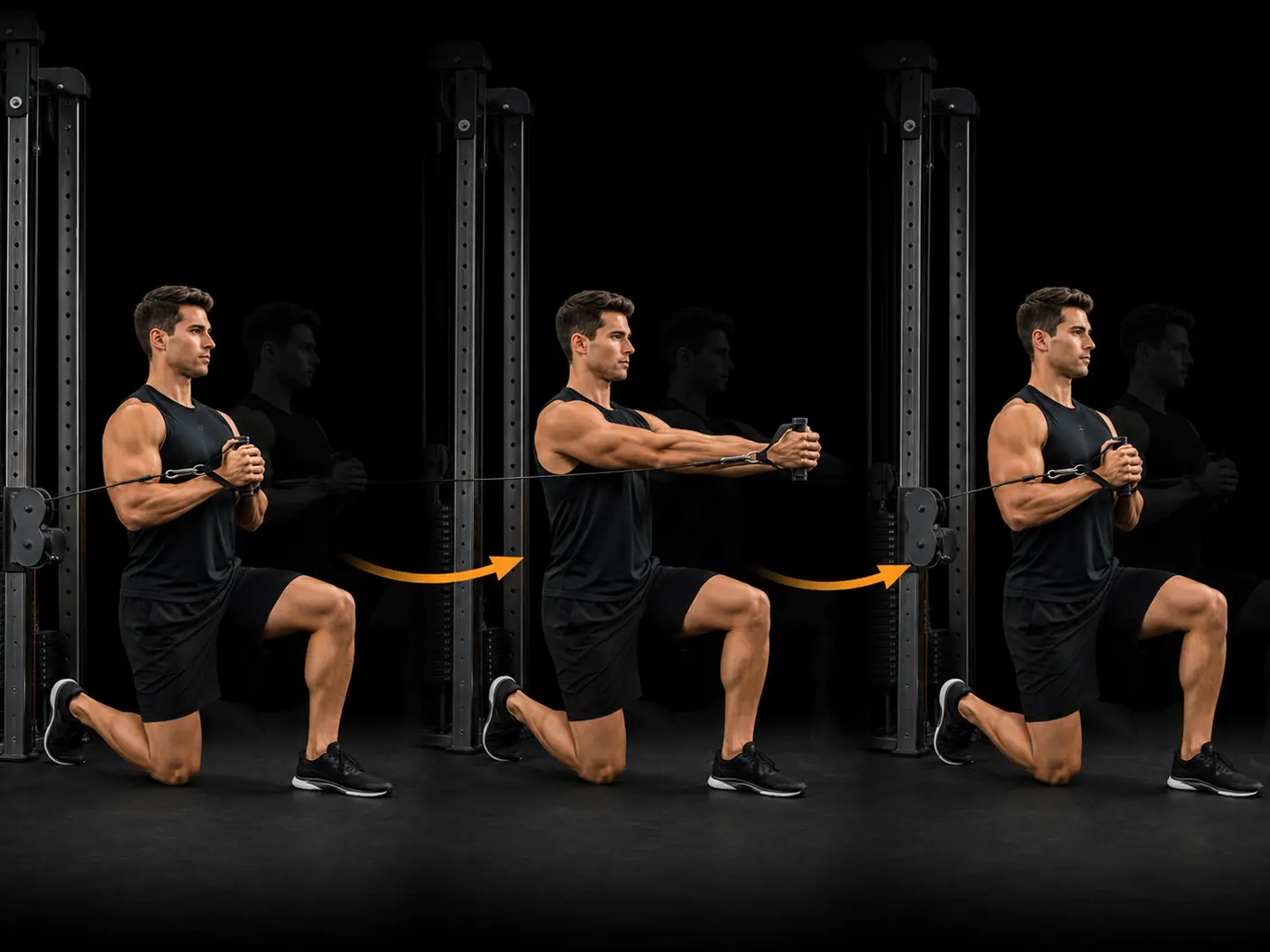
The half-kneeling Pallof press is a cable or band-based anti-rotation exercise performed from a split stance on one knee, requiring the core to resist lateral forces rather than produce movement. It trains the obliques and transverse abdominis to stabilise the spine under load, while the reduced base of support in the half-kneeling position places additional demand on hip stability. It suits intermediate trainees looking to build functional core strength for sport or general fitness.
How to do it
Kneel on one knee, opposite foot forward. Grip the cable at the chest. Press out and hold. The half-kneeling position reduces base of support and increases demand.
Coaching cues
- Tall half-kneel
- Resist rotation
- Press out
- Hold
Why train it
- The anti-rotation demand directly targets the obliques and TVA, developing the deep stability that carries over to compound lifts and athletic movement.
- The half-kneeling position reduces the base of support compared to standing, forcing the glutes and hip flexors to work alongside the core to maintain an upright posture throughout the set.
- Because the resistance must be resisted rather than overcome, the exercise reinforces controlled bracing patterns that transfer well to squatting, hinging, and rotational sport movements.
- It is equipment-efficient and easily scalable — adjusting the cable or band tension allows the movement to be progressed or regressed without changing the pattern itself.
Common mistakes
- Letting the torso rotate toward the cable as you press — brace through the obliques before the press begins and maintain that tension throughout the hold.
- Losing the tall half-kneel by sinking into the hip — think of driving the back knee gently into the floor to keep the pelvis neutral and the trunk upright.
- Rushing through the hold phase — press the hands out fully, pause for a deliberate count of two to three seconds, then return under control rather than snapping back.
- Placing the front foot too narrow or too wide — position the lead foot directly forward so the knee tracks over the toes and the hips remain square to the front.
Primary: Obliques, Transverse Abdominis.
Secondary: Gluteus Maximus, Hip Flexors.
Equipment
Good for
Easier variation
Standing Pallof press — wider base, easier to control.
Similar movements
Frequently asked
- What muscles does the half-kneeling Pallof press work?
- The primary muscles are the obliques and transverse abdominis, which resist the rotational pull of the cable or band. The glutes and hip flexors are also engaged to stabilise the pelvis and maintain the half-kneeling position.
- How many sets and reps should I do?
- Two to four sets of eight to twelve reps per side works well for most general fitness and athletic performance goals. Prioritise a full hold at extension over accumulating reps quickly — quality of resistance matters more than volume here.
- What is the difference between the standing and half-kneeling Pallof press?
- The half-kneeling position narrows your base of support compared to standing, which increases the stability demand on the hips and core simultaneously. It also makes it easier to identify and correct asymmetries between sides, as any imbalance in hip or core stability becomes more apparent.
- Can I use a resistance band instead of a cable machine?
- Yes — anchoring a resistance band to a fixed point at chest height replicates the cable stimulus closely. Be aware that band tension increases as you press out, whereas a cable maintains relatively constant load, so start with a lighter band than you might expect.
- Where does the half-kneeling Pallof press fit in a programme?
- It is most commonly used as an accessory or activation movement, placed after main compound work or as part of a warm-up to prime core stability. Because it is not a high-fatigue exercise, it also fits well between lower-body sets as active rest.
Want this movement in a plan built for you?
Adaptiv programmes the right exercises for your goal, equipment and experience — then adapts them as you train.
Build my programme