Cable Anti-Rotation Hold
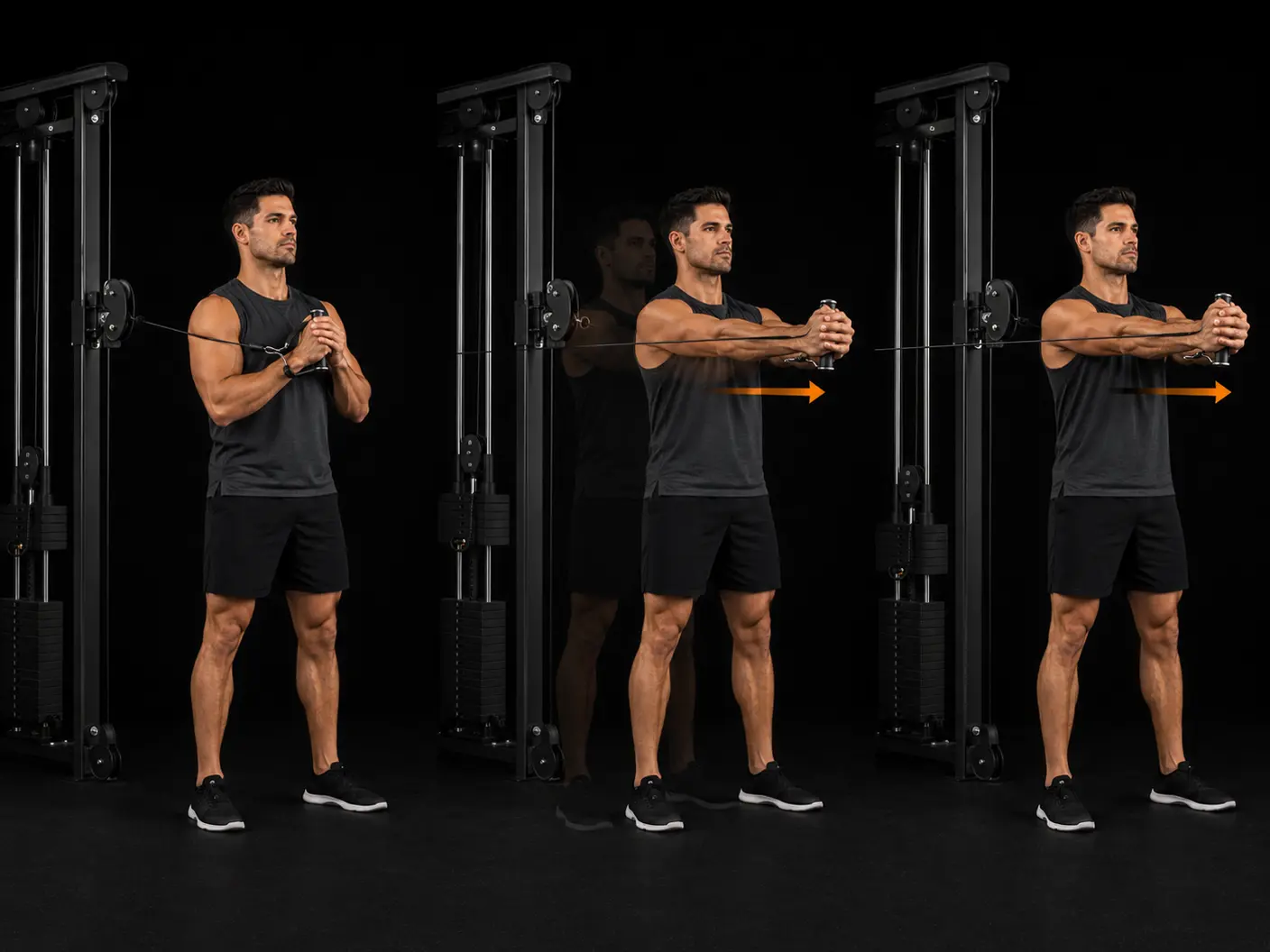
The cable anti-rotation hold is an isometric core exercise that trains the body's ability to resist rotational force rather than produce it. Standing side-on to a cable machine, the lifter presses a handle out from the chest and holds position while opposing the lateral pull of the cable — a demand that directly challenges the obliques and transverse abdominis. It suits anyone building a foundation of core stability, from general fitness trainees to athletes who need a resilient trunk under load.
How to do it
Set a cable at chest height. Stand side-on with the handle in both hands at the chest. Step away from the stack until the cable is taut. Press the hands directly out in front of the chest and hold this position for a set time, resisting the cable's rotational pull. Do not allow the torso to rotate. Return the hands to the chest and repeat.
Coaching cues
- Resist the rotation
- Handle at chest height
- Brace hard
- Tall posture
Why train it
- It develops anti-rotational stiffness in the obliques and TVA, which underpins safe force transfer through the torso in virtually every compound lift.
- The isometric nature of the hold means the core musculature is trained under sustained tension, reinforcing the bracing patterns that carry over to sport and daily movement.
- Because load and hold duration are easily adjusted on a cable stack, the exercise scales well across ability levels without requiring a change in equipment or technique.
- Incorporating the glutes and shoulders as secondary stabilisers means the exercise reinforces full-body alignment rather than isolating the core in isolation from the rest of the kinetic chain.
Common mistakes
- Allowing the torso to rotate toward the cable — brace the core firmly before pressing out and treat any rotation as a signal to reduce the load or shorten the hold duration.
- Setting the cable too low or too high — position the pulley precisely at chest height so the force vector challenges rotation rather than introducing unwanted flexion or extension.
- Holding the breath throughout the hold — maintain steady, controlled breathing while keeping the brace firm, as breath-holding unnecessarily elevates internal pressure and limits how long quality tension can be sustained.
- Collapsing through the upper back as the arms extend — keep tall posture with the shoulders drawn back, ensuring the load is absorbed by the trunk rather than transferred into a rounded spine.
Primary: Obliques, Transverse Abdominis.
Secondary: Gluteus Maximus, Anterior Deltoid.
Equipment
Good for
Easier variation
Banded Pallof press — lighter resistance via band.
Similar movements
Frequently asked
- What muscles does the cable anti-rotation hold work?
- The primary muscles are the obliques and transverse abdominis, which work isometrically to prevent the torso from rotating toward the cable. The glutes and shoulders contribute as secondary stabilisers to maintain upright posture and a steady arm position.
- How many sets and reps should I do for the cable anti-rotation hold?
- Because this is a timed hold, a practical starting point is 3 sets of 20–30 seconds per side with a load that makes the final few seconds genuinely challenging without causing form breakdown. As stability improves, extend the hold duration or increase the cable weight before adding more sets.
- Where does the cable anti-rotation hold fit in a training programme?
- It works well as a core accessory movement, typically placed after primary compound lifts or within a dedicated core circuit. Its low skill requirement and controlled loading make it suitable for both general fitness and athletic performance programmes.
- What are good alternatives if I do not have access to a cable machine?
- A resistance band anchored to a fixed point at chest height replicates the force vector closely and is a practical substitute. Pallof press variations using a band follow the same mechanics and can be performed almost anywhere with a sturdy anchor.
- Is the cable anti-rotation hold suitable for beginners?
- Yes — it is classified as a foundational movement because the technique is straightforward and the load is fully adjustable. Beginners should start with a light cable setting, focus on tall posture and a firm brace, and prioritise hold quality over duration or weight.
Want this movement in a plan built for you?
Adaptiv programmes the right exercises for your goal, equipment and experience — then adapts them as you train.
Build my programme