Tall-Kneeling Pallof Press
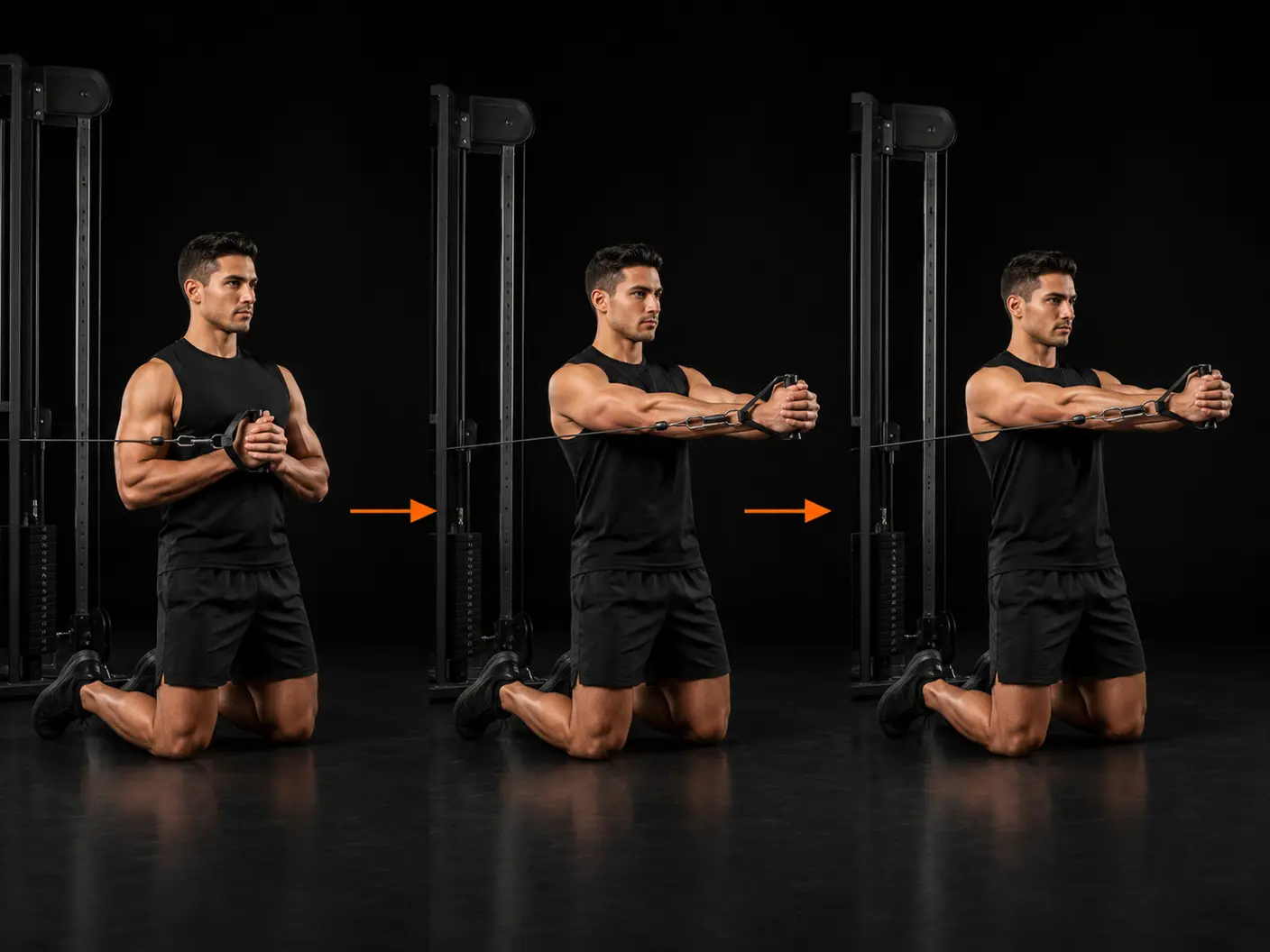
The tall-kneeling Pallof press is an anti-rotation core exercise performed facing perpendicular to a cable machine or resistance band, with both knees on the floor and no leg base to draw stability from. By removing the lower-body base, the position increases the rotational demand on the trunk compared with its standing equivalent, requiring the obliques and transverse abdominis to work harder to resist the pull of the load. It suits intermediate trainees building functional core stability for sport or general fitness.
How to do it
Kneel upright (tall kneeling) with both knees on the floor, facing perpendicular to a cable or band. Hold the handle at the chest. Brace hard. Press the handle out in front of the chest and hold for 2–3 seconds. Return the handle to the chest. The tall-kneeling position removes the base from the legs, increasing the rotational challenge versus standing.
Coaching cues
- Tall kneeling
- Resist rotation
- Press out straight
- Brace hard
Why train it
- The tall-kneeling position eliminates the legs as a stability aid, placing a greater anti-rotational demand directly on the obliques and TVA.
- Because the movement resists rotation rather than producing it, it trains the core in the pattern most relevant to athletic performance and everyday load transfer.
- The glutes and hip flexors must maintain an upright pelvic position throughout, adding an element of hip stability to the session.
- It requires only a cable machine or resistance band, making it accessible across most gym settings and straightforward to adjust for load progression.
Common mistakes
- Allowing the torso to rotate toward the cable as you press — brace the trunk before the press begins and maintain that tension throughout the full range.
- Shrugging or flaring the elbows as the handle moves away from the chest — keep the shoulders depressed and press in a straight horizontal line.
- Sitting back onto the heels rather than maintaining a true tall-kneeling position — stack the hips directly over the knees and squeeze the glutes to hold that upright alignment.
- Rushing the pressed position — hold the handle extended for the full 2–3 seconds before returning, as this is where the anti-rotational demand is highest.
Primary: Obliques, Transverse Abdominis.
Secondary: Gluteus Maximus, Hip Flexors, Rectus Abdominis.
Equipment
Good for
Easier variation
Standing Pallof press — wider base of support.
Similar movements
Frequently asked
- What muscles does the tall-kneeling Pallof press work?
- The primary muscles are the obliques and transverse abdominis, which resist the rotational pull of the cable or band. The glutes and hip flexors contribute by stabilising the pelvis and maintaining an upright posture throughout the movement.
- How many sets and reps should I do?
- A practical starting point is 3 sets of 8–12 controlled repetitions per side, holding the pressed position for 2–3 seconds on each rep. Because this is a stability exercise, quality of resistance matters more than volume, so reduce the load if you cannot maintain a neutral torso.
- What is the difference between the tall-kneeling and standing Pallof press?
- The tall-kneeling variation removes the feet and lower leg from the base of support, which reduces the ability to use hip and ankle strategy to counter rotation. This shifts more of the anti-rotational demand to the core directly, making it a useful progression once the standing version is well controlled.
- Is the tall-kneeling Pallof press suitable for beginners?
- It is classified as an intermediate exercise because the reduced base of support demands a reasonable level of existing core stability and body awareness. Beginners would typically build confidence with the standing Pallof press first before progressing to the tall-kneeling variation.
- Can I do this with a resistance band instead of a cable machine?
- Yes — anchoring a resistance band to a fixed point at chest height replicates the cable set-up closely. Bear in mind that band resistance increases as you press further from the anchor, so the loading profile differs slightly from a cable, but the movement pattern and coaching cues remain the same.
Want this movement in a plan built for you?
Adaptiv programmes the right exercises for your goal, equipment and experience — then adapts them as you train.
Build my programme