Pallof Press
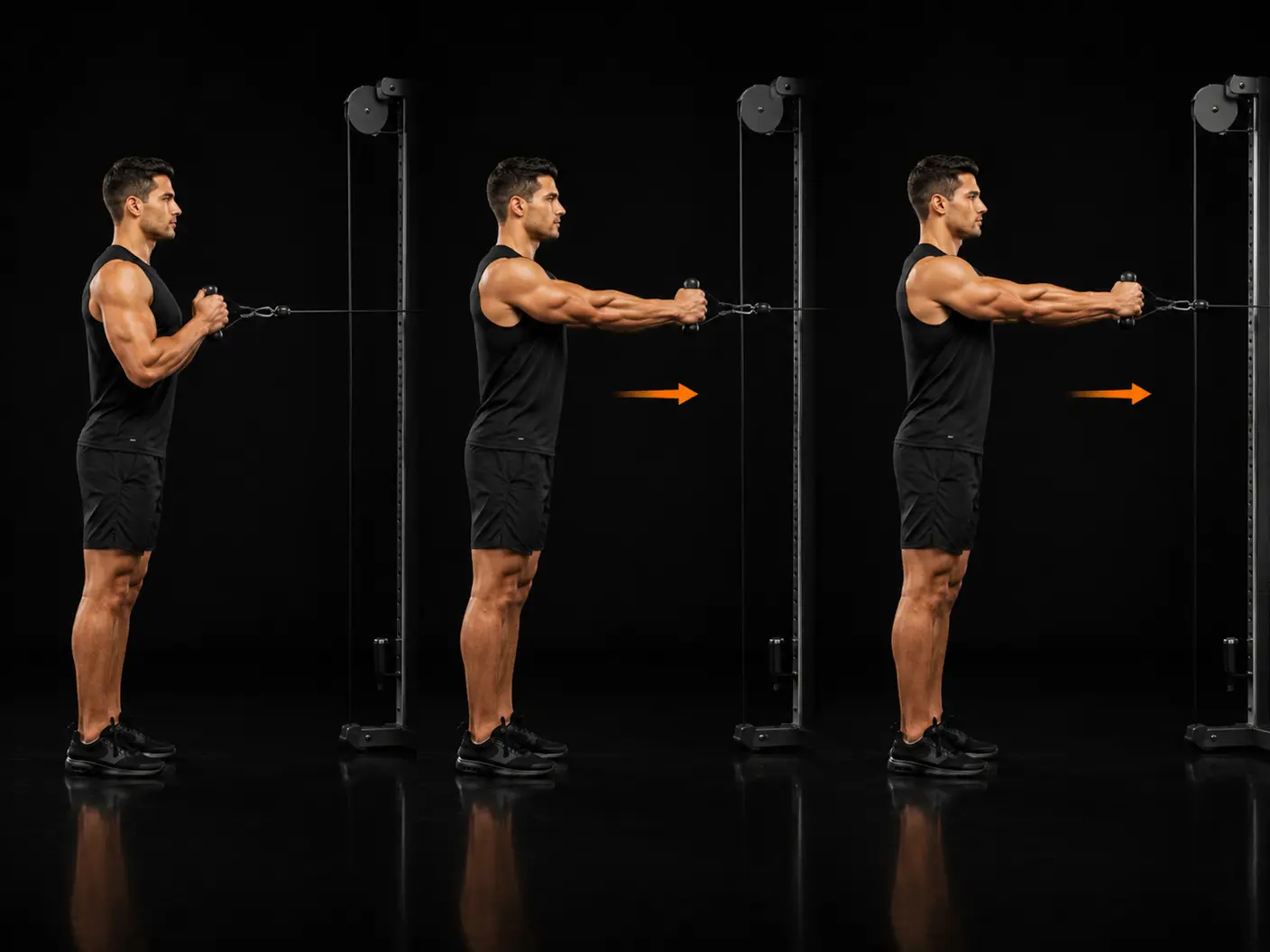
The Pallof press is an anti-rotation core exercise performed with a cable machine or resistance band set at chest height. Standing side-on to the anchor point, the lifter presses both hands straight out from the chest and resists the lateral pull that attempts to rotate the torso — training the core to stabilise rather than produce movement. It suits anyone from general fitness participants building foundational core control through to athletes requiring robust rotational stiffness under load.
How to do it
Set a cable or band at chest height. Stand side-on with the cable in both hands at the chest. Step away from the stack until the cable is taut. Press the hands out in front of the chest; resist the rotational pull. Hold for 2–3 seconds at full extension. Return.
Coaching cues
- Resist the rotation
- Press straight out
- Hold at full extension
- Brace hard
Why train it
- It directly trains the obliques and TVA to resist unwanted rotation, developing the kind of core stability that transfers to sport and everyday movement alike.
- Because the movement is low-impact and easily scaled by adjusting band tension or cable weight, it is accessible to a wide range of training ages and fitness levels.
- The held extension position demands sustained bracing, which reinforces the habit of maintaining intra-abdominal pressure — a skill that carries over to compound lifts such as squats and deadlifts.
- Training in a standing, upright position means the glutes and anterior core must work together to maintain a stable base, making it a more integrated stimulus than many floor-based core exercises.
Common mistakes
- Setting up too close to the stack — step far enough away that the cable or band is taut before you begin pressing, so resistance is present throughout the entire movement.
- Allowing the torso to rotate towards the anchor point — the point of the exercise is to prevent that rotation entirely, so brace the core hard and keep the shoulders square throughout.
- Rushing through the extension — press out deliberately and hold at full extension for the prescribed two to three seconds rather than bouncing the hands in and out.
- Flaring the arms wide instead of pressing straight out — keep the hands and forearms tracking directly forward from the chest to maintain the correct line of force against the cable or band.
Primary: Obliques, Transverse Abdominis.
Secondary: Rectus Abdominis, Gluteus Maximus.
Equipment
Good for
Easier variation
Banded Pallof press — easier resistance curve.
Similar movements
Frequently asked
- What muscles does the Pallof press work?
- The primary muscles trained are the obliques and the transverse abdominis (TVA), which work to resist the rotational pull of the cable or band. The anterior core and glutes act as secondary stabilisers to keep the body in a neutral, upright position throughout the movement.
- How many sets and reps should I do on the Pallof press?
- A common starting point is three sets of eight to twelve reps per side, holding the extended position for two to three seconds on each rep. Because this is an anti-rotation stability exercise rather than a strength or hypertrophy movement, quality of bracing and control matters more than chasing higher numbers.
- Is the Pallof press suitable for beginners?
- Yes — it is classified as a foundational movement and is well-suited to beginners provided the load is set conservatively. Start with a light band or low cable weight that allows you to hold a square, stable position throughout; increase resistance only once you can maintain clean form for the full set.
- What are good alternatives to the Pallof press if I do not have a cable machine?
- A looped resistance band anchored to a fixed upright at chest height replicates the exercise closely and is the most direct substitute. The key requirement is an anchor point that creates a consistent horizontal pull, so any sturdy post or rack upright will work.
- How does the Pallof press differ from other core exercises?
- Most common core exercises — crunches, leg raises, sit-ups — train the core to produce movement. The Pallof press trains the core to resist movement, specifically rotation, which more closely reflects how the core functions during compound lifts and athletic actions. This makes it a useful complement to, rather than a replacement for, other core work in a well-rounded programme.
Want this movement in a plan built for you?
Adaptiv programmes the right exercises for your goal, equipment and experience — then adapts them as you train.
Build my programme