Landmine Rotation (Chop)
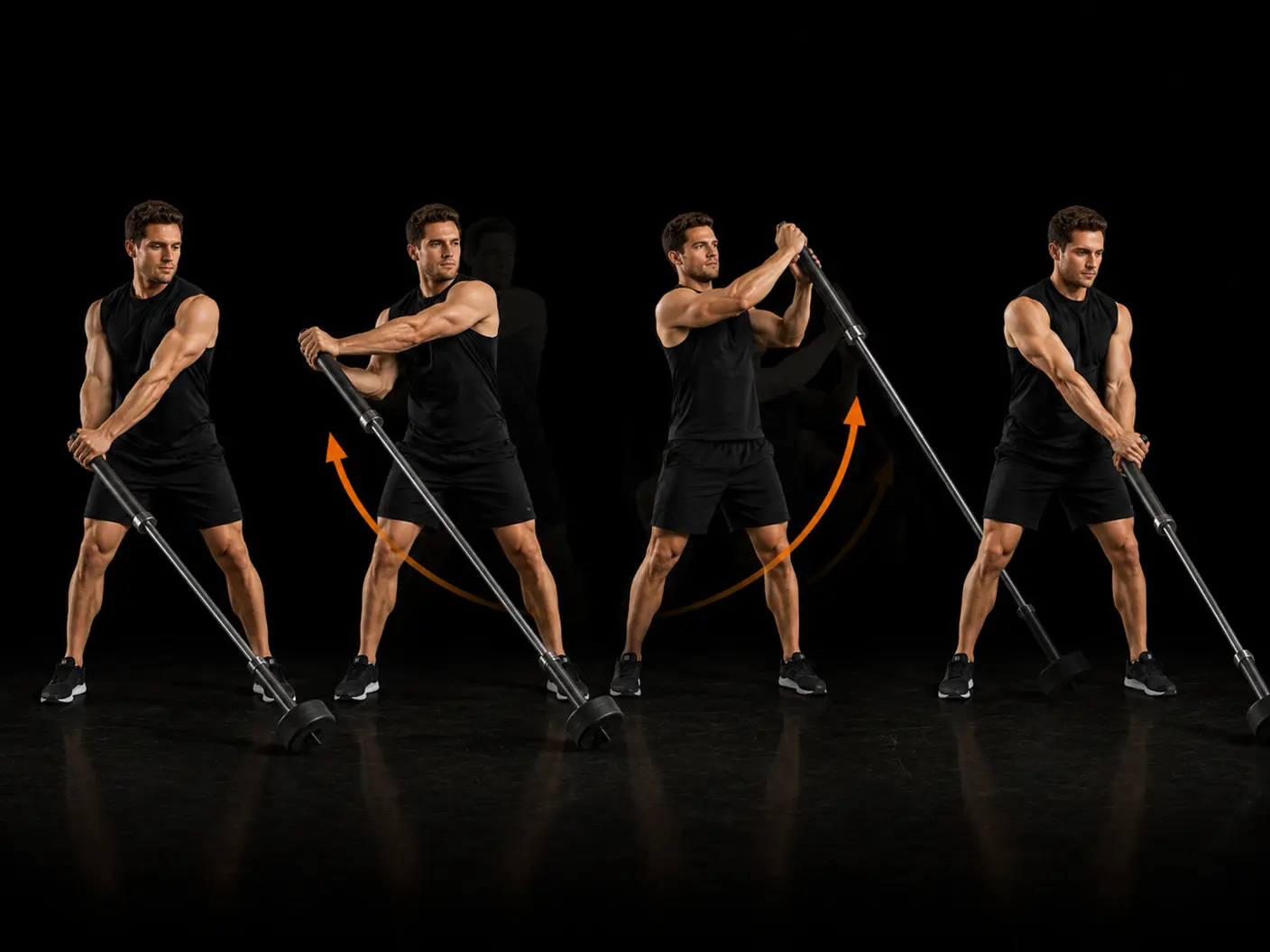
The landmine rotation, sometimes called a landmine chop, is a rotational core exercise performed with a barbell loaded into a landmine attachment. The lifter sweeps the bar through a controlled arc from shoulder to shoulder, training the obliques and transverse abdominis to produce and resist rotation simultaneously — a pattern that underpins a wide range of athletic movements. It suits intermediate trainees who have already developed a baseline of core stability and are ready to introduce rotational load.
How to do it
Stand facing a landmine with the bar in both hands overhead. Rotate side to side in a controlled arc, pivoting on the feet; the bar travels in a half-circle from shoulder to shoulder. Keep the arms relatively straight.
Coaching cues
- Pivot on the feet
- Rotate through the hips
- Control the arc
- Brace throughout
Why train it
- The arcing path of the landmine guides the bar through a mechanically sensible range, allowing the obliques and TVA to be loaded through rotation without placing excessive demand on the spine.
- Because the movement requires the feet to pivot and the hips to drive the arc, it develops rotational power that transfers directly to throwing, striking, and change-of-direction sports.
- Training rotation under load teaches the shoulders and hips to work as a coordinated unit, reinforcing the full-body sequencing that underlies efficient athletic performance.
- The landmine attachment constrains the bar's path, making the movement more accessible than a free-weight rotational lift and easier to load progressively over time.
Common mistakes
- Keeping the feet fixed and rotating only through the lower back — allow the heel to pivot on the trailing foot so the hips can drive the movement properly.
- Bending the arms and turning the exercise into a press — keep the arms relatively straight throughout so the load stays on the core rather than shifting to the triceps and shoulders.
- Rushing the arc and losing tension at end range — control the deceleration on each side, as the demand on the obliques is highest when the bar is being redirected.
- Letting the core decompress between repetitions — maintain an active brace from the first rep to the last, resetting your breath at the top rather than releasing tension mid-set.
Primary: Obliques, Transverse Abdominis.
Secondary: Anterior Deltoid.
Equipment
Good for
Easier variation
Russian twist — seated version at lighter load.
Similar movements
Frequently asked
- What muscles does the landmine rotation work?
- The primary muscles are the obliques and the transverse abdominis, which work together to produce and control the rotational arc. The shoulders and hips contribute as secondary movers, stabilising the bar overhead and driving the pivot through each repetition.
- How many sets and reps should I do for the landmine rotation?
- For athletic performance, three to four sets of six to ten repetitions per side works well, with a focus on speed and intent through the arc. For general fitness and core development, the same rep range at a more controlled tempo is appropriate; prioritise quality of movement over load.
- What is the difference between a landmine rotation and an anti-rotation exercise?
- The landmine rotation is technically a rotational exercise — the body moves through rotation — but the obliques and TVA are simultaneously resisting unwanted spinal flexion and lateral bend, which is why it is classified under the anti-rotation pattern. Both the production and the control of movement are trained within the same rep.
- What are good alternatives to the landmine rotation?
- Cable woodchops, medicine ball rotational throws, and pallof press variations all train a similar rotational or anti-rotational pattern. The landmine rotation is distinctive in that it loads the full arc of shoulder-to-shoulder movement, so the closest alternative in terms of mechanics is the cable woodchop performed from a high or mid anchor point.
- Is the landmine rotation suitable for beginners?
- This exercise is rated intermediate, so a foundation of core stability and basic barbell familiarity is advisable before adding it to a programme. Beginners would benefit from mastering plank variations, pallof presses, and bodyweight rotation drills first, then progressing to the landmine rotation once they can maintain a consistent brace under load.
Want this movement in a plan built for you?
Adaptiv programmes the right exercises for your goal, equipment and experience — then adapts them as you train.
Build my programme