Cable Lift (Low to High)
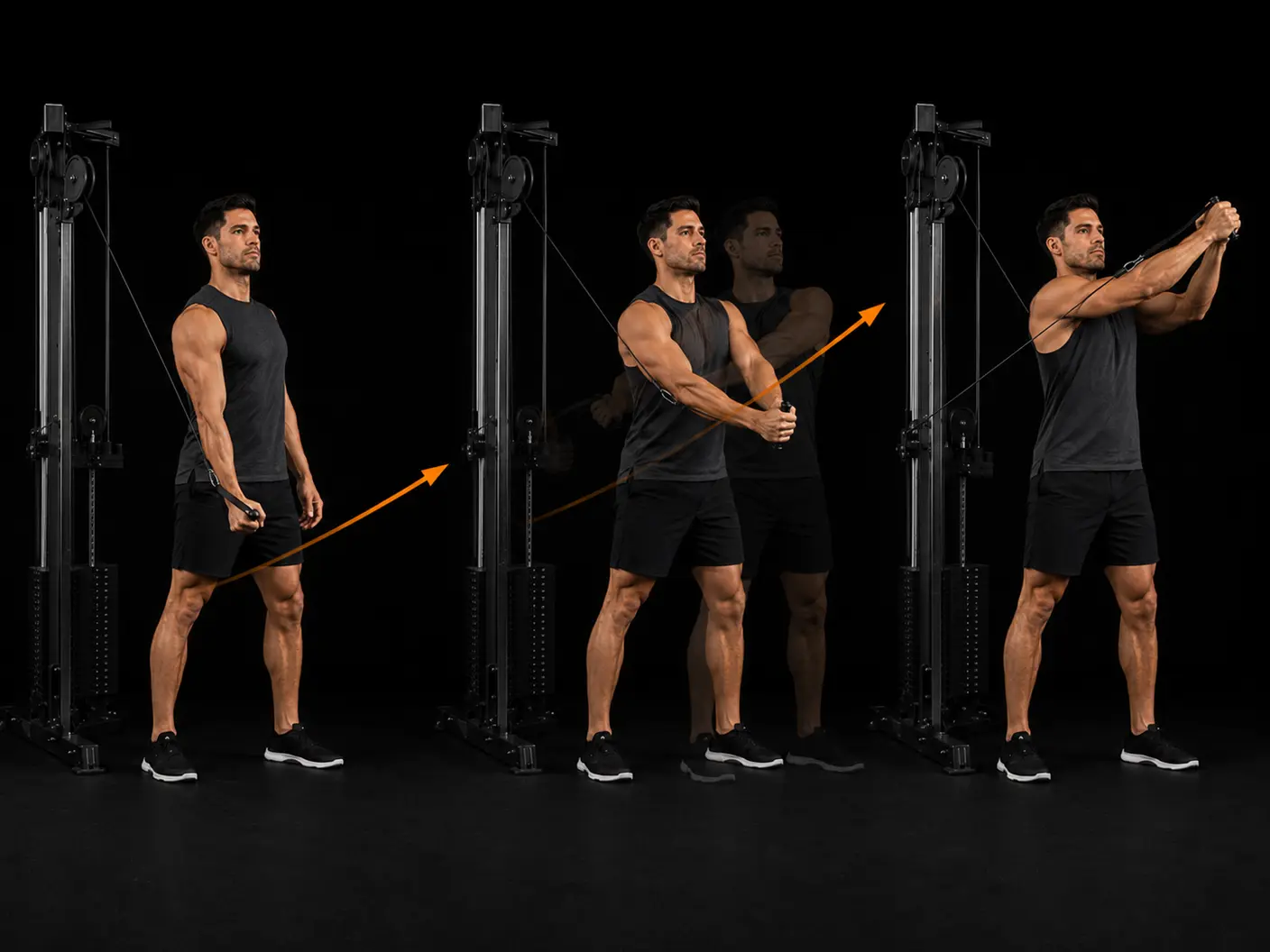
The cable lift is a rotational core exercise performed on a cable machine, training the body's capacity to generate and control force through a low-to-high diagonal pattern. It challenges the obliques and transverse abdominis to coordinate with the hips and upper back across a full range of motion, making it a genuine full-body anti-rotation and rotation exercise. It suits intermediate trainees looking to develop rotational power for sport or to build functional core strength beyond conventional sagittal-plane movements.
How to do it
Set a cable low. Stand side-on. Grip the handle with both hands at the low hip. Rotate and drive the cable up and across the body to overhead on the opposite side. Drive through the hips. Reverse slowly.
Coaching cues
- Drive through the hips
- Cable travels up and across
- Full rotation
- Control the return
Why train it
- The diagonal loading pattern develops rotational power through the hips and core, which transfers directly to throwing, striking, and change-of-direction demands in sport.
- By requiring the obliques and TVA to resist and then produce rotation under cable tension, the movement builds core stability that supports performance across a wide range of compound lifts.
- The glutes are actively engaged to drive the movement, reinforcing the habit of loading the hips rather than the lower back when producing rotational force.
- The cable's continuous tension through the full arc of motion challenges the shoulders and upper back to stabilise the end position, adding useful shoulder-complex work without isolating the joint.
Common mistakes
- Pulling with the arms rather than driving through the hips — initiate every rep by rotating the pelvis and letting the arms follow, keeping the elbows relatively soft throughout.
- Allowing the lower back to hyperextend at the top of the movement — brace the TVA and finish tall, avoiding any backward lean as the cable reaches the overhead position.
- Rushing the return phase — the eccentric portion carries as much training value as the lift itself, so resist the cable on the way back with deliberate control.
- Standing too close or too far from the machine — position yourself so there is meaningful tension in the cable at the start position and the line of pull creates genuine resistance throughout the diagonal path.
Primary: Obliques, Transverse Abdominis, Gluteus Maximus.
Secondary: Anterior Deltoid, Rhomboids.
Equipment
Good for
Easier variation
Band lift — lighter intensity variant.
Similar movements
Frequently asked
- What muscles does the cable lift low to high work?
- The primary muscles are the obliques, transverse abdominis, and glutes. The shoulders and upper back work as secondary stabilisers, particularly at the top of the movement where the cable reaches the overhead position.
- How many sets and reps should I do for the cable lift?
- For athletic performance, 3–4 sets of 8–12 reps per side at a load that allows full hip drive without compensating at the lower back is a practical starting point. For general fitness, 3 sets of 10–12 reps per side works well, prioritising control on the return over adding load.
- What are good alternatives if I do not have access to a cable machine?
- A resistance band anchored low to a fixed point replicates the diagonal pull pattern closely and is the most direct substitute. A medicine ball rotational scoop throw trains a similar movement pattern if you have access to a wall or a partner.
- Is the cable lift suitable for building a stronger core for sport?
- Yes — the low-to-high pattern mirrors the force transfer mechanics common in racket sports, combat sports, and field events where power moves from the ground up and across the body. Programming it alongside anti-rotation work such as pallof presses gives a well-rounded rotational core programme.
- Should I feel this in my lower back?
- You should feel the primary effort in your obliques, TVA, and glutes. If the lower back is the dominant sensation, reduce the load and focus on initiating the movement with hip rotation rather than spinal extension. If discomfort persists, consult a qualified professional before continuing.
Want this movement in a plan built for you?
Adaptiv programmes the right exercises for your goal, equipment and experience — then adapts them as you train.
Build my programme