Bicycle Crunch
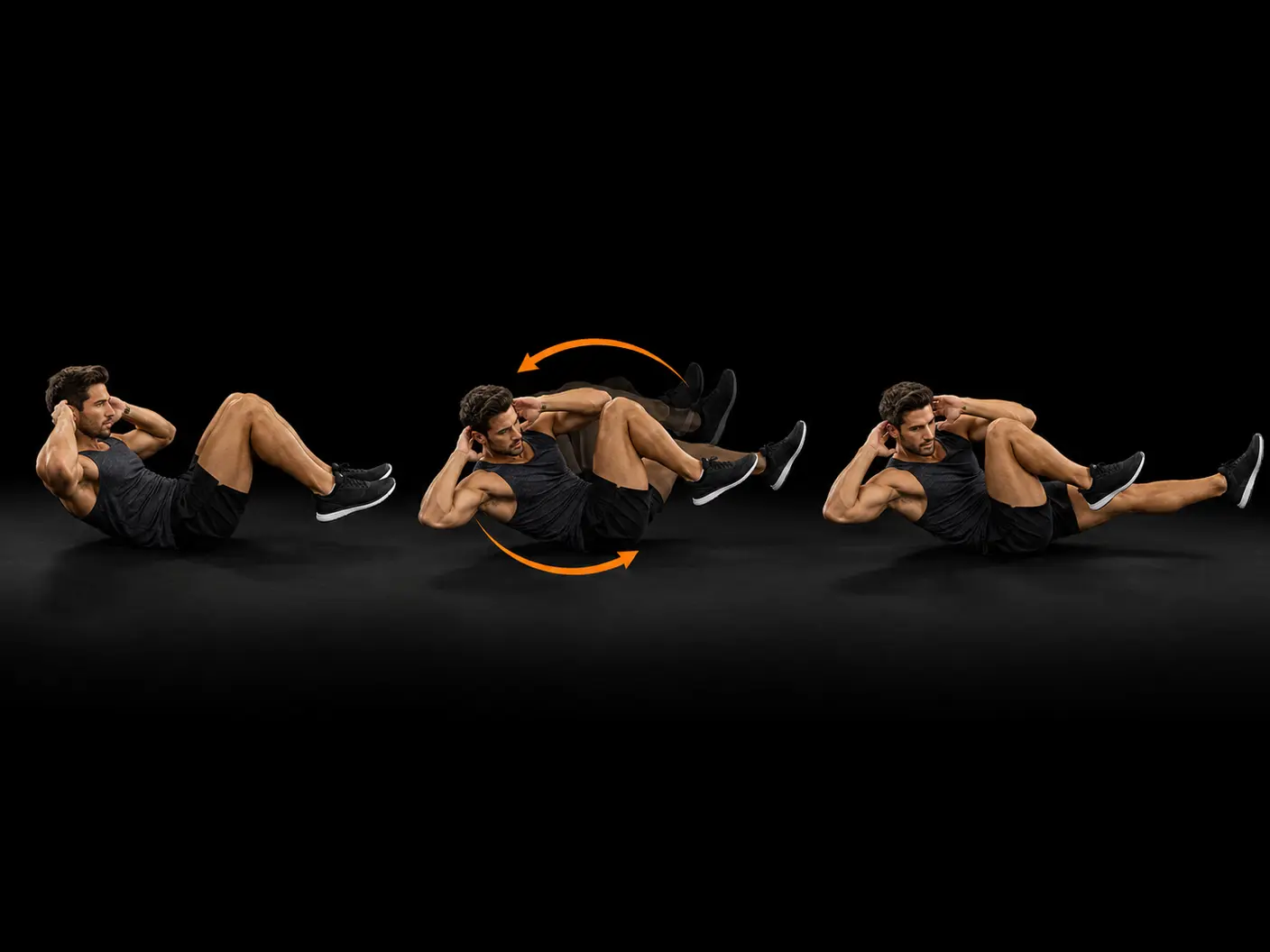
The bicycle crunch is a bodyweight core exercise performed supine, alternating a rotational crunch with a reciprocal leg extension in a cycling motion. It trains anti-extension through the lumbar spine whilst simultaneously demanding rotational control from the obliques, making it one of the more complete abdominal movements available without equipment. It suits beginners building foundational core awareness as well as intermediate trainees seeking oblique hypertrophy without loading the spine.
How to do it
Lie on your back with hands lightly behind the head, elbows wide. Lift the shoulder blades and bring one knee toward the chest while rotating the opposite elbow toward that knee. Simultaneously extend the other leg. Alternate sides in a pedalling motion. Rotate from the ribcage — do not pull on the neck.
Coaching cues
- Rotate from the ribs
- Elbows wide, no neck pull
- Slow and deliberate
- Full extension on the straight leg
Why train it
- The alternating rotation targets the obliques through a meaningful range of motion, making it an effective option for developing lateral core thickness.
- The simultaneous leg extension challenges the hip flexors and forces the lower back to resist extension under load, reinforcing lumbar stability.
- Because the movement requires no equipment, it can be programmed as a finisher, in a circuit, or as part of a warm-up without any logistical overhead.
- The tempo-dependent nature of the exercise means intensity can be regulated simply by slowing the repetition down, giving coaches a straightforward progression tool.
Common mistakes
- Pulling on the neck — keep the hands lightly behind the head and initiate the movement from the ribcage, not by yanking the cervical spine forward.
- Rushing the repetitions — a fast, sloppy cadence reduces oblique involvement and transfers the work to momentum, so move slowly and with deliberate control on each rotation.
- Failing to fully extend the straight leg — a half-extended leg shortens the lever and reduces the demand on the hip flexors and core, so straighten it completely with each cycle.
- Allowing the elbows to collapse inward — keeping the elbows wide throughout maintains an open chest position and prevents the arms from compensating for limited thoracic rotation.
Primary: Obliques.
Secondary: Rectus Abdominis, Hip Flexors.
Equipment
Good for
Easier variation
Dead bug — removes the cervical load and teaches the rotation pattern in a controlled position.
Similar movements
Frequently asked
- What muscles do bicycle crunches work?
- The primary muscles trained are the obliques, which drive the rotational component of the movement. The rectus abdominis and hip flexors act as secondary contributors, assisting with trunk flexion and leg extension respectively.
- How many sets and reps should I do for bicycle crunches?
- For general fitness, two to three sets of 15 to 20 repetitions per side provide a solid stimulus. If the goal is oblique hypertrophy, three to four sets taken closer to muscular fatigue — typically 20 or more controlled reps per side — will accumulate more meaningful volume.
- Are bicycle crunches suitable for beginners?
- Yes, the exercise is classified as foundational and requires no equipment or prior loading experience. Beginners should prioritise learning to rotate from the ribcage rather than the neck, and should reduce speed until that pattern is consistent.
- What are good alternatives to the bicycle crunch?
- Any movement that trains oblique rotation or anti-extension without equipment would be a comparable substitute — such as a standard crunch for the flexion element or a dead bug for anti-extension demand. The specific combination of rotation and reciprocal leg drive is fairly particular to the bicycle crunch within the bodyweight category.
- Will bicycle crunches help with core hypertrophy?
- The exercise is listed as suitable for hypertrophy goals, particularly for the obliques. To drive muscle development, prioritise a slow, controlled tempo and sufficient volume per session, as the movement loses its hypertrophic value when performed quickly with poor rotation.
Want this movement in a plan built for you?
Adaptiv programmes the right exercises for your goal, equipment and experience — then adapts them as you train.
Build my programme